Fibre Optic Cable Jacket Materials and Composition
Two kinds of people ask what a fibre cable's jacket is made of. The first is an engineer deciding whether a cable may legally go in a particular ceiling. The second is a compliance officer holding a REACH or RoHS questionnaire that needs a number in a box. Both usually get the same unhelpful answer — "LSZH" or "PVC" — which is a material class, not a composition, and which on its own proves nothing at all.
This article gives the actual numbers for every jacket on a fibre cable: general-purpose PVC and LSZH, riser, plenum, the three fluoropolymers, and the outdoor polyethylenes. It explains why each formulation is what it is, which of the ratings printed on a jacket carry legal force in which market, and what to demand as proof.
One caveat stated once and meant throughout: commercial compound recipes are proprietary and no compounder publishes them. What can be sourced is the polymer literature, supplier application guidance, and — for the riser and plenum compounds, where nothing else exists — granted patents from Belden and General Cable. Where the honest answer is a wide range, this article gives a wide range rather than inventing a decimal place.
Where the Mass of a Cable Actually Is
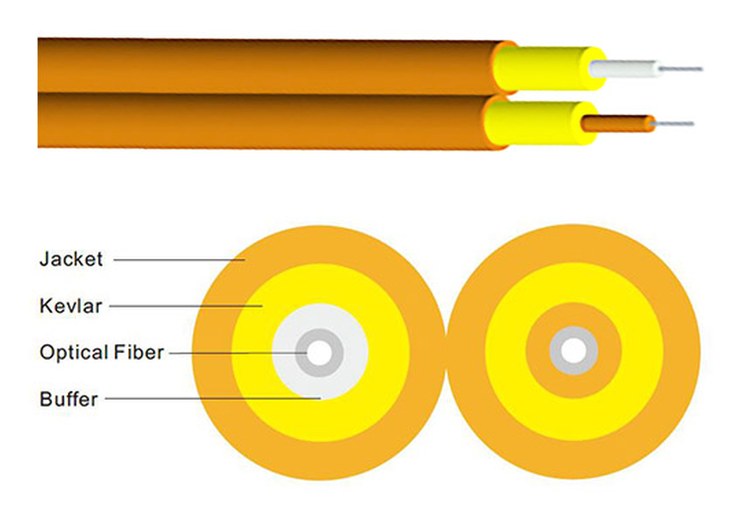
Start with the fact that reframes the whole question. Take an ordinary 2 × 2.0 mm indoor duplex zipcord — the cable behind most LC patch cords in a rack. Work out the cross-sectional area of each layer from its nominal diameter, multiply by material density, and you get the weight breakdown of the finished cable.

The jacket is about 77 % of the cable's mass. Add the 900 µm tight buffer, which is the same family of material, and polymer is around 95 % of what you take delivery of. The glass everybody is actually buying comes to roughly 0.6 %.
Three consequences follow, and they are why this article exists:
- Every material declaration is really a jacket declaration. When a customs form or a RoHS questionnaire asks what the product is made of, the truthful answer is dominated by one compound.
- Every fire test is really a jacket test. Silica does not burn. What burns in a cable fire is the sheath and the buffer, and the smoke and the acid gas come from the same place.
- Jacket choice moves the price more than fibre grade does. Going from PVC to LSZH on the same cable typically adds far more to the bill of materials than moving from OM3 to OM4 glass, and going from riser to plenum adds more again.
The exact split shifts with construction. Heavier aramid loading pushes the yarn share from under 4 % to nearly 8 % and takes it out of the jacket. Loose-tube outdoor cables carry steel tape and gel, so the polymer share drops. But for any tight-buffered indoor cable the pattern holds: you are mostly buying jacket.
The Six Jackets, in One Table
Before the chemistry, the map. Every indoor fibre cable sold in North America sits in one of these rows, and the row decides both the compound and roughly half the price.

The row that surprises people is the top one. The dominant plenum jacket on fibre cable is not a fluoropolymer — it is a heavily filled, smoke-suppressed PVC. Belden's own plenum fibre datasheets list the outer jacket and the 900 µm buffer as PVC, on cables listed OFNP. FEP's reputation as "the plenum material" comes from copper Cat 5e and Cat 6, where it is the pair insulation and is chosen as much for its dielectric constant as for fire. On fibre there is no dielectric requirement, so the cheaper route wins.
General Purpose: Inside a PVC Jacket
PVC is the default indoor jacket because it is cheap, easy to extrude, takes colour well, and is inherently flame retardant for a reason worth understanding: PVC resin is about 57 % chlorine by weight. That is not an additive; it is the polymer. Chlorine radicals interrupt combustion in the gas phase, which is why unplasticised PVC has a limiting oxygen index of 40–45 when air is only 21 % oxygen.
The problem is that PVC resin alone is a rigid, brittle solid, useless as a sheath. Making it flexible means adding plasticiser — and plasticiser is a hydrocarbon oil. It is fuel. A flexible PVC jacket is therefore a compound that has had its flame resistance partly engineered out and then partly bought back with additives.

Reading the PVC column: resin 40–60 %, plasticiser 11–27 %, calcium carbonate anywhere from 5 % in a thin insulation to 31 % in a heavily filled sheath, plus a few percent each of heat stabiliser and antimony trioxide. Antimony trioxide is worth a note: it is not a flame retardant by itself. It works only with a halogen present, forming antimony halides in the flame. Put it in an LSZH compound and you have added cost and nothing else.
The regulatory exposure of PVC lives almost entirely in these additives, not in the resin:
- Phthalate plasticisers. RoHS Annex II, amended by Delegated Directive (EU) 2015/863, restricts DEHP, BBP, DBP and DIBP to 0.1 % each in any homogeneous material, applicable to general electrical equipment from 22 July 2019. All four are also REACH Candidate List substances and on the Authorisation List. The high-molecular-weight plasticisers actually used in modern cable are not Candidate List substances: DINP and DIDP carry a REACH Annex XVII restriction that covers only toys and childcare articles, not cable, and DOTP carries no Annex XVII restriction at all.
- Lead stabilisers. European stabiliser producers completed a voluntary phase-out at the end of 2015; REACH Annex XVII entry 63, as amended by Regulation (EU) 2023/923, then made it law — lead below 0.1 % by weight in PVC articles, in force from 29 November 2024. Calcium-zinc systems are now standard. Older formulation tables still show lead; a current datasheet that does is a red flag.
What PVC cannot do is burn cleanly. The chlorine that suppresses the flame becomes hydrogen chloride in the smoke, which is corrosive and acutely irritant, and plasticised PVC produces dense black smoke. In a sealed building the smoke and the acid, not the flame, are what injure people and destroy electronics. That is the entire reason the next section exists.
General Purpose: Inside an LSZH Jacket
An LSZH compound removes the halogen completely and starts from a polyolefin — polyethylene, EVA, or an ethylene-octene elastomer. Those are excellent cable materials and utterly flammable: polyethylene has a limiting oxygen index of 17–18, below the 21 % oxygen content of air, meaning it will happily sustain its own flame.
Flame retardancy has to be added, and with no halogen available the mechanism is physical rather than chemical. A mineral hydrate is loaded into the polymer. In a fire it decomposes endothermically, absorbing heat, releasing water vapour that dilutes the flammable gases, and leaving a ceramic oxide residue that shields the polymer beneath.
This works, but it is inefficient per kilogram, so the loading has to be enormous. Peer-reviewed formulations and compounder guidance converge closely: 50 % is the floor, 60–65 % is the normal working range, and demanding specifications reach 65–70 % by weight of aluminium trihydroxide or magnesium dihydroxide. The best-corroborated number in this article is also the most surprising: the largest single ingredient of an LSZH jacket is powdered mineral, not polymer.
That fact explains every practical difference an installer notices:
- LSZH is stiffer and less forgiving on bends. Two thirds of the jacket is rock.
- It scuffs and tears more easily. Mineral loading at 60 % would cut elongation at break to under 100 % with no help; the 3–6 % coupling agent in the recipe — usually a maleic-anhydride-grafted polyolefin — restores it to 220–250 % in one supplier's published case study. A cheap LSZH compound that skips the coupling agent looks identical on a datasheet and cracks when you pull it round a corner.
- It takes up water more readily and is not a substitute for an outdoor jacket.
- It costs more — typically 30–60 % over PVC for the same cable.
ATH or MDH: the Extruder Decides
Aluminium trihydroxide and magnesium dihydroxide do the same job, and buyers often treat them as interchangeable. They are not, and the reason has nothing to do with fire performance.

ATH begins decomposing at about 200–220 °C, absorbing roughly 1100 kJ/kg and releasing 34.6 % of its own weight as water. MDH holds on until 320–330 °C, absorbs somewhere around 1200–1400 kJ/kg depending on whose datasheet you read, and releases 31 %.
The constraint is that the filler must survive extrusion. Polyethylene and EVA compounds run at 160–170 °C, comfortably below ATH's decomposition, so ATH is the correct and cheaper choice. Polypropylene and engineering thermoplastics need 230 °C or more, where ATH would release its water inside the machine — foaming the melt, leaving voids in the wall, and arriving at the fire with its flame retardant already spent. Those compounds need MDH.
So a datasheet claiming MDH on a polyethylene-based jacket is either a premium thermal choice or a spec sheet written by marketing. Ask which base resin the compound uses; the pairing has to make sense.
OFNR: What a Riser Compound Adds
A riser cable runs vertically between floors, and UL 1666 tests exactly that geometry: a two-storey shaft, a 154 kW burner, and a requirement that flame does not propagate past 12 ft with the temperature at that height staying under 850 °F. A chimney is the worst case for flame spread, so the compound has to work harder than a general-purpose one.
It is still PVC. Belden's OFNR fibre datasheets list the jacket and buffer as PVC, exactly as the OFNP ones do — the difference is entirely in the formulation. General Cable's patent EP2534201A2 covers PVC jackets for riser and plenum cable together, and gives the shape of the additive package:
| Component | Weight % | Versus a general-purpose PVC |
|---|---|---|
| PVC resin | 30 – 50 % | Slightly lower — displaced by additives |
| Plasticiser (DIDP, DPHP) | 10 – 30 % | Similar, but higher-molecular-weight grades |
| Brominated phthalate | 0 – 20 %, typically 2 – 4 % | Added. A plasticiser that is also a flame retardant |
| Antimony trioxide | 1 – 5 % | Similar range, but now with bromine as well as chlorine to work on |
| Chlorinated paraffin wax | 4 – 7 % | Added. More chlorine, plus processing aid |
| Aluminium trihydroxide | 1 – 30 % | Added. Endothermic cooling and smoke reduction |
| Micro metal-oxide particles | 1 – 30 %, typically 5 % | Added. Amorphous silica, char reinforcement |
| Calcium carbonate | 0 – 30 % | Similar |
Because that patent spans both listings, treat the ranges as the envelope a flame-rated PVC jacket lives in rather than a riser-only recipe. The pattern is clear either way: a rated compound is a general-purpose PVC with a halogenated flame retardant, an antimony synergist and a mineral hydrate stacked on top. Every one of those displaces resin or plasticiser, which is why riser cable is stiffer and heavier than the general-purpose equivalent as well as dearer.
Two other routes reach riser. Flame-retardant polyethylene (FRPE), mineral-filled, is used where a halogen-free jacket is wanted. And riser-grade LSZH exists as a catalogue product — commercial halogen-free compounds are explicitly rated "up to UL 1666 riser", with published oxygen indices spanning roughly 28 to 52 depending on grade. Riser is the ceiling for halogen-free, and the next two sections explain why.
OFNP: The Plenum Compound, and a Surprise
A plenum is a space used to move air around a building, usually the void above a suspended ceiling. Anything burning there feeds smoke directly into the air-handling system, so NFPA 262 — the Steiner tunnel test, formerly UL 910 — measures smoke as strictly as flame. The pass criteria are flame travel under 5 ft, peak optical density under 0.50, and average optical density under 0.15, over a twenty-minute burn.
Meeting the smoke limits, not the flame limit, is what makes plenum compounds difficult. And it produces a formulation that contradicts what most buyers expect:

Three things in that chart are worth stopping on.
The smoke suppressant is a molybdate, and there is a lot of it. Ammonium octamolybdate at 13 % plus zinc molybdate at 4.3 % is roughly 17 % of the compound by weight doing nothing but suppressing smoke. Molybdenum compounds promote char formation in the condensed phase, so carbon ends up as solid residue rather than as soot in the air. General Cable's later plenum patent uses the same chemistry, at 20–30 phr ammonium octamolybdate and 20–25 phr zinc molybdate.
There is no antimony trioxide. That is the surprise, and it points at a real trade-off: antimony trioxide is an excellent flame retardant and a smoke promoter, because the antimony halides that quench the flame also raise soot yield. Against NFPA 262's optical density limits that is an expensive thing to be carrying, so this formulation buys flame retardancy from brominated plasticiser and ATH instead and spends the rest of the budget on suppressing smoke.
It is a common choice rather than a rule, and it is worth saying so: General Cable's patent covering both riser and plenum jackets keeps antimony trioxide at 1–5 % and still claims NFPA 262. A later patent from the same company gives cost, not smoke, as its reason for reducing or eliminating antimony. So read the absence as what plenum formulators frequently do, not as chemistry that is barred.
The plasticiser is doing two jobs. Phosphate ester at 13 % and brominated aromatic ester at 8.7 % together replace the ordinary phthalate. Both plasticise, and both are flame retardants in their own right — phosphorus in the condensed phase, bromine in the gas phase. Nothing in a plenum compound is allowed to be purely fuel.
The result reported in that patent is an oxygen index of 44.8 % and a smoke density of 18 Dm/g, against 52.8 % and 21.0 for the control. Commercial plenum compounds are sold on oxygen indices of 46–66 %.
FEP, PVDF and ECTFE
The other route to plenum is to use a polymer that barely burns at all. Three fluoropolymers do this, and they are not interchangeable.

FEP is a copolymer of tetrafluoroethylene and hexafluoropropylene — the HFP fraction is small and varies by grade, and published figures disagree enough that it is not worth quoting a single number. Its composition question has the simplest answer in this article: suppliers describe it as a copolymer "without additives", so a FEP jacket is essentially 100 % polymer plus pigment. With an oxygen index above 95 % it needs no flame retardant and no smoke suppressant. It is also the most expensive option here by a wide margin, and it is where the "plenum means FEP" belief comes from — true for copper data pairs, largely not for fibre.
PVDF is polymerised vinylidene fluoride. Neat, its oxygen index is 44 % — good, but not plenum-good. Plenum grades are compounded, and one supplier publishes oxygen indices of 75 and 95 for its plenum range. It is the fluoropolymer actually used on fibre: one supplier markets a grade specifically for "low shrinkage over fiber optic cable", which matters because a buffer that shrinks stresses the glass and moves the loss. PVDF is stiff — flexural modulus 1700–2500 MPa against a few hundred for PVC — and on a tight buffer that stiffness is deliberately used as protection.
ECTFE is a 1:1 alternating copolymer of ethylene and chlorotrifluoroethylene, oxygen index 52 %, positioned for demanding plenum jacketing. It is the rarest of the three on fibre.
One point for anyone writing a halogen-free specification: all three are halogenated, and ECTFE contains chlorine as well as fluorine. They pass IEC 60754-1 comfortably — because that test explicitly excludes hydrofluoric acid. If your requirement is genuinely zero-halogen, a fluoropolymer jacket does not meet it, whatever the acid-gas certificate says.
Why LSZH Cannot Reach Plenum
This question comes up on nearly every data-centre project: we want halogen-free and plenum. The answer, as far as published products go, is that you cannot have both.
It is worth being precise about why, because the usual explanation is wrong. Nothing in the NEC or NFPA 262 bans halogen-free compounds. The plenum test does not mention halogen content at all. A halogen-free compound is entirely free to pass it. Conventional LSZH simply does not.

The mechanism is arithmetic. An LSZH compound protects itself by dehydrating its mineral filler: a fixed quantity of water, absorbing a fixed quantity of heat. That is a finite heat sink. NFPA 262 runs for twenty minutes with a large burner. Once the ATH or MDH has given up its water, what remains is a polyolefin — and polyolefins carry roughly 46 MJ/kg of heat of combustion — something like two and a half times PVC, three to four times PVDF or ECTFE, and on the order of seven times PTFE or FEP. Even at 50 % mineral loading the compound still brings more than 20 MJ/kg to a test that measures flame travel, which is heat-release driven.
The clearest confirmation is how compounders organise their own catalogues: halogen-free lines are rated "up to UL 1666 riser" and stop there, while plenum is served by an entirely separate vinyl-and-olefin product family. Riser is the ceiling.
Note the honest limit of that statement: no halogen-free OFNP-listed product appears in published sources, which is not the same as proving none exists. If a supplier claims one, the question is simple — show the UL file number and the NFPA 262 report.
Outdoor: Polyethylene and Carbon Black
Outdoors the enemies change. Nobody worries about smoke in a duct bank; they worry about ultraviolet light, water and thirty years of temperature cycling. The answer is black polyethylene, governed in North America by ICEA S-87-640 and mirrored in USDA RUS Bulletin 1753F-601a.
| Type | Density, g/cm³ | Where it is used |
|---|---|---|
| L1 — low density | 0.920 – 0.940 | Flexible drop and indoor/outdoor |
| L2 — linear low density | 0.925 – 0.945 | Tough, good stress-crack resistance |
| M — medium density | 0.940 – 0.955 | The workhorse outside-plant jacket |
| H — high density | 0.952 – 0.973 | Duct and abrasion-critical routes |
Those are natural-resin densities. The compounded, carbon-loaded material runs about 0.012 g/cm³ higher — carbon black is denser than polyethylene, so loading it in raises the figure.
The carbon black is not a colour choice. Polyethylene without a UV screen embrittles and cracks within a few years of sunlight, and carbon black at the right loading and particle size is the most effective and cheapest screen available. The specification is precise:
- Minimum 2.35 % furnace black by weight, measured per ASTM D1603 — note D1603, not D4218, which is the muffle-furnace method.
- 2.6 % nominal.
- Average particle size not greater than 20 nm, compounded into the resin before extrusion rather than dry-blended at the head.
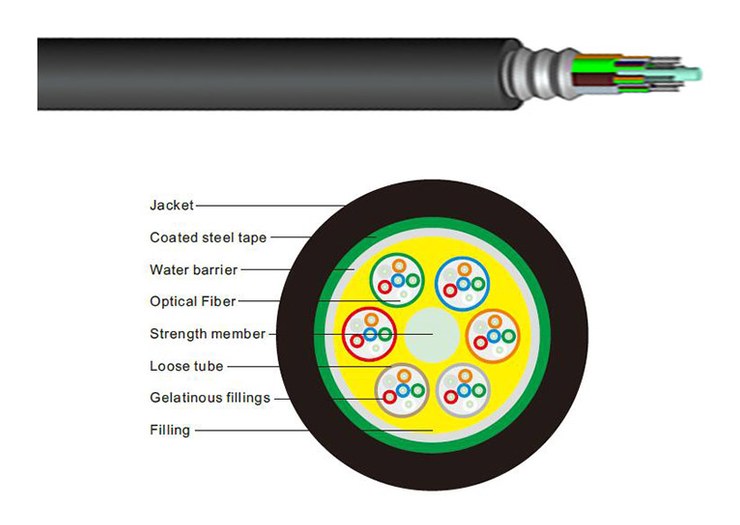
So an outdoor PE jacket is roughly 97 % polyethylene, 2.6 % carbon black, and a fraction of a percent of antioxidant. It is the simplest compound in this article, and the only one whose key ingredient a buyer can verify cheaply: carbon black content is a straightforward laboratory test. On an aerial route in direct sun for decades — ADSS in particular — it is worth actually testing rather than accepting. Our outdoor cable selection guide covers the rest of the sheath decision.
The Buffer and the Coating Underneath
Two layers sit inside the jacket, and only one of them varies.
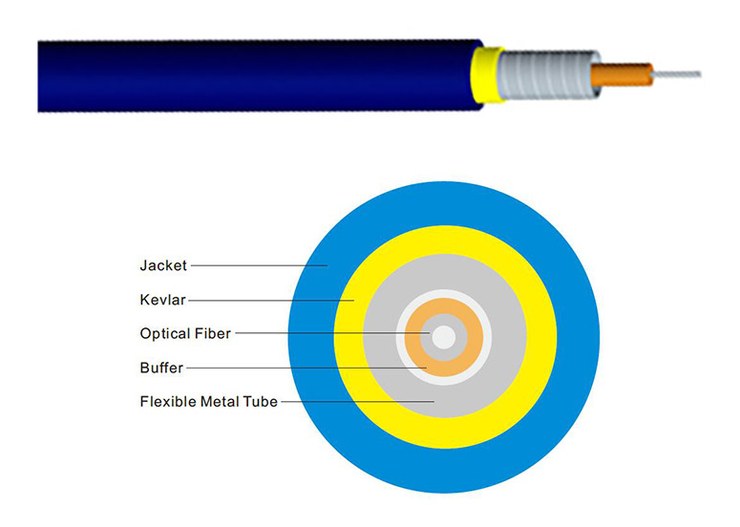
On any standard telecom fibre the 250 µm coating is a UV-cured acrylate. The fibre manufacturer applies it in two layers — a soft inner coating that isolates the glass from microbending and a harder outer one that takes handling — and it is the same material whether the finished cable is general-purpose or plenum. Specialty fibres for high-temperature or hermetic service use polyimide, silicone or carbon instead, but those do not turn up in a patch cord. One detail for anyone measuring: the nominal "250 µm fibre" is typically specified at 245 ± 5 µm.
The 900 µm tight buffer does vary, and it is part of the fire rating. It is the second-largest polymer mass in the cable, so a plenum listing cannot be achieved by the jacket alone:
| Buffer material | Used on | Why |
|---|---|---|
| PVC, plenum grade | OFNP | Same molybdate chemistry as the jacket |
| PVDF | OFNP | Very high modulus, low shrinkage over the fibre |
| FRPE or FRPP with Mg(OH)₂ | OFNP, halogen-free layer | Mineral-filled polyolefin, under a PVC jacket |
| PVC, riser grade | OFNR | The standard indoor buffer |
| LSHF | OFNR, general purpose | Halogen-free constructions |
| Hytrel (TPEE) or nylon | Any | Strippability and mechanical protection, not fire |
Buffer shrinkage is the failure mode to know about. A buffer that shrinks back over time puts the glass into compression, and the result is attenuation that appears months after installation and has no visible cause. It is a compound property, invisible on a datasheet, and one of the better reasons to buy tight-buffered cable from someone who tests finished assemblies rather than assembling bought-in components.
What Binds in North America
In the United States and Canada the jacket's fire performance is a code matter, set by NEC (NFPA 70) Article 770, with listing requirements in section 770.179 and permitted applications in Table 770.154(a). The product standard a cable is certified against is UL 1651, Optical Fiber Cable.
Six letters carry all the meaning. OFN is optical fibre nonconductive — no metallic member anywhere in the cable. OFC is optical fibre conductive — it contains metal, whether armour, a strength member or a tone wire. The suffix is the space: P plenum, R riser, G general purpose.
| Listing | Where it may go | Flame test |
|---|---|---|
| OFNP / OFCP | Ducts, plenums, environmental-air spaces | NFPA 262 (formerly UL 910) |
| OFNR / OFCR | Vertical shafts, floor to floor | UL 1666 |
| OFNG / OFCG, OFN / OFC | General use, not risers or plenums | UL 1685, or CSA C22.2 No. 0.3 FT4 |

Substitution runs one way, and the second rule is the one people miss. Plenum substitutes for riser, riser for general purpose — that much is well known. The rule that catches projects is that a nonconductive OFN type may always replace the matching conductive OFC type, and the reverse is never permitted. If a drawing calls for OFNR and an armoured OFCR turns up, it does not comply, no matter that the fire rating looks equal or better. Metal in the cable is the issue, not the flame test.
What Binds in Europe
Europe regulates the same property through an entirely different instrument. Under the Construction Products Regulation, cables permanently installed in a building are construction products; the harmonised standard is EN 50575, which covers optical fibre cable, and classification is by EN 13501-6. CE marking with a Declaration of Performance has been mandatory since 1 July 2017.
The result is a Euroclass, and unlike a UL listing it is a compound statement of four things:
| Part | Meaning | Scale |
|---|---|---|
| Main class | Heat release and flame spread | Aca best, then B1ca, B2ca, Cca, Dca, Eca, Fca |
| s — smoke | Total and peak smoke, plus transmittance | s1a best (≥ 80 % transmittance), s1b (≥ 60 %), s1, s2, s3 |
| d — droplets | Flaming droplets during the test | d0 none, d1 none lasting over 10 s, d2 otherwise |
| a — acidity | Corrosivity of the combustion gas | a1 (< 2.5 µS/mm, pH > 4.3), a2 (< 10 µS/mm, pH > 4.3), a3 otherwise |
So a real specification reads Cca-s1a,d1,a1, and each element is separately tested and separately declared. This is the most demanding cable fire classification in commercial use — four separate properties, each tested and each declared. The NEC is law too, adopted by statute across the United States and enforced by the authority having jurisdiction; what the Euroclass adds is not legal force but resolution.
Two practical points. First, the CPR harmonises testing, not requirements: which Euroclass a building needs is set by each member state's national building regulations, and they differ. Second, and this is the expensive one: a UL plenum or riser listing is not a Euroclass, and a Euroclass is not a UL listing. They are different tests on different apparatus. A cable sold into both markets needs both test programmes, and a supplier who answers a CPR question with an OFNP certificate is telling you they do not have one.
Note also that CPR itself is being replaced: Regulation (EU) 2024/3110 repeals the 2011 regulation with an application date of 8 January 2026 and long product-specific transitions. EN 50575 remains the operative standard for cable today, but expect the paperwork to change.
LSZH Is Not a Defined Term
This is the single most useful thing in this article, so it gets stated plainly: there is no standard anywhere that defines "LSZH". Nor LSOH, LS0H, LSHF, HFFR or ZHLS. They are market abbreviations. UL has said publicly that such claims "are frequently self-certified, and tests used may not be standards-based". The closest thing to a real definition is the IEC 62821 series, which most datasheets never mention.
What the word gestures at is a set of tests, and even those thresholds mostly live in informative annexes — recommendations, not mandatory clauses.

Three traps hide in that table:
- "Under 5 mg/g" and "under 0.5 % halogen" are not the same claim, though the arithmetic tempts you. The first is halogen acid gas evolved, expressed as HCl per gram of sample, under IEC 60754-1 — and 5 mg of HCl is 0.49 % chlorine, not 0.5 %. The second is halogen content, which is IEC 60754-3. Different tests measuring different things. Worth knowing too that the 5 mg/g figure began life as the standard's own precision floor — below it the method is not considered reliable — and the industry then adopted it as a threshold.
- IEC 60754-1 excludes hydrofluoric acid. A fluoropolymer jacket passes it comfortably while being emphatically halogenated. If actual halogen content matters, the test is IEC 60754-3, by ion chromatography, which measures chlorine, bromine, fluorine and iodine directly. Very few suppliers offer it unprompted.
- LOI is a screening index, not a qualification. Limiting oxygen index per ISO 4589-2 or ASTM D2863 is useful for comparing compounds — above about 26 is self-extinguishing, cable-grade LSZH typically sits in the thirties, and plenum compounds higher still — but no IEC cable fire standard uses it as a pass criterion, and the test's own scope warns against inferring real fire behaviour from it. A supplier quoting only an LOI has given you a compound property, not a cable result.
What to Ask For
Everything above reduces to a short list of documents. Ask for these and a jacket claim becomes checkable; accept a datasheet adjective and it stays an adjective.
| Ask for | What good looks like |
|---|---|
| Material composition declaration | Component-by-component weight percent of the finished cable with CAS numbers, identifying the base resin and mineral family, and saying plainly which compound data is the material supplier's proprietary information |
| Fire test reports | Third-party reports naming IEC 60332-1-2, 60332-3-24 Cat C, 60754-1 and -2, 61034-2 — with measured values, not just "pass" |
| NEC listing | A UL or ETL file number you can look up, and the exact type: OFNP, OFNR, OFNG. Not "plenum rated" |
| NFPA 262 or UL 1666 report | For a plenum or riser claim: the actual flame travel and optical density numbers against the limits |
| CPR Declaration of Performance | A DoP with the full Euroclass string, e.g. Cca-s1a,d1,a1, and the notified body number |
| RoHS and REACH statement | Explicit on the four restricted phthalates and on lead below 0.1 %; SVHC statement dated against the current Candidate List |
| Carbon black content, outdoor only | Percentage per ASTM D1603 against the 2.35 % minimum, and average particle size |
| Elongation at break on the jacket | The one number that exposes an LSZH compound formulated without a coupling agent |
We issue a material composition declaration and a non-hazardous article statement for every cable we supply, giving the weight percentage of each layer with CAS numbers, the HS classification, and a straight statement of which compound data belongs to the material supplier rather than pretending to precision we do not have. If you are filling in a customer questionnaire and need it in a particular format, send us the form. Our checklist for buying optics from China covers the wider question of which documents actually mean something.
FAQ
Is LSZH always safer than PVC? In an occupied, poorly ventilated building, yes — that is what it is for. In fire-load terms it is less clear-cut: LSZH compounds are polyolefin-based and, once past the mineral's protection, burn hotter than PVC does. The case for LSZH is smoke and corrosive gas, not total heat release. Specify it where people evacuate through the smoke or where equipment must survive it, not as a blanket upgrade.
Can I get a cable that is both halogen-free and plenum rated? Not from published product lines. Halogen-free compounds top out at UL 1666 riser because the mineral-hydrate mechanism is a finite heat sink and the polyolefin underneath carries about twice the fuel value of PVC. If a supplier claims an OFNP halogen-free cable, ask for the UL file number and the NFPA 262 report before believing it.
Why does plenum cable cost so much more than riser? Roughly 17 % of a plenum PVC compound is molybdate smoke suppressant, which is the expensive ingredient, and the fluoropolymer alternatives cost several times that again. Indicative figures put plenum at 30–50 % above riser for the same cable, and considerably more for fluoropolymer constructions.
Can I use LSZH cable outdoors? Not as an outdoor cable. LSZH is heavily mineral-filled and takes up water in a way carbon-loaded polyethylene does not, and it has no UV package. Use an indoor/outdoor construction with a proper PE outer jacket, or transition at the building entry.
Why does LSZH cost more when the filler is cheap rock? The mineral is cheap; getting 60 % of it into a polymer while keeping the cable flexible is not. The coupling agent, the surface-treated filler grades, the tighter extrusion window and the higher scrap rate are where the money goes.
Our specification says "halogen free" — is IEC 60754-1 enough? No. It measures acid gas evolved, not halogen present, and it excludes fluorine entirely. For a real zero-halogen requirement ask for IEC 60754-3 content data, or specify a CPR acidity class, which is at least legally defined.
Is a plenum cable automatically acceptable in Europe? No. NFPA 262 and the EN 50399 test behind a Euroclass are different tests with different apparatus and different pass criteria. Dual-market product needs both, and neither certificate substitutes for the other.
Does the jacket affect optical performance? Not directly, but it sets the minimum bend radius and how much of an installation pull the fibre feels. A stiff, heavily filled jacket transmits more of the pulling load into the buffer, and a buffer that shrinks puts the glass into compression — macrobend loss is a jacket-and-buffer problem long before it is a glass problem. If you are working to a tight loss budget, our link budget calculator is the place to check the margin.