GYTA vs GYTS vs ADSS: The Outdoor Fiber Cable Selection Guide
Outdoor cable is where fiber projects are won or lost financially: pick one grade too light and the route fails in two winters; one grade too heavy and you've buried money in steel you didn't need. The Chinese YD/T construction codes — GYTA, GYTS, ADSS and family — describe exactly what each cable withstands, once you can read them. This guide decodes the system and turns it into route decisions.
Decoding the Letters
| Code | Meaning |
|---|---|
| GY | Outdoor (field) communication cable |
| T | Loose tube, gel-filled (dry-core variants add D) |
| X | Central (uni) tube instead of stranded tubes |
| F | Non-metallic strength member (FRP) |
| A / S | Armor: Aluminum-PE laminate / corrugated Steel-PE |
| Y | PE sheath · C8 figure-8 self-supporting · (5)3 inner PE + steel armor + outer PE (burial grade) |
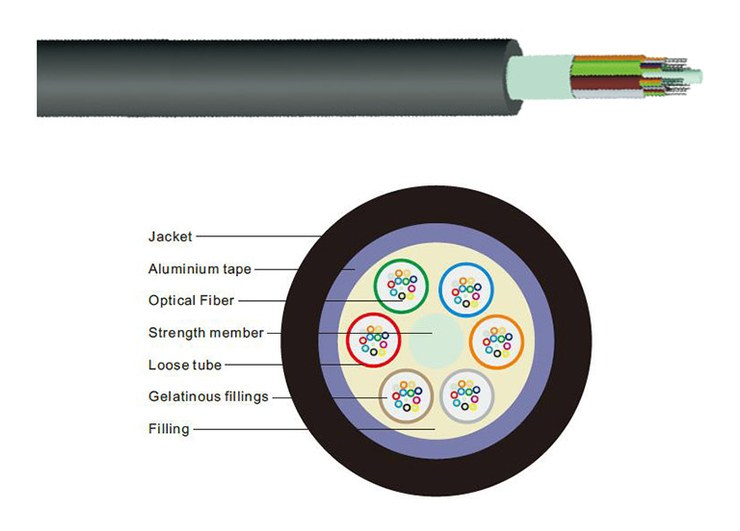
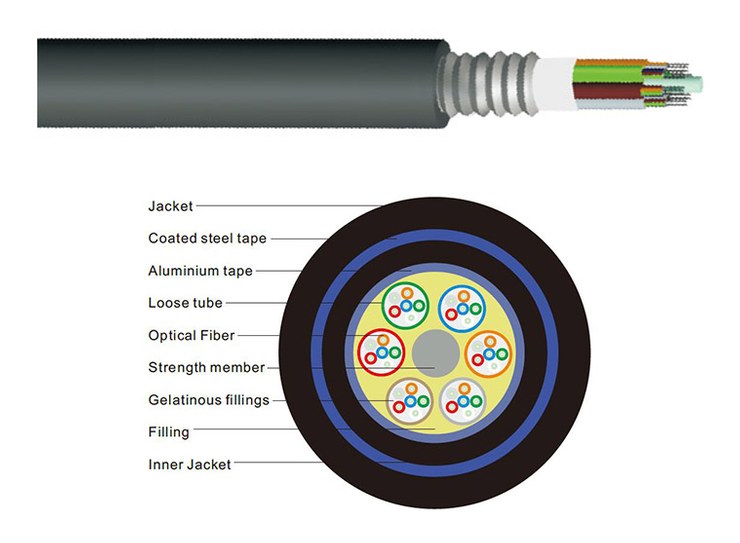
So GYTA = outdoor stranded loose-tube, aluminum armor, PE sheath; GYTA53 adds the double-sheath burial package; GYXTW is the compact central-tube design with parallel steel wires. Once the code reads naturally, every datasheet in the industry organizes itself.
What's Inside a Loose-Tube Cable
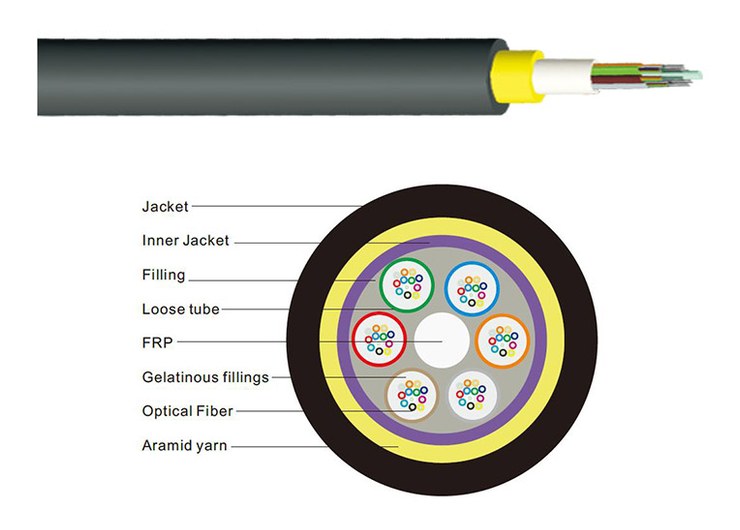
The engineering heart of every outdoor design is the loose tube: fibers float in a gel-filled (or dry water-block) PBT tube with 0.1–0.4% excess fiber length. As the cable stretches under tension or contracts in cold, the tubes take the strain while fibers drift unstressed inside — this is why a properly specified cable holds attenuation from −40 to +70 °C. Around the tubes: a central strength member (steel wire or FRP), water-blocking gel or tapes, armor per the code letters, and UV-stable sheathing. The composed cross-sections on each product page label every layer.
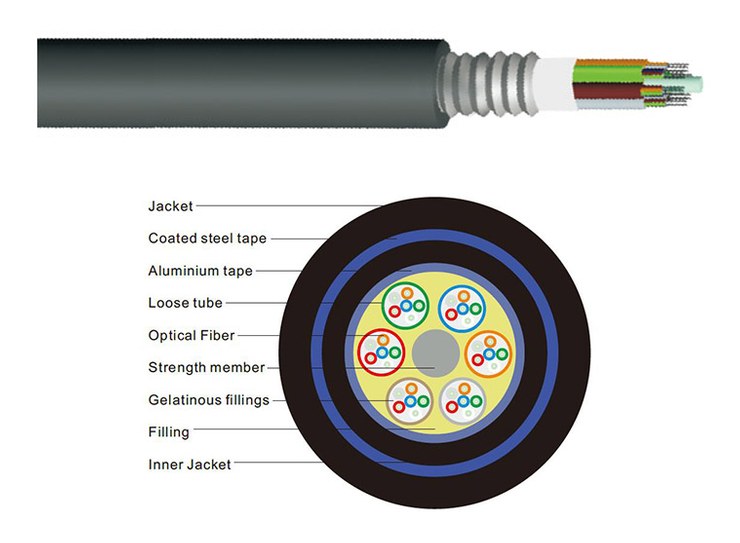
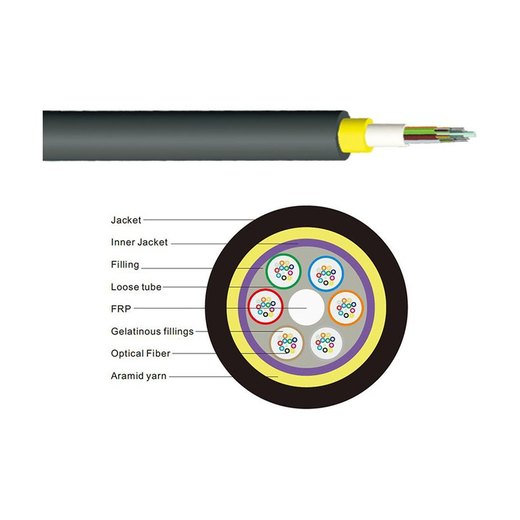
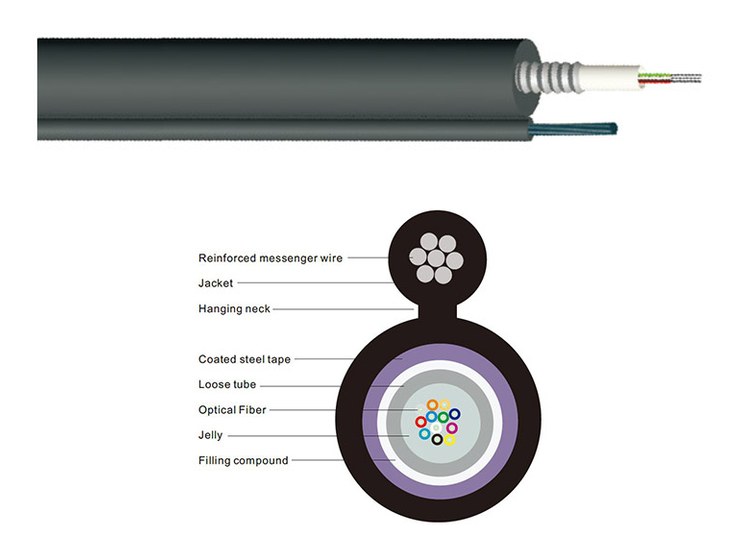
Choose by Route
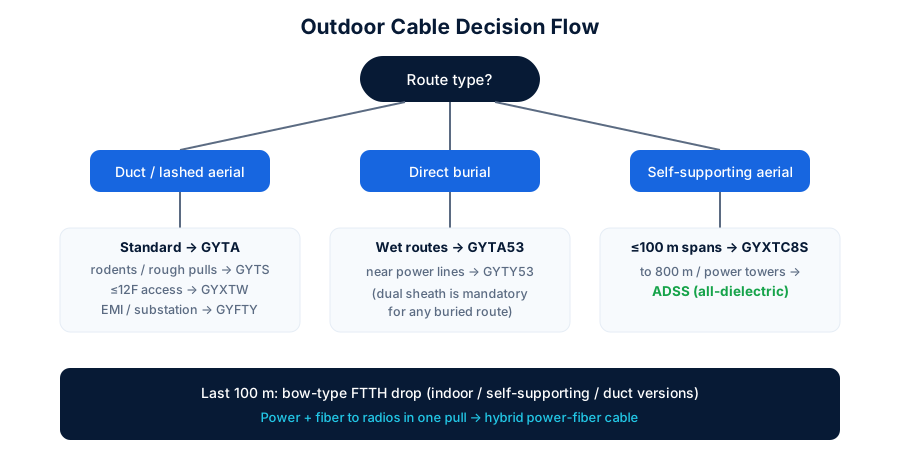
- Duct / lashed aerial: GYTA is the metro default. Upgrade to GYTS where rodents chew or duct pulls are brutal; drop to GYXTW for ≤12F access spurs (lighter, cheaper, still armored).
- Direct burial: the 53-series only — GYTA53 for maximum moisture armor on wet routes, GYTY53 where a dielectric core simplifies grounding near power corridors.
- Self-supporting aerial: GYXTC8S figure-8 hangs itself on spans ≤100 m (messenger extruded in); ADSS owns long spans to 800 m and anything on energized transmission towers.
- High-EMI / substations / electrified rail: GYFTY — zero metal, nothing to ground, nothing for lightning to find.
- 5G/base-station verticals: pull-out riser cable feeds multiple radio levels from one run; hybrid power-fiber delivers data + DC in one pull; waterproof pigtail cable for tower-top jumpers.
Full Series Comparison
| Cable | Armor | Strength | Deployment | Counts | Tensile (N) |
|---|---|---|---|---|---|
| GYTA | Aluminum tape | Steel wire | Duct / lashed aerial | 2-144 | 600/1500 |
| GYTS | Steel tape | Steel wire | Duct / light burial | 2-144 | 1000/3000 |
| GYTA53 | APL + steel, 2 sheaths | Steel wire | Direct burial | 2-144 | 1000/3000 |
| GYTY53 | Steel tape, 2 sheaths | FRP (dielectric) | Burial near power | 2-144 | 1000/3000 |
| GYXTW | Steel tape | 2× parallel wire | Duct / aerial ≤12F | 2-12 | 600/1500 |
| GYFTY | None | FRP + glass yarn | Duct, high EMI | 2-144 | 600/1500 |
| GYXTC8S | Steel tape | 7×1.2 mm messenger | Aerial ≤100 m spans | 2-12 | 3000 short |
| ADSS | None | Stranded aramid | Aerial ≤800 m, towers | 2-48 | 19.6-29.7 kN class |
Every one of these pages cross-links the whole family — the "Outdoor Series" chips jump between constructions so you can compare while reading.
Reading Mechanical Specs
- Tensile, two numbers (e.g. 600/1500 N): long-term/short-term. Short-term covers the installation pull; long-term is the residual tension the cable may live under forever. Exceed long-term at your peril — attenuation creeps upward for years.
- Crush (N/100 mm): resistance to flat squeeze — duct congestion, rocks in backfill, vehicles over hand-holes. Burial grades triple the duct grades.
- Bend radius, 10D/20D: installed/under-tension multiples of diameter. A 15 mm cable pulled around a 150 mm sheave is already at its installed limit.
- Temperature: the spec is about attenuation stability, not survival — gel-filled tubes hold fibers strain-free across the range; cheap gel stiffens at −30 °C and microbends the fibers.
Installation Notes by Method
- Duct: lubricate, respect the calculated pulling tension, use a swivel and breakaway; cap and re-seal cut ends the same day — gel-filled is water-blocking, not water-proof at an open end.
- Burial: 0.8-1.2 m depth typical; sand bedding in rocky trench; warning tape 30 cm above; loop 10-15 m slack at each splice point. The 53-series exists because backfill is merciless.
- Figure-8: tension the messenger to sag tables (≈1% of span at 20 °C), dead-end with preformed grips, bond and ground the messenger at intervals per local code.
- ADSS: string with sock grips and stringing blocks ≥40× cable diameter; respect the space-potential limit of the sheath (AT sheath above ~12 kV fields); armor-rod at every clamp.
Fiber Count Planning
Fiber is the cheapest component of an installed route — construction is 60-80% of cost. The working rule: size for 10-year demand, then double it if the route crosses anything hard to re-open (rivers, highways, other people's towers). Stepping 48F→96F typically adds 10-15% to cable cost and ~2% to project cost; a second dig adds 100%. Splice-plan around 12-fiber loose tubes: counts divisible by 12 keep every tube fully used and every ribbon or tray layout clean.
The Last 100 m
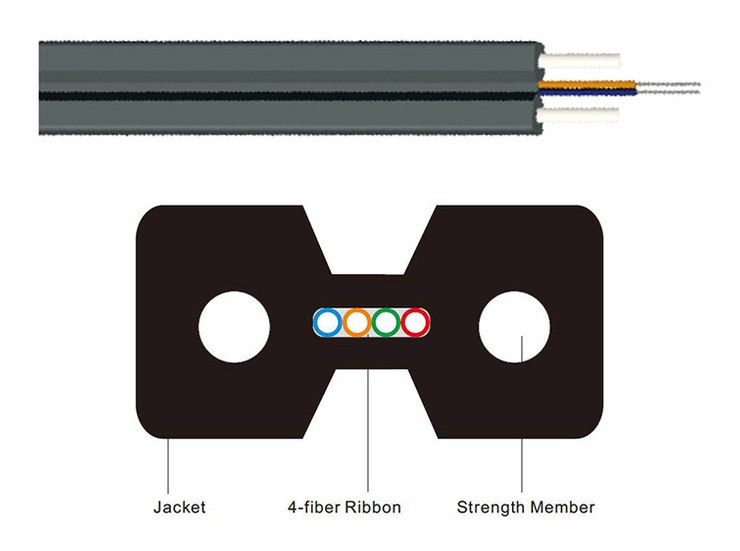
Trunks end at a terminal; subscribers are reached with bow-type drop cable — four versions (indoor 1-2F, indoor 4F, steel-messenger self-supporting, waterproof duct) selectable with live photos on the page — and pre-connectorized SC/APC drop cords. Field practice for the drop is its own craft: see the FTTH installation guide.
Speccing With Us
Send the route profile — deployment mix, span lengths, soil and environment conditions, fiber count and growth horizon — and we return the exact constructions with test reports, meter-marked and cut to drum lengths. Mixed routes ship together: a GYTA duct route with a GYTA53 river crossing and an ADSS tower section arrives as one coordinated order.