The short answer
Inside a rack, a passive copper cable does the job for a fraction of the power and a fraction of the price of two optical modules. Across the room, copper runs out and you need light. Between those two extremes sit active copper and active optical cables, and the boundaries between all four move with every speed generation.
The mistake worth avoiding is treating this as a cost decision alone. At 800G, replacing an in-rack optical link with a passive DAC saves around 32 watts — and across a rack of servers that is kilowatts of power and cooling you never have to provision.
What Is Passive DAC?
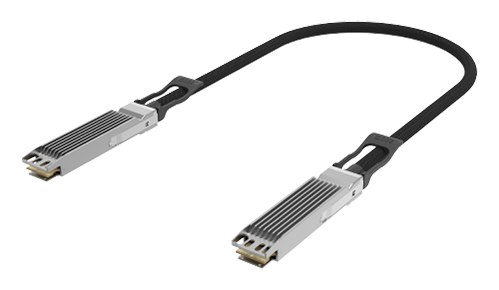
A direct attach copper cable with a transceiver-shaped connector at each end containing nothing but the wiring. There is no signal conditioning of any kind; the switch SerDes drives the copper directly.
Power draw is essentially nil — a few tenths of a watt for the management EEPROM. There is nothing to fail, no laser to age, and latency is the propagation delay of the copper and nothing more. The limit is distance: as speeds rise, the reach shrinks. At 800G a passive DAC is realistically a two- to three-metre cable, and a thick, stiff one at that.
What Is Active copper (ACC / AEC)?
The same copper cable with signal conditioning in the connector — a redriver in an ACC, or a full retimer in an active electrical cable. The electronics restore the waveform, buying back the distance that passive copper lost.
This roughly doubles to triples the reach for a few watts and a modest price increase. It has become considerably more interesting at 800G and 1.6T, where passive copper struggles to leave the rack at all and the alternative is a jump straight to optics.
What Is AOC?
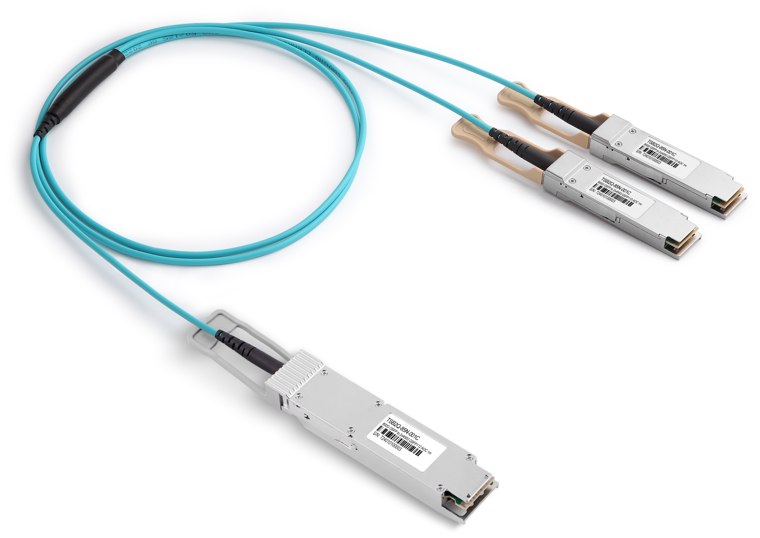
An active optical cable is a permanently attached pair of optical transceivers joined by fibre. From the port's point of view it behaves exactly like a DAC — plug it in and it works, no cleaning, no polarity, no patch panel.
It reaches tens of metres, typically up to 30 for multimode variants and further on request, and it is far thinner and more flexible than copper at the same speed. The trade-off is that it is a fixed assembly: if you need a different length, you buy a different cable, and if one end fails you replace the whole thing.
What Is Transceivers and fibre?
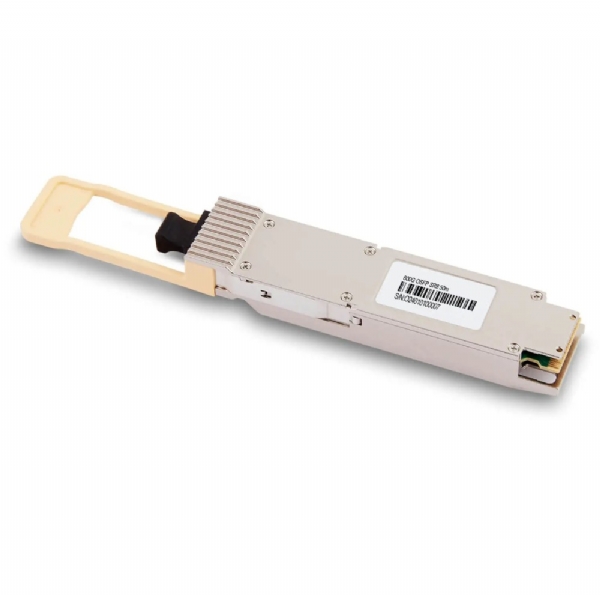
Two separate modules and a structured fibre link between them. The most expensive option per link, the most power-hungry, and the only one that scales past a few tens of metres.
It is also the only one that is re-patchable. The fibre plant is installed once and serves whatever optics you put on it for a decade; when the speed changes, you change the modules and keep the glass. For anything crossing a room, a floor or a building, this is the answer.
DAC vs AOC vs ACC vs Transceivers
The rows that matter most are power and reach. Everything else follows from them.
| Passive DAC | Active copper (ACC / AEC) | AOC | Transceivers and fibre | |
|---|---|---|---|---|
| Typical reach at 400G/800G | 1–3 m | 3–7 m | Up to ~30 m | 100 m to 80 km by variant |
| Power per link | ~0.3 W total | ~2–5 W total | Similar to two modules | Two modules' worth |
| Relative cost per link | Lowest | Low | Medium | Highest |
| Latency added | None beyond propagation | Very small | Very small | Very small |
| Cable bulk | Thick and stiff | Thick and stiff | Thin and flexible | Thin and flexible |
| Re-patchable | No — fixed assembly | No | No | Yes |
| Failure replacement | Whole cable | Whole cable | Whole cable | One module |
| Cleaning required | No | No | No | Yes — every mate |
| Survives a speed upgrade | No | No | No | Fibre does; modules change |
Airflow deserves a mention that datasheets never give it. A rack full of 800G passive DAC is a rack full of thick, stiff cable behind the switch, and that cable blocks air. There are builds where AOC wins not on reach or power but simply because the copper would have cooked the switch.
On the power line, run the numbers rather than trusting intuition: use the power and thermal calculator with the DAC option and then with an 800G module, and look at the rack total. The difference across 32 links is usually the single largest efficiency win available in an in-rack design.
Which One Should You Choose?
Server to top-of-rack, inside the rack: passive DAC
This is the highest-volume link type in any data centre and it is where the power saving compounds. A passive DAC costs a fraction of a watt against roughly 32 W for a pair of 800G modules. Across 32 server links in one rack that is a kilowatt you never provision, never cool and never pay for. Reach is the only question — check the passive reach at your speed before committing, because it shrinks each generation.
Rack to adjacent rack: active copper, if it exists at your speed
ACC and AEC extend copper into the three-to-seven-metre range for a few watts. At 800G and 1.6T this band has become genuinely useful, because passive copper barely leaves the rack and the alternative is a full optical link. Check availability first — the reach classes lag the speed generations.
Across a row, under about 30 metres: AOC
AOC keeps the plug-and-play simplicity of a cable while giving you optical reach and a cable thin enough to dress properly. There is no end-face to clean, no polarity to get wrong and no patch panel to buy. For point-to-point links that will not be re-patched, it is often the cheapest total answer once you count the panels and the labour you did not need.
Anything longer, or anything you will re-patch: transceivers and structured fibre
Past AOC range, or wherever the connection needs to change over time, install fibre and use modules. The glass outlives several generations of optics, which is the real economic argument — you are not buying a link, you are buying an upgrade path. Size it with the MPO cabling planner.
Frequently Asked Questions
How far can a passive DAC go at 800G?
Realistically two to three metres. Copper loss rises steeply with frequency, so every speed generation shortens passive reach: what was seven metres at 10G is a couple of metres at 800G. Always check the specific reach class rather than assuming the length you used last generation is still available.
Is an AOC just two transceivers glued to a fibre?
Functionally yes, and that is the point — it behaves like a cable rather than like a link. The practical differences are that it is a fixed length, it cannot be re-patched, and a failure at either end means replacing the whole assembly. In exchange you skip cleaning, polarity and patch panels entirely.
Do DAC and AOC need switch-side configuration?
For a straight cable, no. For a breakout cable — one 800G port to four 200G devices — yes: the port has to be configured for breakout in the switch OS, and on most platforms that needs a reload. Decide the ratio before you cable, and use the breakout configurator to get the counts right.
Are third-party DAC and AOC compatible with my switch?
They need to be coded for the platform, exactly like transceivers — the switch reads an EEPROM at each end. Tell us the switch make, model and software version on the RFQ and we code and test to it. See EEPROM coding for what is actually in that memory.
Which has the lowest latency?
Passive DAC, by a small margin, because there is no signal processing at all — only propagation delay. In practice the difference between all four options is tens of nanoseconds, which matters for high-frequency trading and essentially nothing else.
The Parts We Build
We build all four, coded and tested for your platform — passive and active copper, AOC in straight and breakout configurations, and the full transceiver range.