The short answer
Both form factors give you eight electrical lanes, both reach 400G and 800G, and both are supported by essentially every serious switch vendor. So the choice is not about capability. It is about two things that pull in opposite directions: how much heat the package can shed, and whether your existing QSFP28 optics still work in it.
Get this wrong and the consequence is not that the link fails on day one. It is that two years later you are running 800G modules at the top of their temperature range, or you are throwing away a stock room full of perfectly good 100G optics.
What Is OSFP?
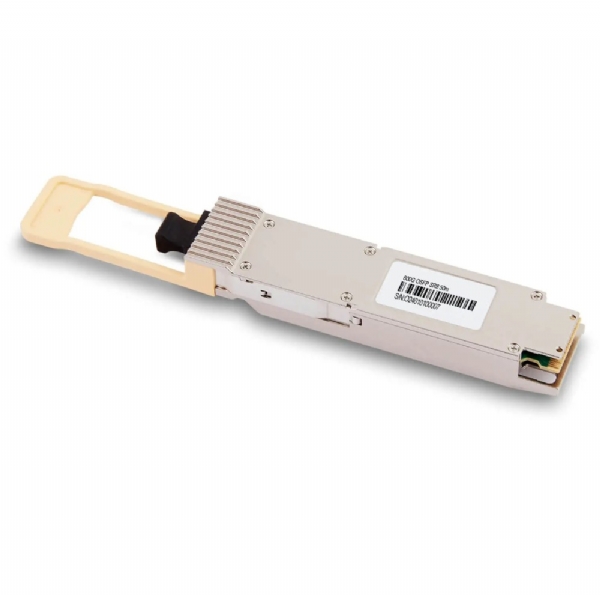
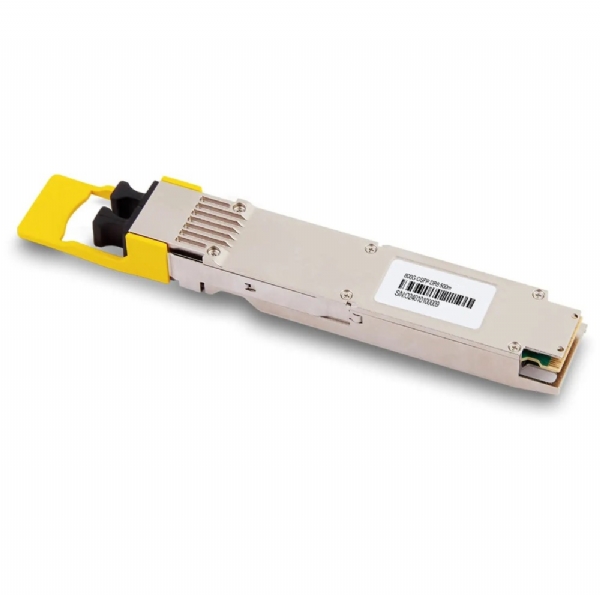
OSFP — Octal Small Form-factor Pluggable — was designed from a blank sheet for eight-lane operation. The body is slightly larger than QSFP-DD, and that extra volume exists for one reason: somewhere to put the heat. At 800G a module dissipates around 16 watts, and at 1.6T around 28, all of it inside a cage in the middle of a dense faceplate.
It comes in two mechanical variants that are not interchangeable. The riding-heat-sink version carries its own heat sink on the module. The flat-top version relies on a heat sink built into the cage, which is what liquid-cooled and some very high-density designs require. Put a flat-top module in a cage expecting a riding heat sink and it will run hot. See the OSFP glossary entry for the detail.
What Is QSFP-DD?
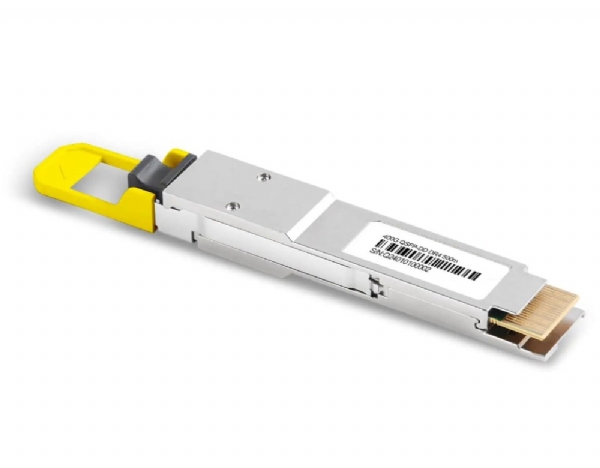
QSFP-DD took the existing QSFP body and added a second row of electrical contacts, doubling the lanes from four to eight without changing the external dimensions. That constraint is also the feature: because the outside is unchanged, a QSFP+ or QSFP28 module drops into a QSFP-DD cage and works. The legacy module engages only the first contact row; it never reaches the second.
For anyone with thousands of installed 40G and 100G optics, that is worth real money. A switch refresh does not have to be a transceiver refresh on the same day, and a 400G leaf can serve 100G servers from its own ports during a migration. The price is volume: less body to spread heat through, which is felt at 800G and above rather than at 400G. See the QSFP-DD glossary entry.
OSFP vs QSFP-DD: The Differences That Matter
The specification sheets look nearly identical, which is why this comparison is usually decided on the two rows that are genuinely different. Everything else is a tie.
| OSFP | QSFP-DD | |
|---|---|---|
| Electrical lanes | 8 | 8 |
| Speeds supported | 400G, 800G, 1.6T (as OSFP224) | 400G, 800G (as QSFP-DD800) |
| Body volume | Larger — more room for heat spreading | QSFP envelope — tighter |
| Typical power envelope | Comfortable to 30 W with the right cage | Workable to ~20 W, harder above |
| Backward compatibility | None — needs an OSFP-to-QSFP adapter | QSFP+/QSFP28 drop straight in |
| Heat sink | Riding heat sink on the module, or flat-top with a cage heat sink | Cage heat sink |
| Where it dominates | AI/HPC fabrics, InfiniBand, 1.6T | General-purpose data centre switching at 400G |
| Optical interoperability | Interoperates with QSFP-DD of the same reach class | Interoperates with OSFP of the same reach class |
| Port density per RU | Slightly lower — larger body | Slightly higher |
The interoperability row is the one people most often miss. OSFP and QSFP-DD are mechanically incompatible but optically identical: a 400GBASE-DR4 is a 400GBASE-DR4 whatever cage it sits in. You can have OSFP at the spine and QSFP-DD at the leaf and the links come up. The form factor is a property of each switch, not of the link.
On power, do the arithmetic rather than trusting a feeling. A 32-port switch fully populated with 800G optics dissipates around 512 W in transceivers alone — run your own numbers in the power and thermal calculator and see what it does to the rack budget before deciding how much headroom you need.
Which One Should You Choose?
For a new AI or GPU cluster: OSFP
The traffic pattern in a training cluster is sustained, synchronised and unforgiving — every port busy, all the time. That is precisely the condition under which thermal margin stops being theoretical. OSFP's larger body and its flat-top variant for cage-cooled designs are why AI reference architectures specify it, and why 1.6T is arriving as OSFP224 rather than as a QSFP derivative.
For a general-purpose data centre upgrade: QSFP-DD
If you are moving a leaf-spine fabric from 100G to 400G and you already own a large fleet of QSFP28 optics, QSFP-DD lets you do it incrementally. Land the new switches, run 400G on the uplinks, and keep the existing 100G optics working in the same ports on the downlinks. At 400G the thermal difference is small enough not to drive the decision.
For 1.6T, whenever you get there: OSFP224
The 1.6T generation lands at roughly 28 W a port. Both an eight-lane OSFP224 at 200G per lane and a sixteen-lane OSFP-XD at 100G per lane are being built, and both assume an OSFP-derived thermal design. If your roadmap includes 1.6T within the life of the switch, specifying OSFP now avoids a form-factor change later.
For a mixed estate: whichever the switch has
Do not try to standardise the form factor across a site — standardise the reach class instead. Decide that your leaf-spine links are DR4 and buy DR4 in whatever cage each switch takes. That is the decision that determines your cabling, and cabling is far more expensive to change than optics.
Frequently Asked Questions
Can I put a QSFP28 module in a QSFP-DD port?
Yes. That is the defining feature of QSFP-DD: the legacy module engages only the first contact row and operates normally. The port runs at 100G while the module is in it. The reverse — a QSFP-DD module in a QSFP28 cage — does not work; it will not physically seat.
Can I put a QSFP28 module in an OSFP port?
Not directly. OSFP is a different mechanical envelope. An OSFP-to-QSFP adapter exists and works, at the cost of some thermal margin and a little space. If backward compatibility is a requirement rather than a nice-to-have, that is an argument for QSFP-DD.
Will an OSFP module talk to a QSFP-DD module?
Yes, provided both are the same optical reach class — DR4 to DR4, FR4 to FR4, SR8 to SR8. The optical interface is an IEEE specification and has nothing to do with the package. Mixed-form-factor links are entirely normal in practice.
What is the difference between OSFP RHS and flat-top?
RHS carries an integrated riding heat sink on the module. Flat-top has a bare top surface and depends on a heat sink in the cage — which is what liquid-cooled and certain high-density switch designs need. They are not interchangeable, and ordering the wrong one is a common and avoidable mistake. Tell us the switch model on the RFQ and we will ship the right variant.
Does the form factor change my cabling?
No. Cabling is decided by the optical variant — DR4 needs an eight-fibre MPO with APC polish, FR4 needs a duplex LC — not by the cage the module sits in. Use the breakout configurator to work out what a given port actually needs on the fibre side.
The Parts We Build
We build both form factors in every mainstream reach class, coded and traffic-tested for your switch platform before dispatch.