The short answer
Connecting two data centres over dark fibre used to mean a transponder shelf: a box that converted client Ethernet into a line-side DWDM wavelength, occupying rack space, power and a management system of its own.
Coherent pluggables collapsed that into the router port. 400ZR is the interoperable standard version; ZR+ is the informal name for vendor extensions that go further. Both are enormous simplifications, and both have limits a transponder does not.
What Is 400ZR?
An OIF specification for 400G coherent transport in a QSFP-DD or OSFP module: roughly 80 to 120 km over an amplified DWDM line, plugged directly into a router or switch port.
Its distinguishing feature is genuine multi-vendor interoperability — the modulation and FEC are fixed by the specification, so a 400ZR module from one manufacturer works against another's. That is unusual in coherent transport and it is the main reason 400ZR became a category rather than a product. See 400ZR and ZR+.
What Is ZR+?
Not one specification but a family of vendor extensions beyond 400ZR: longer reach, additional modulation formats, lower line rates traded for distance, sometimes higher output power.
Where 400ZR stops at metro distances, ZR+ variants reach regional ones. The trade-off is that interoperability is no longer guaranteed — two ZR+ modules from different vendors may not negotiate a common mode. Check both ends carefully, and prefer the same vendor at each end unless interoperability has been explicitly demonstrated.
What Is Transponder shelf?
A separate optical transport system: client interfaces on one side, line-side coherent on the other, with its own amplification, management and protection.
More equipment, more power, more to manage — and considerably more capability. Transponders reach further, support more sophisticated modulation and FEC options, offer optical protection switching, and give a transport team the visibility and control they expect. For long-haul and carrier-grade work this is still the right tool.
400ZR vs ZR+ vs Transponder
The power row is the one that catches people out. Check the switch's port map before designing around coherent pluggables.
| 400ZR | ZR+ | Transponder shelf | |
|---|---|---|---|
| Reach | ~80–120 km amplified | Regional — vendor-specific | Long-haul, thousands of km |
| Interoperability | Multi-vendor, by OIF specification | Vendor-specific — verify both ends | Vendor system, ends match by design |
| Form | QSFP-DD / OSFP pluggable | QSFP-DD / OSFP pluggable | Separate shelf |
| Power per port | ~15–20 W | ~20–25 W | Shelf-level |
| Rack space | None — uses a router port | None | 1–several RU plus amplification |
| Optical protection | No | No | Yes |
| Management | Through the router | Through the router | Dedicated transport NMS |
| Relative cost per 400G | Lowest | Low | Highest |
| Best fit | Metro DCI | Regional DCI | Long-haul and carrier |
Two practical constraints that datasheets underplay. First, thermal: at 15 to 25 watts a coherent pluggable is near the top of what a QSFP-DD or OSFP cage can cool, and many switches support ZR modules in only a subset of ports. Get the port map from the vendor before you design the shelf, and check the rack impact in the power and thermal calculator.
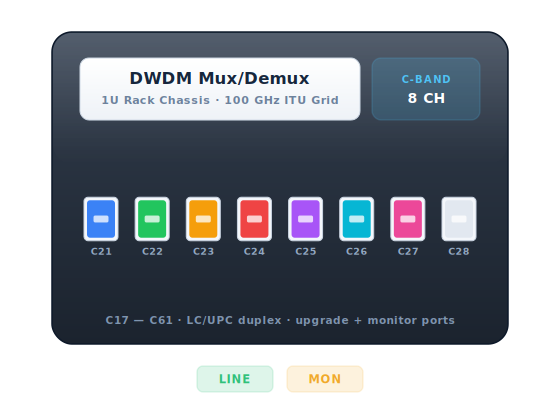
Second, the line side is still a DWDM system. A ZR pluggable removes the transponder, not the amplifier, the multiplexer or the dispersion budget. You still need mux/demux and, past a certain span, amplification — and you still have to close an OSNR budget.
Which One Should You Choose?
Metro data centre interconnect under 120 km: 400ZR
This is exactly what 400ZR was built for and it is a straightforwardly good answer. One less box, one less management domain, one less thing to power. The multi-vendor interoperability means you are not locked to one supplier for the life of the link, which is rare in coherent transport and genuinely valuable.
Regional links beyond 400ZR reach: ZR+, with verification
ZR+ extends the idea usefully, but 'ZR+' describes a direction rather than a specification. Confirm the exact operating mode, line rate and FEC at both ends before ordering, and where possible use the same vendor at each end. A pair of ZR+ modules that cannot agree a mode is an expensive way to discover this.
Long-haul, protected or carrier-grade: a transponder
If the link needs optical protection switching, sophisticated modulation selection, or the operational visibility a transport team expects, a pluggable is not the right tool. Transponder shelves exist because those requirements are real.
Any of the above: check the port thermal map first
Before the architecture discussion goes any further, find out how many ports on your switch can actually take a 20-watt module and where they are. This constraint has redesigned more DCI plans than reach ever has.
Frequently Asked Questions
Is ZR+ a standard?
No. 400ZR is an OIF specification with defined interoperability. ZR+ is a convenient label for vendor extensions beyond it, and different vendors mean different things by it. Treat any ZR+ claim as a starting point for a specification conversation, not as an answer.
Do I still need a DWDM mux with ZR pluggables?
Yes, if you are putting several wavelengths on one fibre pair — which is usually the point. The pluggable replaces the transponder, not the line system. You still need mux/demux, and beyond a certain span, amplification.
Can any switch port take a 400ZR module?
Often not. The power draw is at the top of the cage's thermal envelope, and many platforms support coherent modules in a limited set of ports. Get the supported-port list from the switch vendor early.
How does 400ZR handle dispersion?
In DSP. That is the fundamental advantage of coherent detection: because the receiver recovers the full optical field, chromatic dispersion is corrected mathematically rather than with compensating fibre. It is why coherent links cross long spans with no optical dispersion compensation at all.
What limits the reach if not dispersion?
OSNR. Every amplifier adds noise, and once the signal-to-noise ratio falls below what the modulation format needs, more gain does not help. Higher-order modulation carries more bits and needs more OSNR, which is why reach and capacity trade against each other.
The Parts We Build
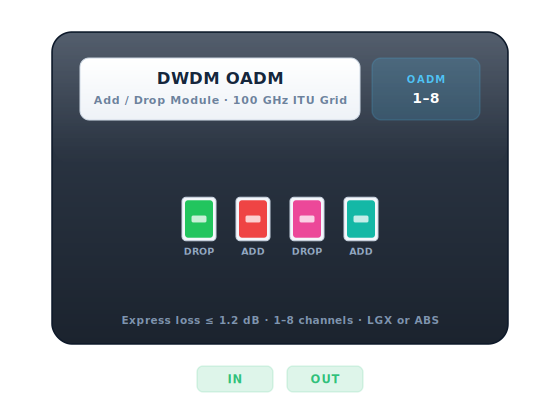
We supply the passive line system that sits under coherent pluggables — mux/demux, OADM and the single-mode plant to carry it.