The short answer
A 400G port can be DR4, FR4 or LR4 and all three carry the same traffic. What separates them is how far they go, and, much more importantly for your budget, what they need on the fibre side. DR4 is parallel: four fibre pairs and an MPO. FR4 and LR4 are wavelength-multiplexed: one fibre pair and a duplex LC.
That single difference — eight fibres versus two — usually matters more than the module price. Across a few hundred links it decides how much trunk cable you install, and trunk cable is a decade-long commitment where the modules are not.
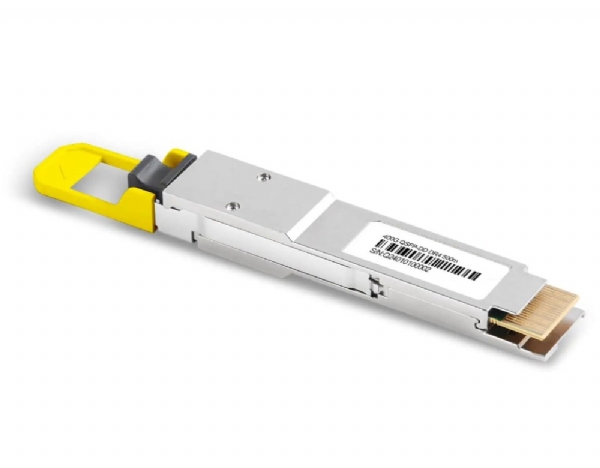
What Is 400GBASE-DR4?
Four parallel lanes at 1310 nm, one lane per fibre pair, terminated in an MPO-12 with APC polish and eight of the twelve positions used. Reach is 500 metres on standard single-mode fibre.
It is the cheapest of the three per module, because there is no optical multiplexer inside — four plain transmitters and four receivers. It is also the natural breakout source: those four lanes can feed four separate 100G devices, which is exactly what the breakout configurator works out for you.
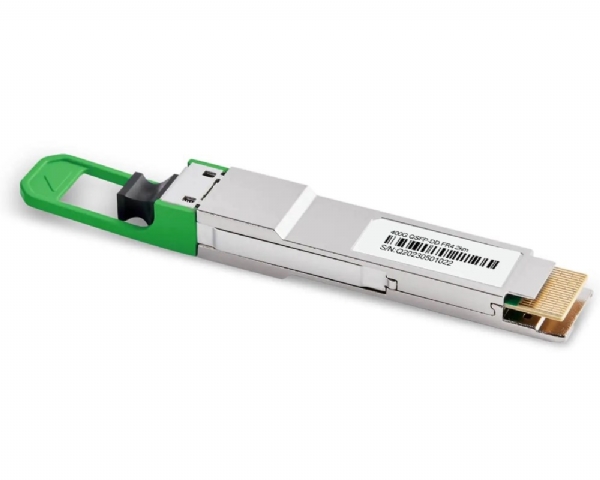
What Is 400GBASE-FR4?
Four CWDM wavelengths between 1271 and 1331 nm multiplexed onto a single fibre pair, terminated in a duplex LC. Reach is 2 kilometres.
The 20-nanometre CWDM spacing means the lasers can run uncooled, which is why FR4 is substantially cheaper than LR4 despite doing the same wavelength-multiplexing trick. For any link that fits inside 2 km on duplex fibre, it is usually the sweet spot.
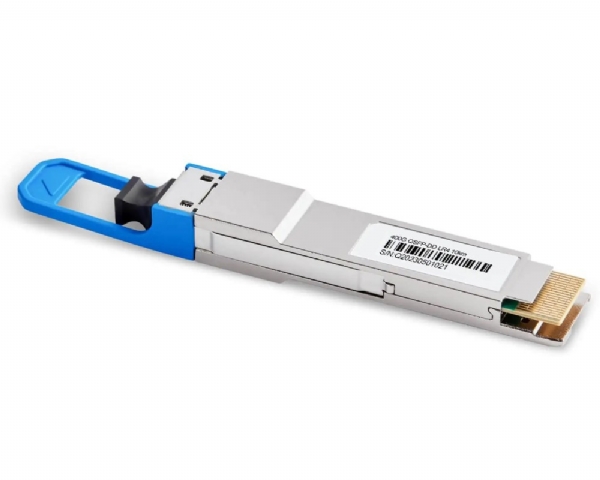
What Is 400GBASE-LR4-6?
Four CWDM wavelengths on the same 1271–1331 nm grid as FR4, on a single fibre pair with a duplex LC. The IEEE 802.3cu variant is specified to 6 kilometres — the "-6" in the name is the reach. Vendors also ship a non-IEEE 10 km 400G LR4 on the LAN-WDM grid; check which one a quotation means.
The tight spacing needs temperature-controlled lasers, and that is the cost difference against FR4. In return you get five times the reach, which is what campus and metro links need. See LAN-WDM for why the wavelengths sit where they do.
DR4 vs FR4 vs LR4: The Differences That Matter
Read the fibre-count row before the reach row. It is the one with the long-term cost attached.
| 400GBASE-DR4 | 400GBASE-FR4 | 400GBASE-LR4-6 | |
|---|---|---|---|
| Reach | 500 m | 2 km | 6 km (IEEE); 10 km vendor variants |
| Wavelengths | 1310 nm parallel, 4 lanes | CWDM 1271–1331 nm | CWDM 1271–1331 nm (IEEE LR4-6) |
| Connector | MPO-12 APC (8 fibres used) | Duplex LC | Duplex LC |
| Fibres per link | 8 | 2 | 2 |
| Laser cooling | Uncooled | Uncooled | Uncooled on the CWDM grid; cooled on LAN-WDM variants |
| Channel loss budget | 3 dB | 4 dB | 6.3 dB |
| Typical power | ~9 W | ~10 W | ~12 W |
| Breaks out to | 4 × 100G | Not natively | Not natively |
| Relative module cost | Lowest | Medium | Highest |
The breakout row is worth dwelling on. Because DR4's four lanes are physically separate fibres, one DR4 port can serve four 100G-DR devices directly through a conversion harness. FR4 and LR4 cannot do this at all — their four lanes are wavelengths sharing one fibre, and separating them needs a demultiplexer, not a cable. If breakout is in your plan, that decides the variant on its own.
On the fibre side, the honest arithmetic: 128 links of DR4 need 1,024 fibres; the same 128 links of FR4 need 256. Run it through the MPO cabling planner and you will usually find the trunk cost difference exceeds the module cost difference several times over.
Which One Should You Choose?
Inside the data hall, and especially with breakout: DR4
Under 500 metres, DR4 is the cheapest module and the only one of the three that breaks out. If you are feeding 100G servers from a 400G leaf, this is the variant — one port, one conversion harness, four servers. Budget for the fibre: eight per link, APC polish throughout, and an MPO-based plant to carry it.
Between buildings on duplex fibre, under 2 km: FR4
This is the variant that fits most campus links. Two fibres per link rather than eight, ordinary duplex LC patching, and uncooled lasers that keep the price sensible. If you already have duplex single-mode between buildings and no MPO plant, FR4 turns that fibre into 400G without laying anything new.
Campus and metro, past 2 km: LR4
When 2 km is not enough, LR4 is the standards-based answer, and the cooled LAN-WDM lasers are what you are paying for. Check the channel budget honestly — 6.3 dB sounds generous until you count the patch panels at each end. The link budget calculator settles it.
Beyond 10 km: look at ER8 or coherent
Past LR4 you are into 400GBASE-ER8 at 40 km or coherent 400ZR at 80 to 120 km. The economics change completely at that point, and so does the amplification you need.
Frequently Asked Questions
Can a DR4 module talk to an FR4 module?
No. They use different wavelength plans and different connectors — DR4 is four fibres of 1310 nm, FR4 is four wavelengths on one fibre pair. Both ends of a link must be the same variant. What can differ is the form factor: a QSFP-DD DR4 talks to an OSFP DR4 quite happily.
Can I run DR4 over multimode fibre?
No. DR4 is a single-mode standard at 1310 nm. For multimode parallel at 400G you want SR8 on OM4, which reaches 100 metres — check the figures in the multimode reach lookup.
Does DR4 need APC connectors?
Yes. Single-mode parallel optics are specified with APC polish, because with four or eight lanes sharing one ferrule the reflection budget is tight. APC and UPC must never be mated — see APC vs UPC.
Which is cheaper overall, DR4 or FR4?
The module is cheaper in DR4; the cabling is cheaper in FR4. Below about 100 links the module price usually dominates and DR4 wins. Above that, and especially where the fibre has to be installed rather than reused, the four-times fibre count usually decides it the other way. Do the arithmetic for your own link count rather than trusting a rule of thumb.
Is 400G-DR4 the same as PSM4?
They are close relatives — both are 1310 nm parallel over eight fibres — but PSM4 is a 100G MSA and DR4 is the IEEE 400G standard. They are not interoperable, and the reach figures differ.
The Parts We Build
All three variants in OSFP and QSFP-DD, coded for your platform and traffic-tested before dispatch.