100G QSFP28 in 2026: Which Variant, and When It Still Wins
100G is not the interesting speed any more, which is precisely why it is worth writing about carefully. The silicon is a decade old, the yields are excellent, four optical approaches compete for the same sockets, and the result is the cheapest gigabit anyone has ever bought in volume. A great many networks that will never need 400G are being quoted 400G anyway.
The family is also unusually wide. Eight meaningfully different optical variants share one cage, spanning 70 metres to 80 kilometres, four wavelength plans and three connector types. They are not interchangeable, the differences show up in the cable plant rather than the switch configuration, and the wrong choice is discovered when somebody tries to patch a duplex module into an MPO panel. What follows is the whole family, ranked by what it obliges you to install — with an honest account of where 400G is the better buy.
Four Lanes of 25G NRZ, and Why It Matters
Almost every QSFP28 variant is four electrical lanes of 25.78 Gb/s NRZ — not PAM4, not 50G, not 100G per lane. Four two-level lanes, which is why the modules are cheap and why they run cool. Note that cheap does not mean FEC-free: only LR4 and ER4 are specified without RS-FEC, and the multimode and parallel variants all rely on it.
That lane structure has three consequences.
It breaks out natively into 4×25G. Each lane is an independent 25G Ethernet lane, so a parallel 100G module fans out to four 25G links with nothing more than a harness — still the most common breakout in enterprise networks.
It is a different exercise from breaking out a 400G port. A 400G port is eight lanes at 50G or four at 100G in PAM4, so breaking it into 4×100G produces children that are themselves PAM4 — not QSFP28 4×25G NRZ links, and a 100G QSFP28 module will not terminate one. The rate matches; the signalling does not. The breakout guide works through why, and this is the single most common misunderstanding when a 400G switch is bought to feed an existing 100G estate.
The exception is worth knowing. 100G SR-BiDi is not 4×25G NRZ — it is two lanes of 50G PAM4 on two wavelengths over one duplex pair. It behaves differently, cannot break out, and needs FEC. It exists to put 100G onto duplex multimode plant built for 10G or 40G.
Every Variant, and What Each One Costs You

| Variant | Reach | Wavelengths | Connector | Breaks out |
|---|---|---|---|---|
| 100GBASE-SR4 | 70 m OM3 / 100 m OM4 | 850 nm × 4 lanes | MPO-12 | 4×25G SR |
| 100G eSR4 | 200 m OM3 / 300 m OM4 | 850 nm × 4 lanes | MPO-12 | 4×25G eSR |
| 100G SR-BiDi | 70 m OM3 / 100 m OM4 | 850 / 900 nm, 2×50G | Duplex LC | No |
| 100G PSM4 | 500 m OS2 | 1310 nm × 4 lanes | MPO-12 APC | 4×25G LR |
| 100G CWDM4 | 2 km OS2 | 1271 / 1291 / 1311 / 1331 nm | Duplex LC | No |
| 100GBASE-LR4 | 10 km OS2 | LAN-WDM 1295–1309 nm | Duplex LC | No |
| 100G ER4 Lite | 30 km OS2, 40 km with FEC | LAN-WDM, APD receiver | Duplex LC | No |
| 100G ZR4 | 80 km OS2 | LAN-WDM, amplified | Duplex LC | No |
Read that table by the connector column, not the reach column. Four are duplex LC and four use an MPO ferrule, and that split decides which panels, trunks and patch cords you own for a decade.

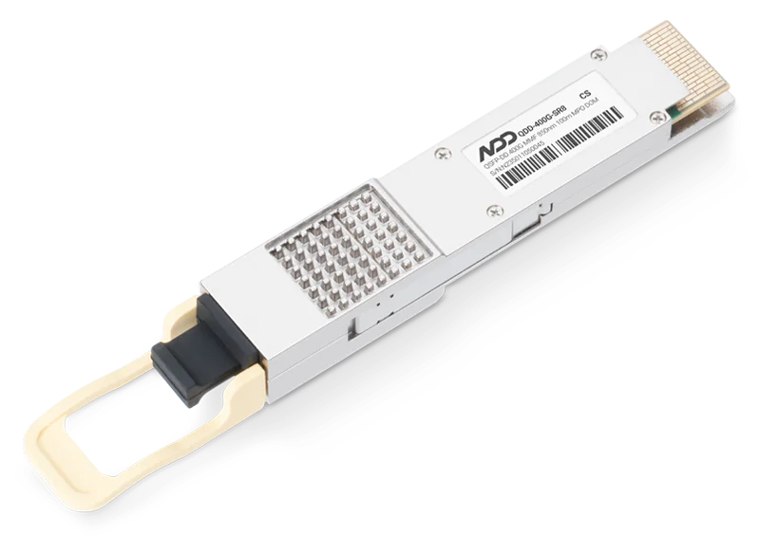
SR4 and eSR4 are the volume parts. 100GBASE-SR4 is 850 nm VCSEL arrays over eight fibres of an MPO-12 — four transmit, four receive, four dark — at 70 m on OM3 and 100 m on OM4. eSR4 is the same optics with a tighter budget, reaching 200 m and 300 m; it is not an IEEE class, so treat it as a vendor extension bought in matched pairs.
SR-BiDi solves one problem: an existing duplex multimode plant. It runs over a single LC pair at 70 m and 100 m, so an ageing 10G or 40G estate reaches 100G without a metre of new fibre. It costs more than SR4 and cannot break out; whether that is a bargain depends on what pulling MPO trunk would have cost.
PSM4 is the cheap single-mode option and the most misunderstood. 100G PSM4 uses four uncooled 1310 nm lasers on eight fibres of an MPO-12 APC ferrule to reach 500 m. The optics are cheap because there is no multiplexer; the fibre is expensive because you need eight strands instead of two. Over a few hundred metres in-building it usually wins; across a campus where fibre is leased or duct is scarce it loses badly. It also breaks out into four 25G single-mode links, which CWDM4 cannot.
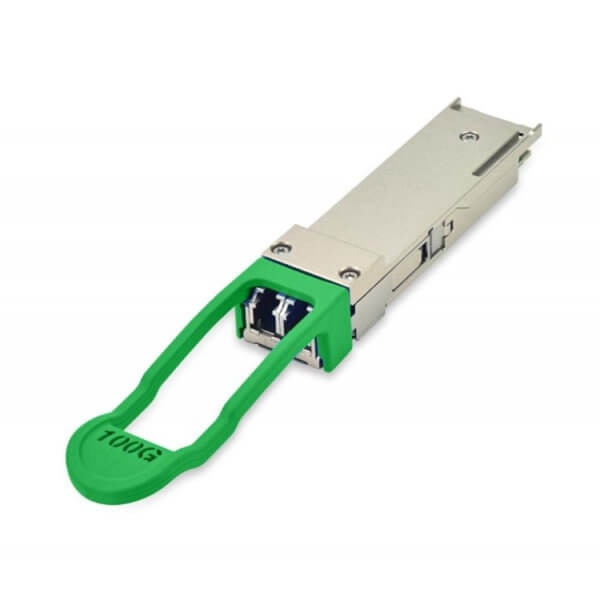
CWDM4 is the fibre-efficient middle. 100G CWDM4 multiplexes four CWDM lanes at 1271, 1291, 1311 and 1331 nm onto one duplex pair for 2 km — uncooled DFB lasers plus a coarse multiplexer, which is why it sits between PSM4 and LR4 on price. If the building already has duplex single-mode risers, this is usually the right 100G optic.
LR4, ER4 and ZR4 are the distance parts, and all three use LAN-WDM: four lanes packed into roughly 1295 to 1309 nm, close enough that the lasers must be temperature-controlled. 100GBASE-LR4 is the IEEE 10 km part and the default campus optic; ER4 Lite reaches 30 km on its own and 40 km with FEC, the extra budget coming from an APD receiver rather than a bigger laser; ZR4 reaches 80 km. Full ER4, where you can get it, does 40 km unaided. All three are direct-detect rather than coherent, which is exactly why 100G stays cheaper than a 400G ZR link over the same fibre.
Choosing between the three single-mode options in a data centre? The SR4 versus PSM4 versus CWDM4 comparison works the trade, including the fibre-count arithmetic that usually decides it.
The 100G Links You Should Not Buy Optics For
A meaningful share of 100G links in any rack are shorter than three metres, and buying optics for those wastes money and watts. A 100G QSFP28 passive DAC has no active components, dissipates essentially nothing, costs a fraction of two SR4 modules plus a patch cord, and has no end faces to contaminate. At 25G per lane NRZ the IEEE objective for passive copper is 5 m — comfortably more than 50G or 100G per lane manage — so the reach genuinely covers in-rack use.
Beyond that, AOC covers the middle ground to a few tens of metres, and the breakout form — a 100G to 4×25G DAC or its active equivalent — is the standard way to feed 25G servers from a 100G leaf port. The DAC, AOC and ACC comparison sets out where each stops being sensible. The rule is cheapest to apply at 100G: inside the rack, copper; inside the row, active cable; beyond the row, optics.
100G as a Breakout Tier
The most common role for 100G in a new 2026 build is not as a switch-to-switch speed at all. It is as the server-facing tier under a 400G or 800G leaf.
An 800G DR8 port carries eight independent 100G single-mode lanes, so one port can serve eight 100G-DR hosts; a 400G DR4 port serves four. In both cases the child links are single-lane 100G PAM4 optics, not QSFP28 4×25G modules — the distinction from the previous section, and the reason a breakout plan drawn on rate alone falls apart in procurement. Work the ratios and the port groups through the breakout configurator before the rack elevation is fixed.
Where QSFP28 is genuinely the breakout tier is one layer down: a 100G leaf port fanned into four 25G server ports. That topology is mature, cheap and supported everywhere. One caution: a parallel 100G module consumes eight fibres whether it serves one host or four, so breakout does not save glass. It saves switch ports and multiplies terminations.
Where 100G Still Beats 400G
Four situations, covering more networks than the marketing suggests.
When the servers are 25G. If the host NICs are 25G and will stay 25G for their depreciation life, the leaf only needs enough uplink to serve them. A 100G leaf with 100G uplinks is a complete design at a fraction of the cost, and the TCO calculator usually shows the 400G alternative losing over five years once optics are counted.
When the link is long and the traffic is not. An 80 km 100G ZR4 pair is dramatically cheaper than a 400G coherent ZR pair, and for a metro link carrying tens of gigabits it is not close. Buy the capacity you need, not the capacity the newest module offers.
When the plant is duplex multimode and staying that way. SR-BiDi reuses fibre a 400G design would replace. The optic costs more; the civil works cost nothing.
When port count matters more than port speed. Cost per usable port, not cost per gigabit, is what most enterprise networks are optimising. Thirty-two 100G ports on a mature platform frequently beat eight 400G ports broken out, once optics, breakout assemblies, panel space and spares are counted.
The honest counter-case: for an AI or storage fabric, for hosts that already have 100G or faster NICs, or where faceplate density is the binding limit, 100G is the wrong answer and the extra cost of 400G is real value. This tier's strength is maturity and price, not headroom.
What to Watch When Buying Compatible 100G
The modules are commodities now, so the risk has moved elsewhere. Five things are worth checking.
Coding, per platform and per software version. The same optical part needs different EEPROM coding for different vendors, who also change what they accept between software releases. Give the supplier the exact switch model and software train; the unsupported-transceiver article covers what the warnings mean and what they do not.
eSR4 in matched pairs. Two vendors' eSR4 modules are not guaranteed to interoperate at extended reach. Buy both ends from one source, or design to SR4 reach and treat the extra distance as headroom.
Connector polish on PSM4. PSM4 is single-mode parallel and wants an APC ferrule. Mating APC to UPC costs typically well over a decibel per mated pair and ruins the return loss, and scratches both faces — the APC versus UPC comparison explains why. This bites when a PSM4 module meets an existing multimode MPO plant terminated flat.
Amplified parts and receiver overload. ER4 Lite and ZR4 are amplified for distance, so on a bench link or a short span the receiver saturates and the link errors or never comes up. Fit a fixed attenuator sized from the measured launch power.
DDM that is real. Digital diagnostics on a cheap module is sometimes a calibration table rather than a measurement. That matters, because DDM receive power is the first number anyone reads when a link misbehaves. Ask whether the values are calibrated per module or copied from a type test.
We build the full QSFP28 range in Shenzhen — SR4, eSR4, SR-BiDi, PSM4, CWDM4, LR4, ER4 Lite, ZR4 and the dual-rate OTU4 variant — coded to your platform and software version, with per-module calibrated DDM and a traffic test in the target switch before shipping. We also make the MPO trunks, harnesses and cassettes the parallel variants need, measured fibre by fibre against the serial number. Send us the fibre type, the panel connector and the distance and we will tell you which of the eight fits; if the answer is a DAC, we will say so. The Ethernet optical standard lookup checks what a name promises before you ask.
FAQ
Can a 100G QSFP28 module go into a 40G QSFP+ port? Physically yes, electrically no at 100G. Many platforms negotiate the port down to 40G if the module supports it, and many QSFP28 modules do not. Check the switch's supported-optics list rather than assuming the cage decides.
Is 100G ZR4 really 80 km? Yes — a direct-detect LAN-WDM module with integrated amplification rated for 80 km on OS2, not a coherent optic. Whether your particular span works depends on its total loss and dispersion, so budget the actual route rather than the headline number.
Do I need FEC on 100G? Only 100GBASE-LR4 and ER4 are specified without it. SR4, PSM4 and CWDM4 all rely on RS-FEC, and SR-BiDi needs it because it is PAM4. The rule is that both ends must agree: a mismatch produces a link that comes up and errors continuously, which looks exactly like a dirty connector and is not one.
SR4 or PSM4 for a 300 m link? Neither, comfortably. SR4 stops at 100 m and eSR4 at 300 m on OM4 with no margin. If the plant is single-mode, PSM4 covers 500 m with room; if you are choosing what to install, single-mode at this distance will outlive several generations of optics. The single-mode versus multimode comparison sets out the full case.