OM3 vs OM4 vs OM5: Choosing Multimode Fiber for 40G/100G/400G
Multimode fiber survives every "single-mode is taking over" prediction for one reason: an 850 nm VCSEL transceiver is still several times cheaper than its single-mode cousin, and most data-center links are still under 100 m. The real question isn't MM vs SM — it's which OM grade to cable so today's 25G lanes become tomorrow's 100G lanes without re-pulling trunks. Here's the complete decision, with numbers.
The Multimode Family & Why It Exists
All three current grades share a 50/125 µm graded-index core optimized for 850 nm VCSEL lasers ("laser-optimized", the LO in OM3's formal name OM3-LO). The graded index profile bends faster ray paths back toward the axis so hundreds of propagating modes arrive nearly together — nearly being the operative word. Residual arrival spread is modal dispersion, and the three grades are simply three quality levels of the same fight against it. (OM1/OM2, with 62.5 µm and non-laser-optimized 50 µm cores, are legacy: fine to keep using at 1G, dead ends beyond 10G — we still supply them for legacy patching.)
Modal Bandwidth, Properly Explained
The datasheet number that separates the grades is EMB — Effective Modal Bandwidth — in MHz·km at 850 nm:
| Grade | EMB @850 nm | Jacket | Standardized |
|---|---|---|---|
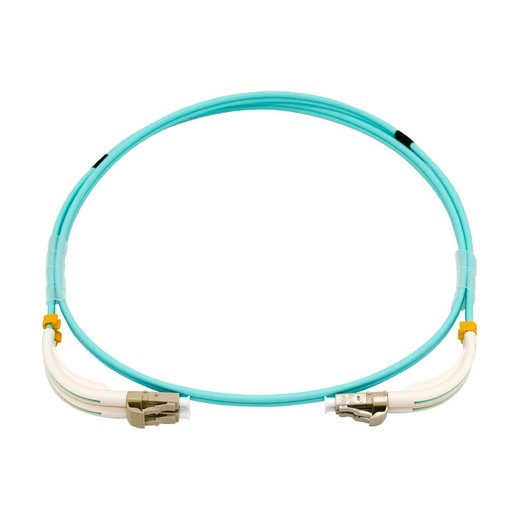
| OM3 | 2000 MHz·km | Aqua | TIA-492AAAC / IEC 60793-2-10 A1a.2 |
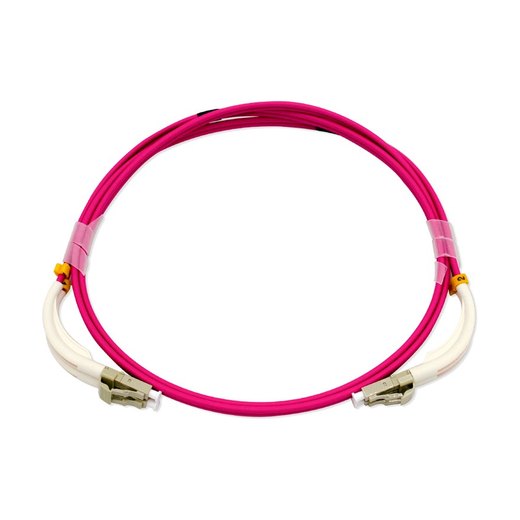
| OM4 | 4700 MHz·km | Violet (Erika) or aqua | TIA-492AAAD / A1a.3 |
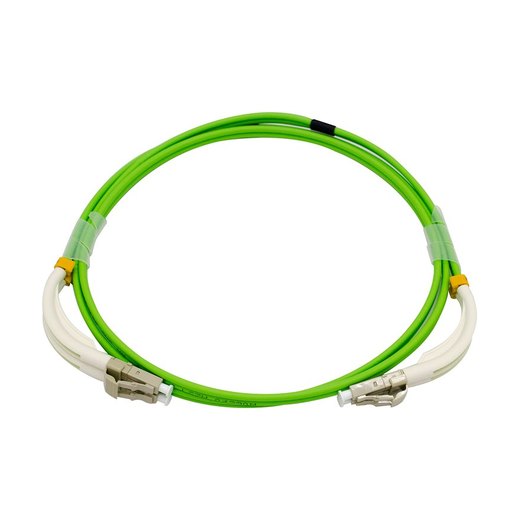
| OM5 | 4700 @850 + 2470 @953 nm | Lime green | TIA-492AAAE / A1a.4 |
Read EMB as a budget: bandwidth × distance is roughly constant. A 25 Gb/s NRZ lane needs about 2000 MHz·km to reach 100 m — exactly OM3's rating, which is why 100G-SR4 stops at 70–100 m on OM3 and stretches to 150 m on OM4's 4700. OM5's headline is not more bandwidth at 850 nm (it matches OM4) but guaranteed bandwidth across 850–953 nm, the window shortwave-WDM uses.
Reach Tables: 10G to 800G
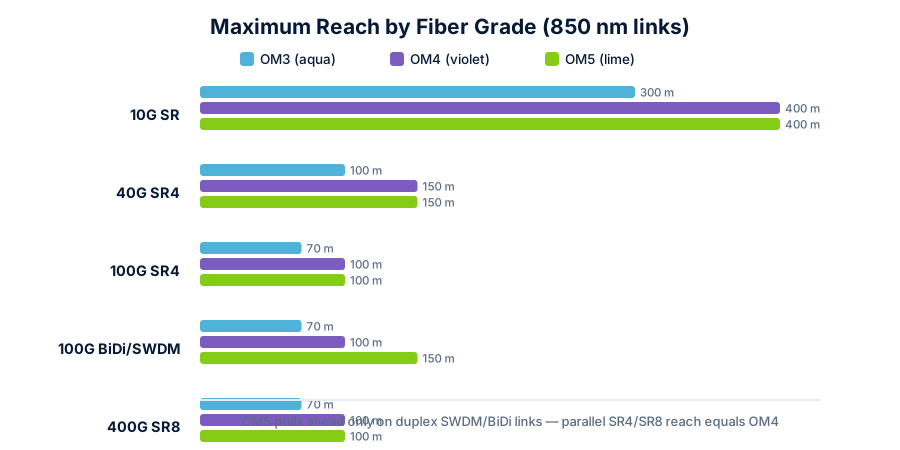
| Standard | Lanes × fiber | OM3 | OM4 | OM5 |
|---|---|---|---|---|
| 10GBASE-SR | 1 duplex pair | 300 m | 400 m | 400 m |
| 25G-SR / lane | 1 pair | 70 m | 100 m | 100 m |
| 40/100G-SR4 | 8 fibers (MPO) | 100 m | 150 m | 150 m |
| 100G SR-BiDi / SWDM4 | 1 pair | 70 m | 100 m | 150 m |
| 200/400G-SR8 | 16 fibers (MPO) | 70 m | 100 m | 100 m |
| 800G-SR8 (2×MPO12/MPO16) | 16 fibers | 30 m | 50 m | 50 m |
Two patterns worth internalizing: reach shrinks as lane rate climbs (PAM4 at 100G/lane is brutal on modal dispersion — hence 800G-SR8's 50 m), and OM5's column only beats OM4 where the optic multiplexes wavelengths (BiDi/SWDM rows).
What OM5 Actually Adds (and Doesn't)
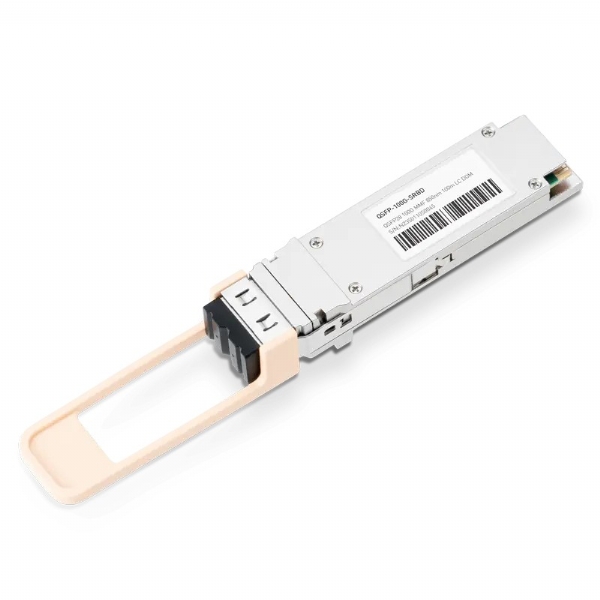
Adds: a specified dispersion window to 953 nm, letting SWDM4 optics run 4 wavelengths down one fiber pair — 100 Gb/s on duplex LC instead of an 8-fiber MPO, at 150 m. For duplex-strategy shops using optics like our 100G QSFP28 SR-BiDi, that halves trunk fiber count versus OM4 parallel.
Doesn't add: anything for SR4/SR8 parallel links (identical reach to OM4), anything at 1310 nm, or compatibility magic — OM5 mates and splices with OM4/OM3 fine, but a mixed channel is rated at the worst grade in the path.
The Cost Model
Typical relative pricing we see across assemblies and bulk cable: OM3 = 1.0×, OM4 ≈ 1.1–1.25×, OM5 ≈ 1.4–1.6×. Fiber is a minority of installed-link cost (labor, pathways, panels dominate), so the OM3→OM4 upgrade usually costs 2–4% of the project for +50% parallel reach — the cheapest future-proofing in networking. OM3→OM5 is a strategy decision: it pays only if SWDM duplex optics are actually on your roadmap.
Three Migration Scenarios
- Existing OM3 plant, rows ≤70 m: stay put. OM3 carries 400G-SR8 to 70 m and 800G-SR8 to 30 m; audit actual link lengths before spending anything.
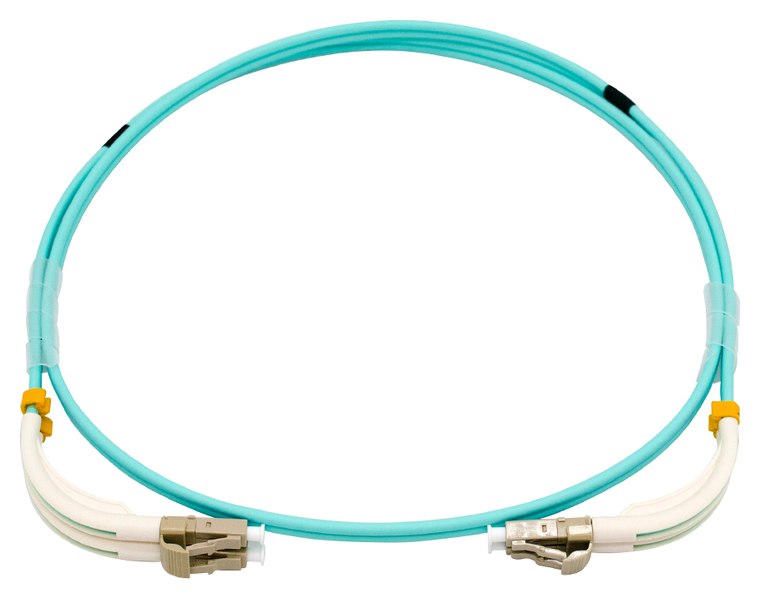
- New build, standard leaf-spine: OM4 trunks (MTP bundle trunks Type B), Base-16 harnesses for SR8 rows, angled LC jumpers at the panel. This is today's 90% answer.
- Hyperscale row / duplex-first strategy: OM5 trunks + SWDM optics halve fiber count; keep jumper colors strict (lime = OM5) so techs can't down-grade a channel silently.
Deployment Practice & Pitfalls
- The weakest-grade rule: one aqua OM3 jumper in an OM4 channel makes it an OM3 channel. Color discipline isn't cosmetic.
- Connector loss budgets shrink with rate: 400G-SR8 over OM4 budgets ~1.8 dB total channel loss. Two low-loss MTP interfaces (≤0.35 dB each on our low-loss line) leave comfortable margin; four standard ones don't.
- Bend radius: laser-optimized fiber tolerates 15 mm bends but every violation costs modal margin exactly where PAM4 can't spare it — use proper zipcord and angled boots rather than heroic routing.
- Test at 850 nm with an encircled-flux source (IEC 61280-4-1); overfilled legacy sources over-report loss on laser-optimized fiber by up to 0.5 dB.
Matching Products
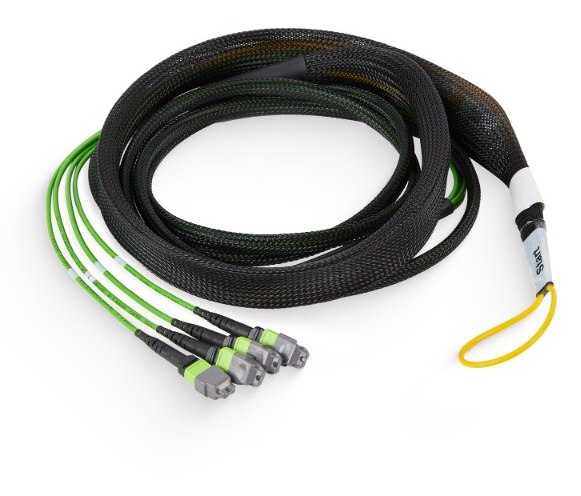
Everything ships in all grades with honest jacket colors: angled LC duplex cords (click OM3/OM4/OM5 on the page to preview each color), MPO-SC harnesses, OM4/OM5 trunks, bulk zipcord, distribution cable, and MPO loopbacks in OM3/OM4 for port testing.