Port Breakout Explained: 800G to 2x400G, 400G to 4x100G
Breakout is sold as a density trick and bought as a cost saving, and both descriptions hide the thing that actually decides whether it works. Nothing inside the module divides anything. There is no splitter, no demultiplexer, no clever optics. The port was always several independent lanes; breakout simply stops pretending they are one.
That single fact explains every rule below — why an 800G DR8 splits happily into two 400G links and a 400G FR4 refuses to split at all, why one 800G optic needs an MPO-16 and the next needs two MPO-12s, and why the switch usually wants a reload to change its mind.
What Actually Splits
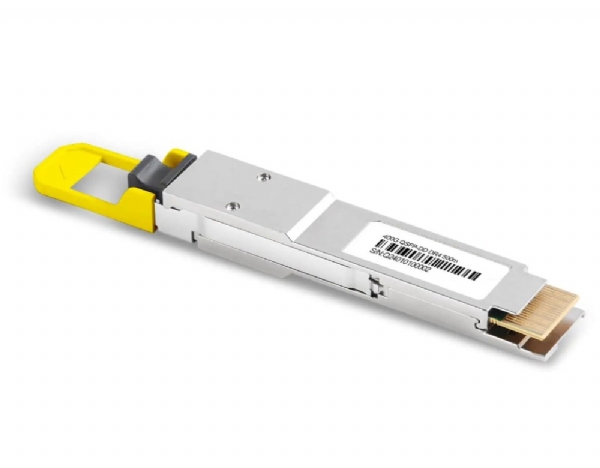
A modern switch port is a group of SerDes lanes wired to a cage. An 800G OSFP port is eight lanes running roughly 100 Gb/s each in PAM4. A 400G QSFP-DD port is eight lanes at 50G, or four at 100G, depending on generation. Those lanes are electrically independent from the ASIC to the module's electrical interface.
"800G" is a decision the switch makes to bond all eight lanes into one MAC and one PCS instance. Breakout is the same silicon deciding to build two MAC instances of four lanes each, or four of two, or eight of one. The optics follow: an eight-lane parallel module simply carries eight lanes, and it neither knows nor cares how the host has grouped them.

Two consequences fall out immediately, and they eliminate most of the questions people ask.
The ratio is bounded by the lane count. An eight-lane port can be 1×800G, 2×400G, 4×200G or 8×100G. It cannot be 3×266G, and it cannot produce more links than it has lanes. Work the arithmetic for your own port inventory in the breakout configurator rather than assuming a ratio exists.
The far end must be a real port of the child speed. Breakout does not create a protocol adapter. Each group of lanes speaks a complete, standard Ethernet PMD, and something at the other end has to speak the same one at the same rate with the same FEC setting.
The Three Ways to Do It
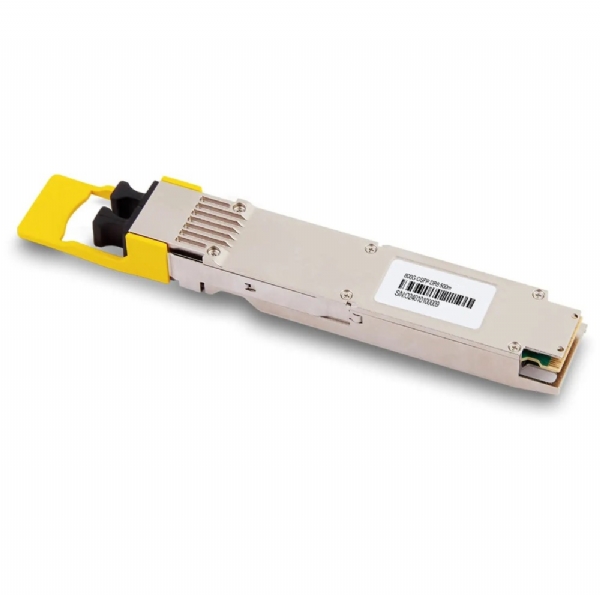
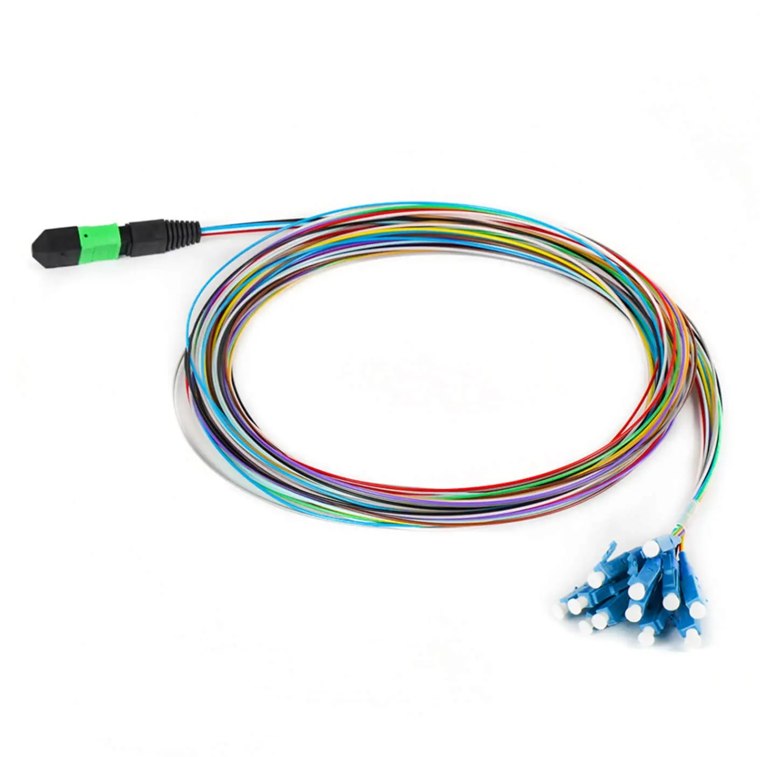
1. A parallel optic plus a fibre harness. The parent port takes an eight-lane parallel module — DR8, DR8-2 or SR8 — and an MPO-to-LC or MPO-to-MPO harness fans the fibres out to the child modules. This is the flexible option: the harness is passive, the child modules are ordinary optics, and the two ends can be different distances apart.
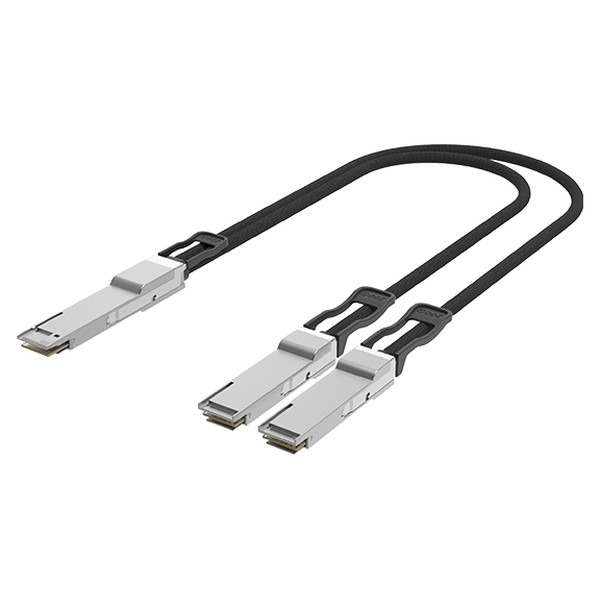
2. A breakout copper or active cable. One assembly, connectors moulded on, one parent plug and two or four or eight child plugs. An 800G to 2×400G breakout DAC is the cheapest link you can build in a rack and consumes essentially no power. The same shape exists as AOC and as retimed AEC for longer runs — the differences between DAC, AOC and ACC matter more here than in a straight point-to-point link, because a breakout assembly is a single SKU per length and per ratio.
3. Transceiver-to-transceiver over structured cabling. The parent optic lands on a patch panel, a trunk crosses the hall, and conversion cassettes at the far end regroup the fibres onto child ports. Nothing is a "breakout product" — the plant does the fan-out. This is the only option that survives a re-patch, and the only one where the two halves can be commissioned by different teams on different days.
Which Optics Break Out, and Which Cannot
This is where most of the mistakes happen, and there is exactly one question to ask: does each lane travel on its own fibre pair, or are the lanes multiplexed onto a shared pair?

DR8 splits to 2×DR4 because each lane is already an independent 100G single-mode lane. An 800G DR8 module launches eight 1310 nm lanes onto eight fibre pairs. Take four pairs to one host and four to another and you have two complete 400GBASE-DR4 links; take one pair to each of eight hosts and you have eight 100G-DR links. Nothing in the module changes.
SR8 splits to 2×SR4 as well, but the fibre map decides how painful it is. Multimode 800G comes in two mechanical flavours: a single MPO-16 carrying all sixteen fibres, or a twin-port module with two MPO-12 receptacles. The twin-port version is already physically split — each MPO-12 is one SR4 group, patched straight through with an ordinary trunk. The MPO-16 version needs a conversion assembly, and you must know which positions map to which lane group before ordering it. See the MPO-12 and MPO-16 comparison for the position maps.
FR4 and LR4 cannot break out at all. Their four lanes are combined onto one fibre pair by an optical multiplexer inside the module. There is no connector position at which one lane exists on its own, so there is nothing to fan out. This is not a licensing or firmware limitation and no configuration changes it — the DR4 versus FR4 versus LR4 comparison covers why the same reach class made two incompatible choices.
2×FR4 and 2×LR4 are a naming trap. An 800G 2×FR4 is two complete four-wavelength engines behind one faceplate, presenting two duplex LC pairs. It breaks out into two 400G FR4 links and stops there, because within each half the four lanes are multiplexed. Buy it when you need 2×400G at 2 km on duplex fibre, not when you want eight-way flexibility.
The Switch Side: Port Groups and Lane Maps
The optics being capable is necessary and not sufficient. Four things on the switch decide whether the ports appear.
Port groups. Most platforms do not let each cage choose independently. Cages are organised into groups sharing a lane map or a MAC block, so setting one port to a breakout mode constrains its neighbours — sometimes disabling them outright. This is a hardware property and the single most common reason a planned port count does not materialise. Check it before the rack elevation is signed off.
Reload. Changing a lane grouping re-programs the MAC and PCS blocks, which on most platforms restarts the port group, the line card or the whole switch. Plan breakout changes into a maintenance window even when the command appears to take effect immediately.
Interface naming. Child ports get compound names — a suffix, a sub-index, a new numbering scheme — and whatever it is propagates into monitoring, the cabling database and the patch labels. Decide the convention once, before the first port is broken out, or you will be reconciling three of them a year later.
Module management. On 400G and above, CMIS carries the breakout configuration to the module: which lanes belong to which application, what the application code is, and what the module should report. A module implementing a different CMIS revision from the one the host expects can be recognised, come up as a single port, and refuse the breakout mode with no useful error. If a correctly coded module links at 1×800G but not at 2×400G, that is the first thing to ask about.
Then check FEC on both ends. A breakout child and its partner must agree; a mismatch produces a link that comes up and errors continuously, which reads as a fibre fault and is not one.
What It Does to the Fibre Plant
Breakout is a cabling decision wearing a switching costume. Three things change on the plant side.
Fibre count. An eight-lane parallel port consumes sixteen fibres, always — whether it serves one 800G host or eight 100G hosts. This is the opposite of the intuition that breakout saves fibre: it saves switch ports and spends exactly the same glass. An 800G MPO port serving eight hosts needs sixteen fibres arriving in eight places rather than one. Run your port count through the MPO cabling planner before ordering trunk, because what changes is the count of terminations.
MPO-16 versus two MPO-12s. A twin-port module fits an existing base-12 plant unchanged, at the cost of two connectors to keep clean. An MPO-16 is one connector, but needs MPO-16 trunk or an MPO-16 to 2×MPO-12 conversion harness at the first panel. What is wrong is discovering which one your modules use after the trunk has been pulled.
| Breakout | Parent optic | Fibres | What the plant has to provide |
|---|---|---|---|
| 800G to 2×400G | DR8, single MPO-16 APC | 16 | MPO-16 trunk, then conversion to 2×MPO-12 APC |
| 800G to 2×400G | 2×DR4 twin-port, 2×MPO-12 APC | 16 | Two ordinary 12-fibre APC trunks, no conversion |
| 800G to 8×100G | DR8, single MPO-16 APC | 16 | MPO-16 to 8×LC duplex hydra harness |
| 400G to 4×100G | DR4, MPO-12 APC | 8 | MPO-12 to 4×LC duplex harness or cassette |
| 800G to 2×400G | 2×FR4, 2×duplex LC | 4 | Two LC duplex cords into existing duplex plant |
Harness or cassette. A harness is cheaper, has one fewer mated pair in the channel and cannot be re-patched. A cassette costs more, adds a mated pair to the loss budget and turns the fan-out into a patchable interface. On a DR-class link the extra insertion loss is easily affordable; on a 100 m SR link at 100G per lane it is not always.
Finally, polarity. A fan-out is where transmit and receive get swapped, and a breakout link has more chances to get it wrong than a straight one because the child legs are individually orientable. Fix a method — our polarity guide sets out the three standard types — and label every leg at manufacture, not on site.
When Breakout Is the Wrong Answer
When the failure domain matters more than the port count. One module, one cage, one line-card slot now carries eight servers, so a single optic failure takes out eight links instead of one. In a rail-optimised fabric where each rail is already a single point of dependence, that concentration is sometimes exactly what you do not want.
When the child links need different reaches. Every leg shares the parent's PMD. If six of your eight hosts are in the row and two are 400 m away, a single SR8 cannot serve both. Two parent optics on two ports beats one heroic assembly.
When the cable becomes unmanageable. Eight legs from one faceplate port, times thirty-two ports, is a bundle nobody can trace or re-dress under pressure. Cassettes cost more and stay serviceable; harnesses in bulk quietly become permanent.
When you are buying switch ports you do not need. Breaking a high-speed port into slower children is only economic if the parent port and optic cost less than the equivalent native ports. At the top of a speed generation they usually do; one generation later they usually do not. The configurator prices both paths side by side.
We build every part of the breakout chain in Shenzhen and treat it as one system: parent and child modules coded to your exact switch platform and software version, breakout DAC and AOC assemblies in the ratio and length you specify, and MPO harnesses and cassettes with the position map built to your lane grouping. Every module is traffic-tested in the target platform, and every fibre in every assembly is measured individually against its serial number — the only way to know a sixteen-fibre harness is right before it is in a rack.
FAQ
Can I break out an 800G port into two 400G links of different types? No. Both halves come from the same module and therefore the same PMD. Two 400G DR4 links, or two 400G SR4 links — never one of each.
Does the far end have to be the same brand? No, but it has to be the same standard, at the same speed, with matching FEC. A 400GBASE-DR4 from any manufacturer will link to a DR8 breakout leg. Coding affects whether the host accepts the module, not whether the optics interoperate.
Is a breakout DAC cheaper than a breakout optic plus harness? Substantially, inside a rack. Beyond a few metres the copper reach runs out and the comparison flips to AOC or AEC. Distance decides first, price second.
Why does my 800G port only offer 1×800G and 8×100G, not 2×400G? Almost always a platform or software limitation in the supported application list rather than an optical one. Check the switch documentation for supported breakout modes on that specific port group, and check which CMIS applications the module advertises.
Do I need APC connectors for breakout? For single-mode parallel optics, yes — DR-class modules specify angled MPO and the whole channel including the harness must match. Multimode parallel is flat-polish. Mixing polishes costs typically well over a decibel per mated pair and ruins the return loss.