Pluggable Optical Amplifiers: Extending Reach Without a Transport Shelf
When a span is too long, the instinctive answer is a higher-power transceiver. Past a certain distance that stops working, because the limit is no longer how much light you launch — it is how much noise has accumulated by the time it arrives.
Optical amplification is the answer, and it has quietly become available in a pluggable form factor. That changes the economics of medium-reach links considerably, and it is a category almost nobody in this industry writes about.
What an Optical Amplifier Actually Does
An erbium-doped fibre amplifier is a coil of fibre doped with erbium, pumped by a laser at 980 or 1480 nm. The pump excites the erbium ions; an arriving signal photon stimulates them to drop back, emitting an identical photon. The signal is amplified directly in the optical domain — no conversion to electrical, no per-channel electronics.
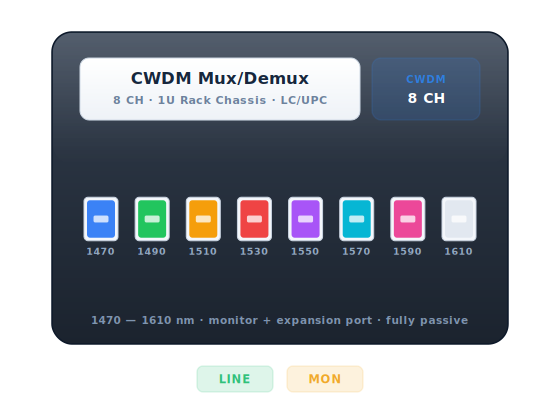
The property that made long-haul DWDM economic is that it amplifies the whole C-band at once. Every DWDM channel passing through gains together, from one device. That is also why it cannot help CWDM, whose channels are spread across 340 nanometres, or O-band systems at 1310 nm.
Booster, In-Line and Pre-Amplifier
Same technology, three positions, three different jobs.
Booster. Immediately after the transmitter, raising launch power into the span. Limited by fibre nonlinearity — push too hard and you distort the signal in the glass itself.
In-line. Mid-span, restoring the signal before it becomes unrecoverable. Each one adds noise, which is what ultimately bounds how many you can chain.
Pre-amplifier. Immediately before the receiver, lifting a weak signal into the detector's range. Usually the most effective single amplifier you can add to a link that is marginally short of budget, because it improves the received signal without adding noise from a whole span behind it.
For a link that is a few decibels short, a pre-amplifier at the receive end is frequently the cheapest fix available — cheaper than re-splicing, cheaper than a higher-class transceiver at both ends.

Why OSNR, Not Power, Sets the Limit
This is the concept that decides whether amplification will help you, and it is worth being precise about.
On an unamplified link, the limit is loss: too little light arrives. Amplification fixes that directly. On an amplified link you can always add more gain, so loss stops being the constraint — and optical signal-to-noise ratio takes over. Every amplifier adds spontaneous-emission noise along with gain. The signal is amplified; so is the noise, plus new noise.
Once OSNR falls below what the receiver's modulation format requires, adding gain does not help at all — you are amplifying noise in lockstep with signal. This is why higher-order modulation trades reach for capacity: 16QAM carries twice the bits of QPSK and needs several more decibels of OSNR to do it.
Practically: if your link fails because too little light arrives, an amplifier fixes it. If it fails because the signal is buried in noise, an amplifier does not.
What Changes When It Is a Pluggable
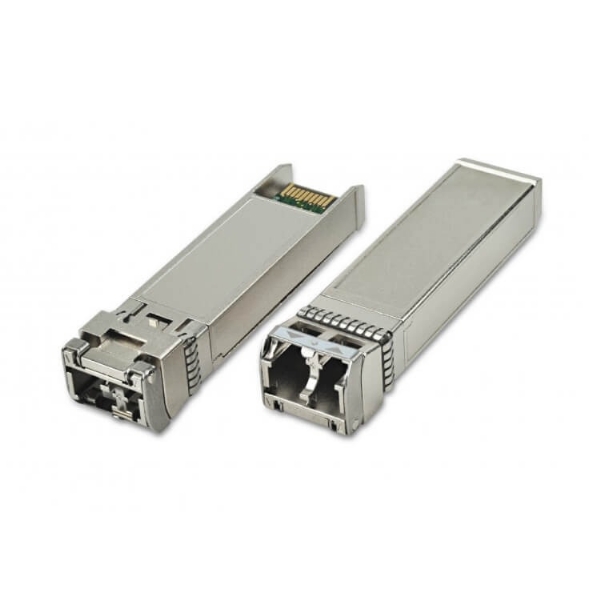
Amplification used to mean a shelf: a chassis, a power feed, a management system and a rack unit or two. Putting an EDFA in a pluggable form factor removes all of that for the cases where a single amplifier at a single point is what you need.
The gains are practical rather than technical. No extra rack space, no separate management domain, no additional power feed, and the amplifier is provisioned by the same team that provisions the port. For a regional link that needs one pre-amplifier to close, that is a substantial simplification.
The constraints are equally practical. Output power and gain are lower than a shelf amplifier, because there is only so much you can do in a pluggable's thermal and electrical envelope. There is no optical protection switching and no sophisticated gain control. And it consumes a switch port that could have carried traffic.
When You Still Need a Shelf
Multiple amplification points. A route with several spans needs in-line amplification at each, and that is a transport system rather than a pluggable.
Optical protection. If the service requires automatic switching to a diverse path, you need equipment that can do it.
High channel counts with per-channel control. Gain flattening and channel power equalisation across a fully loaded C-band is shelf-amplifier territory.
Carrier-grade operations. If a transport team needs the visibility and control of a proper NMS, a pluggable is not going to satisfy them.
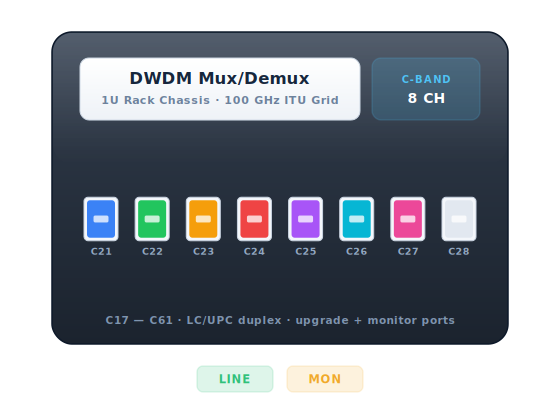
For a single-span data-centre interconnect that is a few decibels short — which is a very common situation — a pluggable amplifier alongside our DWDM mux/demux is frequently the whole solution.
FAQ
Can an EDFA amplify CWDM? No. EDFAs work in the C-band, roughly 1530 to 1565 nm. Only the CWDM channels that fall in that window would be amplified, which defeats the point. This is a structural reason CWDM does not scale to long spans.
Does an amplifier help a link limited by dispersion? No. Amplification adds power; it does nothing about pulse spreading. Check which limit you are actually hitting in the dispersion calculator before buying anything.
Booster or pre-amplifier, if I can only have one? Usually the pre-amplifier. It improves the received signal without adding a span's worth of accumulated noise behind it, and it is not bounded by fibre nonlinearity the way a booster is.
Do coherent pluggables need amplification? 400ZR is specified for an amplified line system, so yes for anything approaching its full reach. The pluggable replaces the transponder, not the line system.