1.6T Optical Interconnect: OSFP-XD, 200G Lanes and What Actually Ships in 2026
Every module generation gets announced as a bandwidth doubling, and every generation the interesting engineering happens one level down: at the lane. 1.6T is not eight more lanes than 800G. It is the same eight lanes running at 200 Gbps each instead of 100. Understanding that one fact tells you most of what you need to know about what to buy, what to keep, and what will break.

Why 200G Per Lane Is the Whole Story
Look at the progression honestly. 100G QSFP28 was 4 lanes of 25G NRZ. 400G moved to 8 lanes of 50G PAM4 — doubling the lane count and switching modulation. 800G kept 8 lanes and pushed each to 100G. 1.6T keeps 8 lanes again and pushes each to 200G.
Two consequences fall straight out of this:
- Fiber count per port has not changed since 400G. Eight lanes means eight TX and eight RX fibers for parallel optics. An MPO-16 trunk bought for 800G SR8 carries 1.6T when you swap the optics on both ends. The glass does not care about the lane rate.
- Electrical signal integrity gets brutally harder. 200G PAM4 per lane means roughly 106 GBaud symbol rates on the host side. Trace loss budgets that were merely tight at 100G/lane become the dominant design constraint. This is the real reason CPO and LPO are being discussed at all — the copper between the ASIC and the faceplate is running out of headroom.
If someone tells you 1.6T requires re-cabling, ask which optic they mean. For parallel short-reach (SR8-class), it does not. For single-mode DR8 it does not either. The trunk survives; the modules and switches turn over.
The SerDes Problem Behind It
It is worth being specific about why 200G lanes are hard, because the answer explains most of the industry's current architectural churn.
A 200G PAM4 lane runs at roughly 106 GBaud. The Nyquist frequency is therefore around 53 GHz, and a printed circuit board trace does not care about your roadmap — insertion loss climbs roughly with the square root of frequency, plus a linear dielectric term. In round numbers, a channel that cost you 10 dB at 100G/lane costs closer to 16–20 dB at 200G/lane over the same physical geometry.
The industry has three levers and is pulling all of them at once:
- Better materials. Ultra-low-loss laminates, smoother copper foil, larger via-free regions. Real gains, but expensive and finite.
- Shorter traces. This is the entire logic of near-package and co-packaged optics — covered in our LPO vs CPO vs NPO guide.
- More DSP. Works, but the DSP is already the largest single consumer of module power, and the thermal budget is the binding constraint.
Nothing about this touches your fiber. It is entirely a copper-and-silicon problem between the ASIC and the faceplate. That is why a cabling team's exposure to 1.6T is far smaller than the headlines suggest — and why the exposure that does exist is concentrated in link margin rather than in connector types.
OSFP-XD vs QSFP-DD1600: Two Answers to the Same Problem
Two form factors carry 1.6T, and they made opposite bets.

OSFP-XD
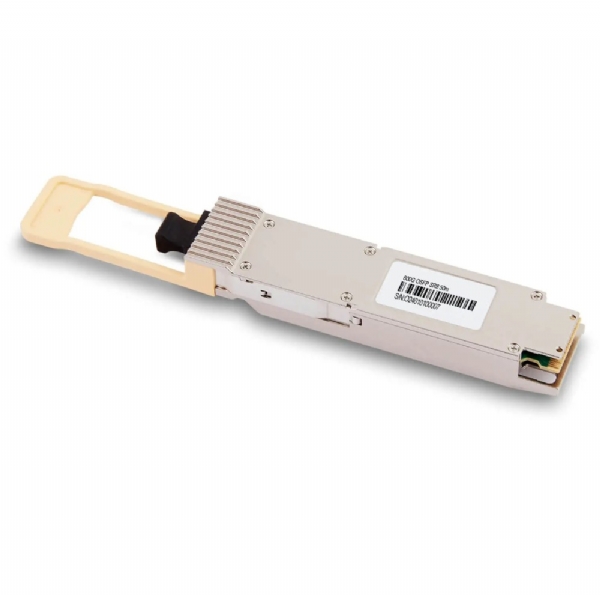
OSFP-XD extends the OSFP mechanical envelope to 16 electrical lanes. Run those at 100G each and you get 1.6T with today's proven 100G SerDes; run them at 200G and you have a path to 3.2T in the same shell. The module is physically larger than QSFP-DD, which sounds like a drawback until you consider the thermals — more surface area, more room for a heatsink, and the OSFP family already supports integrated riding heatsinks.
QSFP-DD1600
QSFP-DD1600 keeps 8 lanes and requires all of them to run at 200G. The advantage is mechanical continuity: same cage geometry as QSFP-DD, same faceplate density, backward compatible with QSFP-DD800 and QSFP28 modules in the same port. The cost is that there is no 100G-SerDes fallback — you need working 200G electrical lanes from day one.
The Thermal Wall
A 1.6T DR8 module dissipates in the 25–30 W range depending on DSP architecture. Put 32 of those in a 2RU switch faceplate and you have 800–960 W of optics alone, in a space that used to hold 150 W of QSFP28s.

Three practical effects you will feel in the field:
- Riding heatsinks become mandatory, not optional. The OSFP form factor was designed with this in mind. QSFP-DD1600 depends far more on chassis airflow design.
- Flat-top vs finned-top module variants stop being cosmetic. Liquid-cooled systems and adapter cards want flat-top; air-cooled switches want finned. Ordering the wrong one means the module physically fits but cooks. NVIDIA's own DAC part numbers carry an explicit
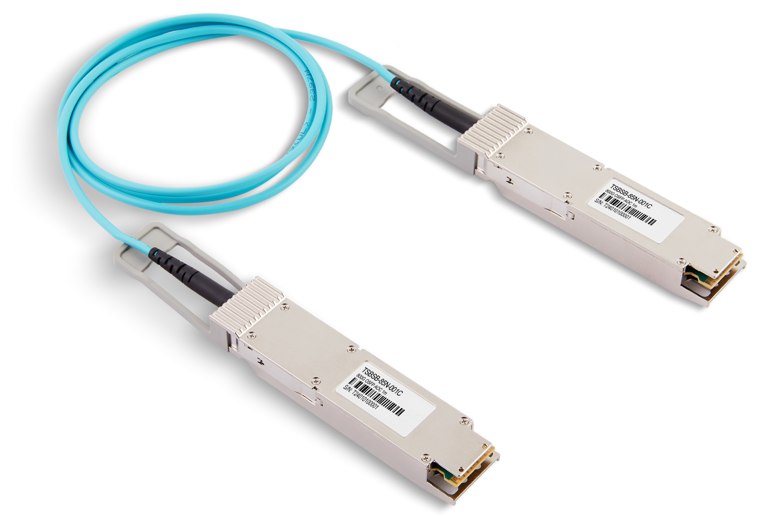
-FLTsuffix for exactly this reason. - Cable bulk affects cooling. A wall of thick 26 AWG DAC in front of a switch blocks the air it needs. This is a real argument for AOC over DAC at 800G and above, even at distances where copper technically works.
There is a second-order effect worth planning for: modules throttle before they fail. A 1.6T optic in an under-cooled cage will typically reduce its own transmit power or raise its FEC workload rather than dropping the link. The symptom you see is not an alarm — it is a fabric that runs 3% slower than the design and nobody can explain why. Read module case temperature via DDM during commissioning and record it as a baseline, not just as a fault threshold.
What One 1.6T Port Can Become
Very few 2026 deployments connect 1.6T to 1.6T. The overwhelming majority of 1.6T ports exist to feed slower endpoints — that is the whole reason to buy the port density.

Two rules govern whether a given breakout is actually available to you:
- The switch OS has to support the grouping. Lane grouping is a software configuration; the cable is passive to this decision. Confirm the platform supports 8x200G before you design around it.
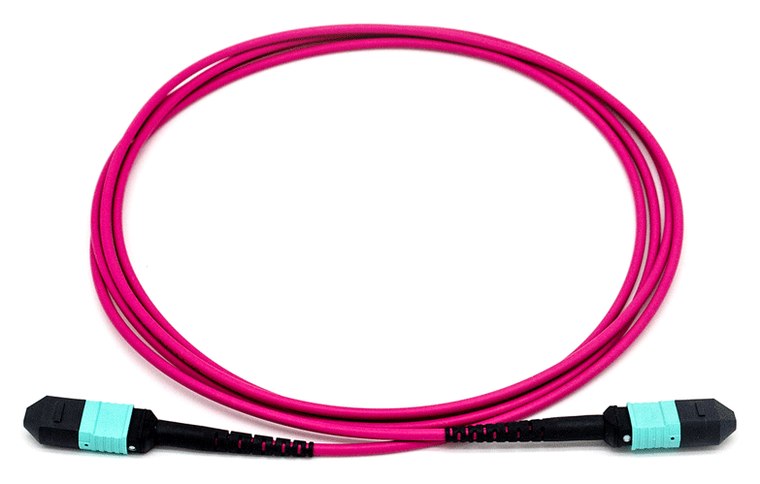
- The fiber plant has to carry the lanes. An 8-way breakout needs all sixteen fibers reaching eight endpoints. An MPO-16 trunk does this in one connector; MPO-12 plant cannot, at any price.
This is the single most common planning error we see: a fabric designed around 1:8 breakout economics, cabled with base-12 trunk, discovered at commissioning.
What This Means for Your Cable Plant
Here is the part most 1.6T coverage skips. Structured fiber has a 10–15 year service life. Optics turn over every 3–4 years. So the question is not "what cable do I need for 1.6T" but "what cable survives 1.6T and whatever comes after".
| Decision | Recommendation |
|---|---|
| Multimode fiber grade | OM4 minimum for new builds. OM5 only if you have a concrete WDM-over-MMF plan — most AI fabrics do not. |
| Parallel connector | MPO-16 for anything 8-lane. Do not install MPO-12 for a fabric that will see SR8 or DR8. |
| Polish on single-mode | APC for anything you might later run coherent over. UPC is fine for DR8/FR8 inside a hall. |
| Trunk fiber count | Over-provision. Pulling fiber is the expensive part; the glass itself is cheap. |
The related read here is our MPO-to-LC breakout guidance — breakout topology matters more at 1.6T because a single port now feeds up to eight endpoints.
1.6T Over Copper: The 3-Metre Reality
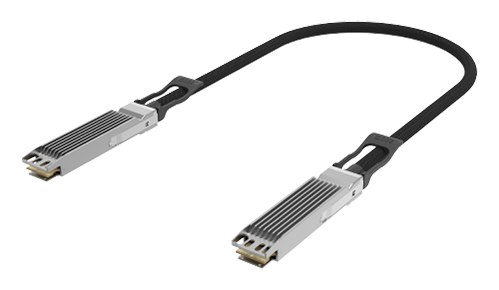
Passive DAC at 200G per lane is genuinely hard. At 800G (100G/lane) passive twinax comfortably reaches 3 m in 26 AWG. Push to 200G/lane and the same gauge gets you roughly 1–2 m before insertion loss and crosstalk eat the eye.
What that means operationally: in-rack 1.6T copper works, adjacent-rack 1.6T copper mostly does not. The 3–10 m band that active DAC used to cover moves to AOC or to active electrical cable with retimers. Budget accordingly — the "copper is cheap" assumption weakens with every lane-rate jump.
For the current generation, our 800G OSFP112 passive DAC covers in-rack runs to 3 m, and the 800G to 2x400G breakout AOC handles the rail-to-node hops that copper can no longer reach cleanly.
Where the Standards Actually Are
Three bodies matter, and their timelines do not align — which is why "1.6T" means slightly different things depending on who is speaking.
| IEEE 802.3dj | The Ethernet task force covering 200G-per-lane electrical and optical PHYs, including 1.6TbE. This is the source of the eventual interoperable optical specs. |
|---|---|
| OIF CEI-224G | The electrical interface work — the common electrical I/O that makes 200G lanes possible between ASIC, retimer and module. Everything else waits on this. |
| MSAs (OSFP, QSFP-DD) | The mechanical and management specifications: cage dimensions, thermal interface, CMIS management. Faster-moving than IEEE, which is why hardware ships ahead of ratified PHYs. |
The practical translation: early 1.6T deployments are MSA-conformant, vendor-validated pairs, not fully interoperable IEEE links. Do not assume any two 1.6T modules will interoperate simply because both say 1.6T on the label. Validate as a pair, on the platform, before volume ordering. This is the same pattern the market went through at 400G and it resolves the same way — but not before you have bought your first tranche.
A Migration Path That Does Not Waste Money
A sane sequence for an operator sitting on 400G today:
- Freeze your connector standard now. MPO-16 on parallel, LC or a chosen VSFF type on duplex. Mixed plant is what actually costs money later.
- Buy trunk fiber for two generations ahead. Fiber count, not fiber grade, is where people under-buy.
- Keep DAC to in-rack only. Do not build a 5 m copper habit you will have to unwind.
- Let the switch decide the module form factor. There is no prize for standardising on OSFP-XD if your next switch ships QSFP-DD1600 cages.
- Validate coding and thermals per platform. A 1.6T module that links up but throttles is worse than one that fails cleanly.
FAQ
Can I run 1.6T over the MPO-16 trunk I installed for 800G?
Yes, for parallel short-reach optics. 800G SR8 and 1.6T SR8 both use 8 TX + 8 RX fibers. Verify your trunk's insertion loss budget still fits — 1.6T link budgets are tighter, so a marginal channel that passed at 800G may not.
Is OSFP-XD backward compatible with OSFP?
Mechanically the XD variant is a distinct, larger envelope. Do not assume an OSFP-XD module drops into an OSFP cage. Check the switch datasheet for the specific cage type.
Do I need OM5 for 1.6T multimode?
No. 1.6T SR8 is 8 parallel lanes at 850 nm — it does not use the wideband window OM5 provides. OM4 is the practical choice unless you have a specific SWDM roadmap.
How far does 1.6T passive copper actually go?
Plan for 1–2 m at 200G per lane in production, with 3 m achievable only in short, well-controlled channels. Treat anything beyond in-rack as an optical problem.