MPO-12 vs MPO-16: The Connector Choice That Decides Your 400G/800G Breakout
Two connectors look nearly identical in a tray. One has twelve fibers, one has sixteen. Choose wrong and you either strand a third of your trunk capacity or find that your new 800G optics will not accept a single-connector patch at all.

Same Body, Different Fiber Count
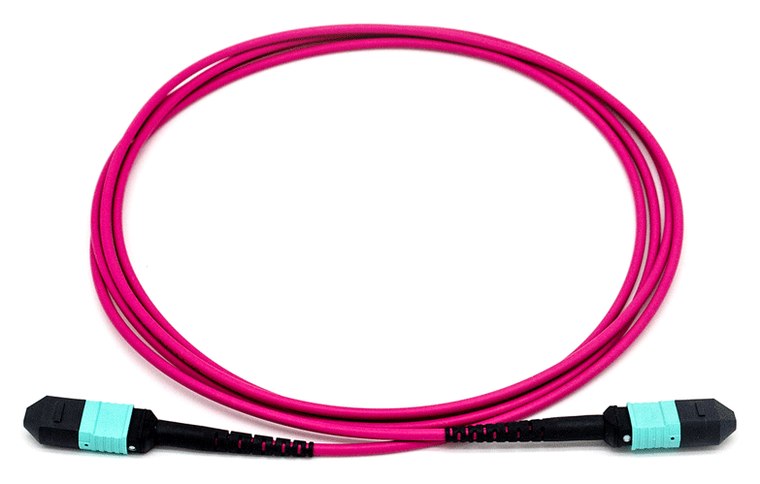
MPO-12 and MPO-16 share the same connector footprint, latch and general handling. Inside, the ferrule holds a single row of either twelve or sixteen fibers. Everything else — polish type, polarity conventions, cleaning procedure — carries over.
The difference only matters when you map optics onto fibers.
How We Ended Up With Both
MPO-12 came first, from a telecom ribbon heritage where twelve fibers was the natural unit. When 40G SR4 and 100G SR4 arrived, they needed 4 TX + 4 RX = 8 fibers. Engineers used an MPO-12 and left the middle four unused. Slightly wasteful, but the connector already existed and the ecosystem was mature.
Then 400G and 800G moved to eight lanes. Now you need 8 TX + 8 RX = 16 fibers — four more than an MPO-12 can carry. Two options: use two MPO-12s per port, or use one MPO-16. MPO-16 won for new designs, and that is why SR8-class optics present a single MPO-16 interface.
Which Optic Needs Which Connector
| Optic | Lanes | Fibers needed | Connector |
|---|---|---|---|
| 40G SR4 | 4 | 8 | MPO-12 — 4 fibers idle |
| 100G SR4 | 4 | 8 | MPO-12 — 4 fibers idle |
| 400G DR4 / SR4 | 4 | 8 | MPO-12 — breaks out to 4x100G |
| 400G SR8 | 8 | 16 | MPO-16 (or 2x MPO-12 on older designs) |
| 800G SR8 / DR8 | 8 | 16 | MPO-16 — all 16 used |
| 1.6T SR8 / DR8 | 8 | 16 | MPO-16 — same fibers, faster lanes |

Look at the third row of that figure carefully, because it is the one that costs money. An 800G DR8 needs sixteen fibers. A twelve-fiber trunk does not carry it — not with a penalty, not at reduced performance, but at all. You need two trunk paths and a cassette arrangement to recombine them, and now a single link depends on two connectors staying in the correct order.
Breakout: Where It Really Bites
Straight port-to-port links are forgiving. Breakout is where the fiber count decides what is physically possible.
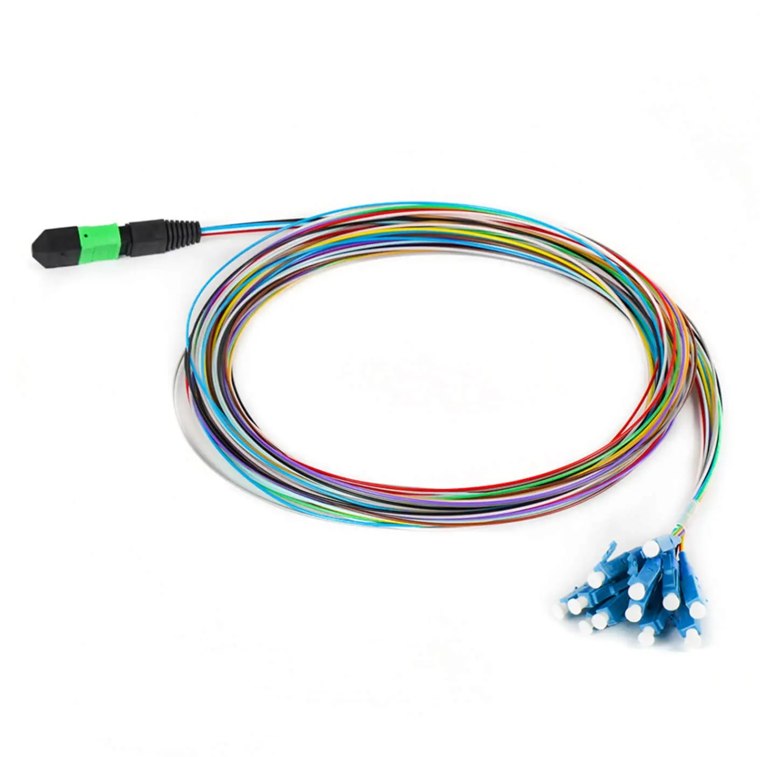
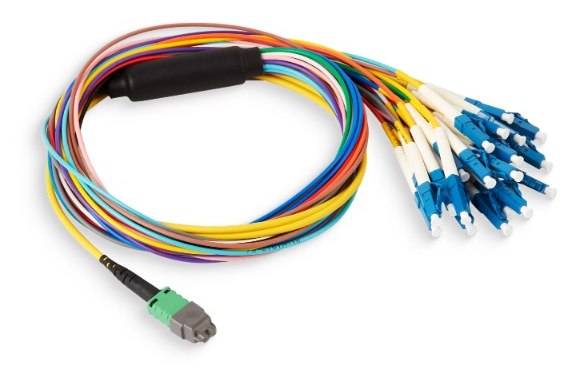
An 800G DR8 port breaking out to 8x100G needs all sixteen fibers reaching eight separate duplex endpoints. That is a native MPO-16 to 8x LC harness. Attempt it through MPO-12 infrastructure and you need two connectors, two trunk paths, and a cassette arrangement that keeps lane order correct on both — doable, but you have just doubled your connector count and your chances of a polarity mistake.
Compare that with a 400G DR4 breaking out to 4x100G: 8 fibers, one MPO-12, one MPO-to-LC harness, done.
This is the practical reason to install MPO-16 in any fabric that will see eight-lane optics — not because MPO-12 cannot carry the light, but because the breakout topology gets ugly fast.
Base-8 Structured Cabling
There is a third convention worth knowing: base-8 systems, where trunks are built in multiples of 8 fibers rather than 12. Corning's EDGE8 is the best-known commercial example, and the logic is sound — if your optics consume fibers in groups of 8, a trunk built in groups of 8 has zero stranded fibers.
Base-12 systems, by contrast, always leave a remainder when feeding 8-lane optics. On a 144-fiber trunk that is real money sitting idle.

The loss argument is the one that actually decides projects. A 400G DR4 link has roughly 3 dB of channel budget. Each conversion cassette costs you a mated pair — call it 0.35 dB with good components — and a base-12 path needs two of them where base-8 needs none. Spending 0.7 dB of a 3 dB budget on cassettes that exist purely to solve an arithmetic mismatch is a hard thing to defend in a design review.
A note on the commercial landscape, since the terminology gets used loosely. Base-8 is a design principle, not one vendor's product. Corning markets it as EDGE8 within a wider EDGE / Pretium EDGE pre-terminated ecosystem, and other manufacturers ship equivalent base-8 trunk, module and harness families under their own names. What matters when you specify is the fiber grouping and the polarity method, not the trade name — and any competent supplier, ourselves included, will build MPO trunks and harnesses to a base-8 fiber map on request.
If you are designing a greenfield fabric around parallel optics, base-8 or MPO-16 native both avoid the stranding problem. If you have existing base-12 plant, conversion trunks let you interoperate — at the cost of that extra connector pair in the loss budget.
Polarity Still Applies
Changing fiber count does not exempt you from polarity discipline. Type A, B and C conventions work the same way on MPO-16 as on MPO-12 — you still need TX at one end to land on RX at the other, consistently, across every trunk, cassette and jumper in the channel.
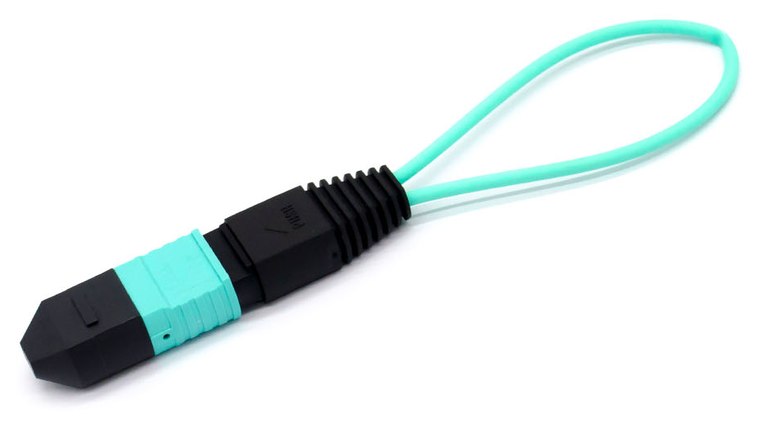
Our full treatment is in MPO/MTP polarity explained. The short version for mixed-count plant: document your convention before you order, not after the link fails, and keep an MPO loopback in the toolkit for isolating polarity faults from optic faults.
Buying Rules
- Check the optic first. The transceiver datasheet states the connector. Everything follows from that.
- New parallel-optics fabric? MPO-16. Do not install MPO-12 trunk for a fabric that will see SR8 or DR8 within its service life.
- Existing MPO-12 plant with 8-lane optics coming? Plan conversion points. Cassettes at the patch panel, not adapters mid-span.
- Do not mix counts inside one channel. A trunk that changes fiber count mid-path is a documentation problem waiting to become an outage.
- Buy low-loss. Eight-lane optics have tighter budgets than four-lane, and LPO-based systems tighter still.
FAQ
Can I plug an MPO-12 connector into an MPO-16 adapter?
Mechanically it may enter, but the fiber positions do not align as intended and you will not get a working 8-lane link. Treat them as incompatible.
Is MTP the same as MPO?
MTP is US Conec's branded, tightened-tolerance implementation of the MPO standard. MTP connectors are MPO connectors — usually better ones.
Do I need MPO-16 for 400G DR4?
No. DR4 is four lanes — 4 TX + 4 RX = 8 fibers, which fits an MPO-12 comfortably.
What about MPO-24?
Two rows of twelve. Used in high-density trunk applications rather than as a direct transceiver interface. Handling and cleaning are noticeably harder; specify it only where fiber density genuinely demands it.