Choosing 800G Optics: SR8, DR8, 2xFR4 and 2xLR4 by Reach
An 800G module list looks like six products. It is really two products with three reach settings each, and the choice between the two is made on the day you pull cable, not on the day you buy optics.
Everything in an 800G port comes down to eight lanes of roughly 100 Gb/s PAM4. What differs between the PMD families is where those eight lanes go once they leave the electrical interface: onto eight separate fibre pairs, or combined four-at-a-time onto shared pairs. That single decision fixes the connector, the trunk you have to install, the reach you can reach, and how the port can be broken out.
Module price is the least interesting variable in the comparison, and the one buyers spend the most time on. What follows ranks the classes by the thing that actually costs money over five years: the cable plant each one obliges you to own.
The First Fork Is Not Reach
Before any distance question, answer this one: is this link inside a hall on multimode fibre, or is it on single-mode?
Multimode 800G means VCSEL arrays at 850 nm and a strict, short reach that gets shorter every generation. Single-mode 800G means 1310 nm lasers, reaches from 500 m to 10 km, and a plant that will still be useful at 1.6T and beyond.
The honest position in 2026 is that multimode 800G is a narrower proposition than multimode 100G was. At 100G per lane the multimode reaches — set in IEEE 802.3db-2022 and carried into 802.3df-2024 for the eight-lane 800G parts — are 60 m on OM3 and 100 m on OM4 for the SR class, and 30 m and 50 m for the shorter VR class. Those are real distances inside a row and marginal distances across a hall. Meanwhile a 500 m single-mode DR8 costs a modest premium over SR8 and never has to be replaced because a row moved. If you are building new, look hard at whether multimode earns its place before you cable for it — the single-mode versus multimode comparison sets out the full argument.
If you already have an OM4 plant with life in it, multimode 800G is a perfectly sound way to use it. Just measure the actual channel lengths first, and check them against the numbers below rather than against the reaches you remember from 100G.
The Actual Reach Numbers

| Class | Fibre | Reach | Lanes on fibre | Connector | Breakout |
|---|---|---|---|---|---|
| 800GBASE-VR8 | OM3 / OM4 | 30 m / 50 m | 8 pairs, parallel | MPO-16 or 2×MPO-12 | 2×400G VR4, 8×100G |
| 800GBASE-SR8 | OM3 / OM4 | 60 m / 100 m | 8 pairs, parallel | MPO-16 or 2×MPO-12 | 2×400G SR4, 8×100G |
| 800G DR8 / 2×DR4 | OS2 | 500 m | 8 pairs, parallel | MPO-16 APC or 2×MPO-12 APC | 2×400G DR4, 8×100G DR |
| 800G DR8+ / DR8-2 | OS2 | 2 km | 8 pairs, parallel | MPO-16 APC or 2×MPO-12 APC | 2×400G DR4-2 (per-lane 100G only at DR reach) |
| 800G 2×FR4 | OS2 | 2 km | 2 pairs, 4 wavelengths each | 2×duplex LC | 2×400G FR4 only |
| 800G 2×LR4 | OS2 | 10 km | 2 pairs, 4 wavelengths each | 2×duplex LC | 2×400G LR4 only |
Three notes on reading that table.
The VR and SR split is real and is often ignored. VR8 and SR8 are the same technology at different specified reaches, and vendors sometimes sell a VR-class part into an SR-class application because "50 m is basically 100 m". At 100G per lane on multimode it is not. Measure the channel, add the patch cords at both ends, and buy for the measured length.
DR8+ is not a different PMD, it is a better one. The 2 km variants use the same eight parallel single-mode lanes with more launch power and better receivers. That matters commercially: a DR8+ plant is a DR8 plant, so if there is any chance of a 2 km run appearing, cable for parallel single-mode and change only the module.
2×FR4 and 2×LR4 are two modules in one shell. Each duplex LC pair carries a complete 400GBASE-FR4 or LR4 signal with its four wavelengths multiplexed together. They break out into 2×400G and no further — the breakout guide explains exactly why WDM lanes cannot be separated at a connector.
Fibre Count and Connectors
Per 800G port, the glass looks like this:
- Parallel classes (VR8, SR8, DR8, DR8+): 16 fibres. Either one MPO-16, or two MPO-12s in which positions 1–4 are TX, 5–8 are dark and 9–12 are RX — 8 usable fibres per connector.
- WDM classes (2×FR4, 2×LR4): 4 fibres. Two duplex LC pairs, and each pair carries four wavelengths.
That is a factor of four in fibre count for the same 800 gigabits, and it is the largest single difference between the two families. Across a thousand-port fabric it is the difference between 16,000 and 4,000 fibres arriving at a patch field, with all the trunk, tray, panel and termination labour that implies. Put your own numbers into the MPO cabling planner before deciding — the module price delta is frequently smaller than the plant delta.
The MPO-16 against twin MPO-12 choice deserves its own thought. Twin-port modules land on an existing base-12 plant unchanged, which is why they dominate where 400G infrastructure already exists. MPO-16 halves the number of connectors to inspect and clean and is where the industry is heading for 8-lane and 16-lane optics. Both are correct; committing to one per plant is what matters. Our MPO-12 and MPO-16 article has the position maps.
Power and Thermal, Class by Class

The interesting result here is a negative one: reach class barely affects power at 800G. Published maxima run around 14.5 W for a 2×FR4, 16 W for a VR8, 17 W for a DR8 and 18 W for a 2×LR4. The DSP dominates, and every one of these classes runs the same class of DSP.
The consequences are practical rather than dramatic. A fully populated 32-port 800G switch is dissipating roughly half a kilowatt in optics alone regardless of which class you chose, and that heat has to leave through the faceplate. Two things follow. First, thermal headroom is a switch and airflow problem, not a module-selection problem — check it in the power and thermal calculator against your actual inlet temperature. Second, a module running hot reports it: watch DDM case temperature, because the failure mode at the top of the range is not a dead module but a link that flaps on a warm afternoon.
Where power genuinely differs is one step down the reach ladder. A passive DAC for an in-rack link draws essentially nothing and needs no DSP at all. Every in-rack link you keep on copper is roughly 30 W of optics and cooling you never have to buy.
What Each One Costs You in Cable Plant
Ranked by total installed cost rather than module price, the order changes.
Cheapest plant: 2×FR4 and 2×LR4. Four fibres and LC connectors. If you already have duplex single-mode structured cabling and LC patching, these classes drop into it with no new trunk at all. For campus and building-to-building links at 2 km and 10 km they are usually the only sensible answer.
Most future-proof plant: DR8 and DR8+. Sixteen fibres of OS2 parallel single-mode. Expensive to install, and then it serves 400G, 800G and 1.6T DR-class optics without being touched. In a fabric you expect to upgrade twice, this is the one that amortises.
Cheapest modules, most constrained plant: VR8 and SR8. Sixteen fibres of multimode, and a reach that shrinks at the next lane rate. Correct where the plant already exists and the distances are genuinely short. A poor choice for a greenfield hall you expect to still be running in 2032.
No plant at all: DAC, AOC and AEC. For links inside a rack or between adjacent racks, the cheapest 800G link is not an optic. Compare properly using the cost-per-port framework before defaulting to optics for a two-metre hop.
Choosing, in Order
Five questions. Stop at the first that answers.
- Under 2 m? Passive DAC. No optic required — that is the 100G-per-lane objective, and 800G passive assemblies beyond it are vendor territory.
- Inside a hall on existing multimode, measured under 100 m on OM4? SR8, or VR8 if measured under 50 m. Verify the measurement.
- Inside a hall or campus, new plant, up to 500 m? DR8 on parallel single-mode. This is the default for AI fabrics.
- Up to 2 km? DR8+ if you already have parallel single-mode, 2×FR4 if you have duplex. The existing plant decides, not the optic.
- Up to 10 km? 2×LR4 on duplex single-mode. Beyond that you are into coherent territory.
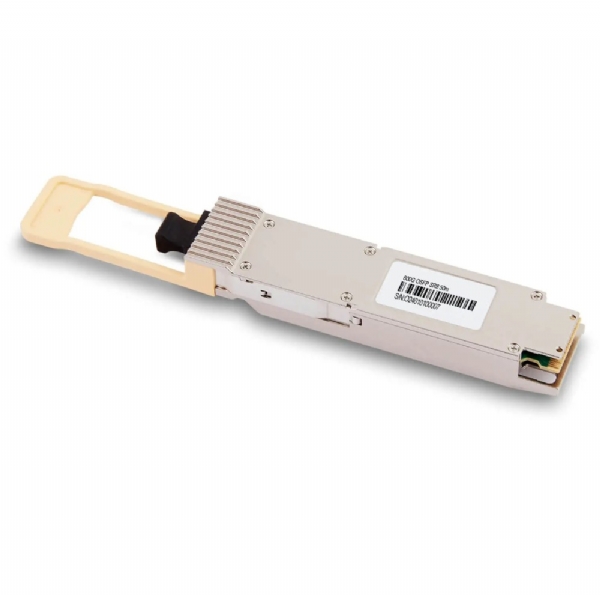
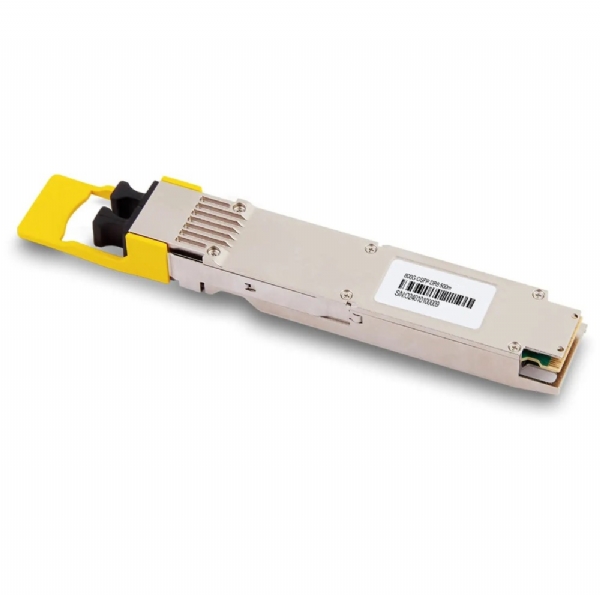
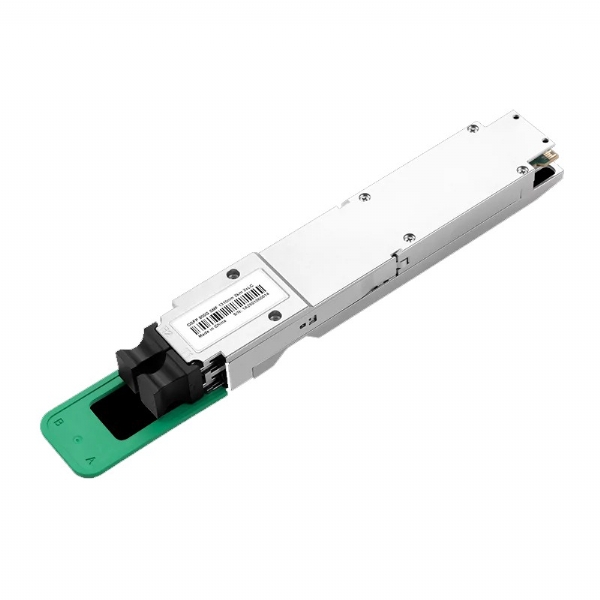
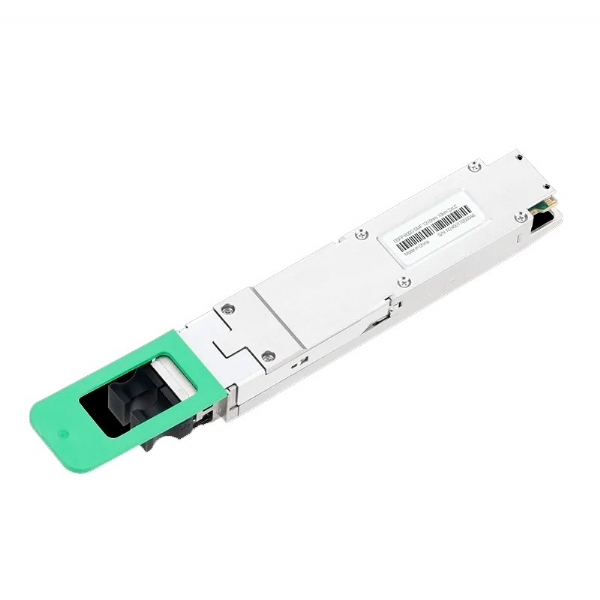
We manufacture all six classes in Shenzhen in OSFP and QSFP-DD800, including the twin-port MPO-12 and single MPO-16 variants of the parallel classes, and code each one to the exact switch platform and software release you name on the order. Every module is traffic-tested in the target platform before dispatch, and where you are also buying the plant from us, every fibre in every trunk and harness is measured individually so that the module and the channel arrive already known to match.
FAQ
Is 800GBASE-SR8 the same as 2×400G SR4? Mechanically and optically yes — eight parallel 100G multimode lanes. The name differs by whether the host groups them as one port or two. A twin-port module with two MPO-12s makes that grouping physical.
Can I use a DR8 over a 100 m link? Yes. Single-mode reaches are maxima, and there is no minimum that matters at these power levels for DR-class optics. It costs a little more than SR8 and buys you a plant that survives the next two upgrades.
Do I need APC on single-mode parallel? Yes. DR-class parallel single-mode specifies angled MPO, and the whole channel must be APC end to end. Multimode parallel remains flat-polish. Mixing them costs typically well over a decibel per mated pair and ruins the return loss.
What about 800G ZR for long haul? Different technology entirely — coherent rather than direct detection, single wavelength, tens to hundreds of kilometres. It does not compete with any class in this article.
Which class does an AI fabric usually want? DR8 or 2×DR4 for leaf-to-spine, and passive DAC inside the rack. The parallel single-mode plant is what makes the 1.6T upgrade a module swap instead of a re-cable.