Reading Optics Part Numbers: SR, DR, FR, LR, ER, ZR Decoded
A transceiver's name is the only interoperability contract that exists. The vendor logo links to nothing; the standard name does. Two modules built by companies that have never spoken will pass traffic if and only if the letters and digits after BASE- agree — and the fibre in the ground has to have been bought against those same letters years earlier.
The trouble is that the scheme grew by accretion across twenty-five years of amendments, absorbed MSA names IEEE never wrote, then acquired vendor part numbers on top. So "DR4" and "FR4" look like siblings and behave nothing alike, the 4 in SR4 counts something entirely different from the 4 in LR4, and one of the most deployed letters — Z — is not in IEEE 802.3 at all.
This is the decoder. For a single standard, the Ethernet optical standard lookup returns the wavelength plan, fibre type, connector, reach and loss budget directly. To read a name you have not seen before, read on.
How a Standard Name Is Built
An IEEE 802.3 port type is written as rate + BASE + medium/reach letter + coding letter + lane count. Most of the industry's confusion comes from reading that as three fields instead of five.

The rate is the MAC data rate — payload, not line rate. A 400G port carries 400 Gb/s of Ethernet across four lanes of PAM4, and the gap between those two numbers is coding and FEC overhead. BASE means baseband signalling, has appeared in every Ethernet name since 10BASE5, and tells you nothing you can act on.
The next letter is the medium and reach class — the field that decides what fibre you need and how far you can go. That is the table below.
Then a coding letter. R means the 64B/66B physical coding sublayer, used by every serial Ethernet PHY from 10G upward; X meant 8B/10B, which is why 1000BASE-SX is spelled with an X. On anything modern the letter is always R, which is exactly why people stop seeing it and read "SR" and "DR" as indivisible words. They are not: S and D are the reach letters and the R is the same R in both. The lane digit comes last, and its meaning changes from name to name.
Every Reach Letter and What It Buys
The whole alphabet, with reaches as IEEE specifies them.
| Letter | Meaning | Wavelength plan | Reach | Fibre |
|---|---|---|---|---|
| V | Very short reach multimode | 850 nm VCSEL | OM3 30 m / OM4 50 m | Parallel MMF, one pair per lane |
| S | Short reach multimode | 850 nm VCSEL | 10G: OM3 300 m / OM4 400 m. 25G and 50G lanes: 70 / 100 m. 100G lanes: 60 / 100 m | Parallel MMF, one pair per lane |
| D | 500 m parallel single-mode | 1310 nm, the same wavelength on every fibre | 500 m; the 2 km builds are DR+ in the market, -2 in IEEE | Parallel OS2, one pair per lane |
| F | 2 km single-mode | 1310 nm region; CWDM 1271/1291/1311/1331 nm with four lanes | 2 km | Duplex OS2 |
| L | 10 km single-mode | CWDM 1271–1331 nm at 40G and 400G; LAN-WDM 1295.56–1309.14 nm at 100G and 200G LR4 | 10 km; 400GBASE-LR4-6 is the 6 km IEEE variant | Duplex OS2 |
| E | Extended reach | LAN-WDM around 1310 nm at 100G; CWDM at 40G | 40 km (the ER4-Lite variant is 30 km, 40 km only with FEC) | Duplex OS2 |
| Z | About 80 km — an IEEE letter only at 100G | 1550 nm; DWDM and coherent at 400G | 80 km, usually with amplification | Duplex OS2 |
| C | Twinaxial copper cable assembly | None | 5 m at 25G per lane, about 1 m at 200G | Twinax |
| K | Backplane | None | About 1 m of circuit board | PCB |
| T | Twisted pair | None | 30–100 m | Balanced copper |
One entry deserves more than a row. Z is an IEEE letter in exactly one place. 100GBASE-ZR is a real published PMD — IEEE Std 802.3ct-2021, coherent, 80 km over a DWDM system. Everything else wearing the letter is convention: 10GBASE-ZR, 40GBASE-ZR4 and the direct-detect 100G ZR4 are names every vendor honours and no standard defines. At 400G, IEEE started P802.3cw, 400 Gb/s over DWDM systems, and withdrew the PAR in May 2024 — leaving 400ZR where it began, in the OIF implementation agreement and the OpenZR+ MSA. Specify which document your ZR module claims conformance to, because 400ZR and ZR+ are genuinely different things.
The ladder from 30 m to 80 km is clean, and the 200G-per-lane generation is already bending it: in the draft P802.3dj the 2 km objective is met by 800GBASE-DR4-2 rather than by anything called FR. That draft was at D3.1 in May 2026 and is not yet a published amendment, so treat those names as provisional — but when convention and a published amendment disagree, the amendment wins.
The Digit That Means Two Different Things
In 100GBASE-SR4 the 4 counts fibre pairs. In 100GBASE-LR4 the 4 counts wavelengths. Same digit, same position, completely different consequence for everything downstream.

The rule: V, S and D are parallel; F, L and E are wavelength-multiplexed — with the exception that a single-lane F or L, such as 100GBASE-FR1 or 100GBASE-LR1, has nothing to multiplex and runs one wavelength on one pair. Three things follow from which side of that line a module sits on.
Fibre count. An SR4 or DR4 consumes eight fibres, which is why they land on an MPO connector: positions 1–4 transmit, 5–8 dark, 9–12 receive. An LR4 or FR4 consumes two, on a duplex LC. For the same 400 Gb/s one needs four times the glass, and across a hall of trunks that is the dominant cost.
Whether it can break out. A parallel PMD fans out into independent child links because each lane already exists alone on its own pair. A WDM PMD cannot, at any price, because there is no connector position at which one lane exists by itself. The DR4 versus FR4 versus LR4 comparison covers why two standards at nearly the same reach made opposite choices; the breakout guide covers what to do about it.
What the optics cost to build. A parallel module is four identical uncooled lasers and no filters; a WDM module is four wavelengths plus a multiplexer and demultiplexer. Parallel is cheaper per module and dearer per metre of plant, and the crossover is usually a few hundred metres.
The Names IEEE Never Defined
Some of the highest-volume optics ever shipped have names in no IEEE amendment. IEEE standardises to a requirement; the market periodically wants something between two, and an MSA fills the gap.
100G PSM4 is 500 m of parallel single-mode at 1310 nm on eight fibres — a 100G DR4 before DR existed — written because LR4 at 10 km was expensive overkill for a data centre and SR4 at 100 m was not enough. A PSM4 module is still the cheapest way to cross 500 m at 100G.
100G CWDM4 is 2 km on duplex fibre using the 1271/1291/1311/1331 nm CWDM grid — effectively a 100GBASE-FR4 written a decade before IEEE got there. A CWDM4 module and a PSM4 module both do 100G over single-mode and are interchangeable in no respect: different fibre count, connector and reach. The SR4 versus PSM4 versus CWDM4 comparison is worth reading before an order — this is the most common mis-buy at 100G.
eSR4 is "extended SR4": the same 850 nm parallel optics with a better power budget. At 40G it reaches 300 m on OM3 and 400 m on OM4 against SR4's 100 m and 150 m; the 100G eSR4 part is a more modest 200 m and 300 m. SWDM4 puts four wavelengths on one multimode pair, which is what SWDM exists to do, and BiDi does it with two wavelengths on two fibres — which is why a BiDi module drops into an existing duplex multimode cord with no re-cabling.
None of these are inferior. They are bilateral: an MSA module interoperates only with another of the same MSA, so both ends of a link must be specified together and stay that way through every replacement.
Prefixes and Suffixes: 2x, -2, -S, -Lite
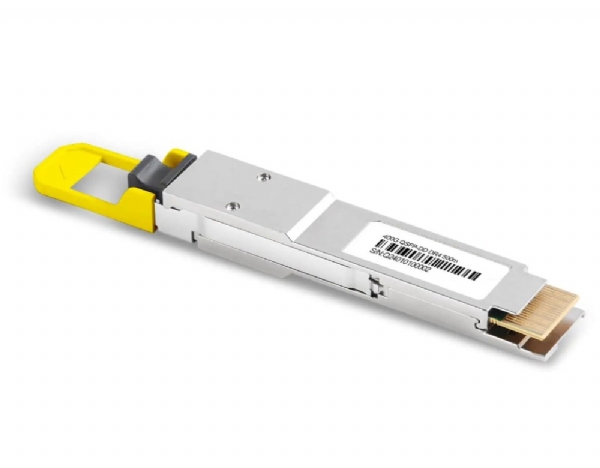
The 2x prefix on 800G. An 800G 2xDR4 or 2xFR4 is two complete 400G optical engines behind one faceplate; an 800GBASE-DR8 is eight lanes of one PMD. Both carry 800 Gb/s, and only the second is a single Ethernet port in the IEEE sense. Practically, the prefix tells you the connector will be two MPO-12s or two duplex LCs rather than one MPO-16 — which is what choosing among the 800G reach classes turns on.
The -2 suffix. The draft P802.3dj way of saying "the same PMD, further". 800GBASE-DR4-2 and 1.6TBASE-DR8-2 are the 2 km versions of the 500 m DR4 and DR8. The market got there first and calls the same idea DR4+ or DR8+, so you will see both spellings quoted for one part.
-Lite. A de-rated variant of a real standard — the same optical class with a specification reduced somewhere. 100G ER4-Lite reaches 30 km unamplified and 40 km only with FEC, where full ER4 does 40 km on its own; CWDM4-Lite trades case-temperature range for cost. The name says a corner has been cut deliberately, and you need to know which corner.
-S and friends. Cisco part numbers carry SR4-S, PSM4-S, CWDM4-S, LR-S and ZR4-S, and Cisco's own ordering guides list them without ever defining the suffix. Treat that as instruction: match the IEEE or MSA name and the platform coding, and let the trailing letter be a stock code.
Turning a Vendor Part Number Into a Standard
A vendor part number is a stock-keeping string that happens to contain the standard. To buy a compatible part you extract four fields and ignore the rest.
1. The form factor — QSFP28, QSFP-DD, OSFP, SFP28 — almost always the leading token, and the field with no flexibility. 2. The aggregate rate — 100G, 400G, 800G. 3. The PMD — SR4, DR4, FR4, LR4, CWDM4, PSM4 — the field this article is about, and the one that must match the far end and the fibre plant exactly.
4. The platform to code for. Not in the part number at all: it is the switch make, model and software version the module will live in. That determines the EEPROM coding, and it is the field most often left off an enquiry. The unsupported-transceiver guide covers what happens when it is.
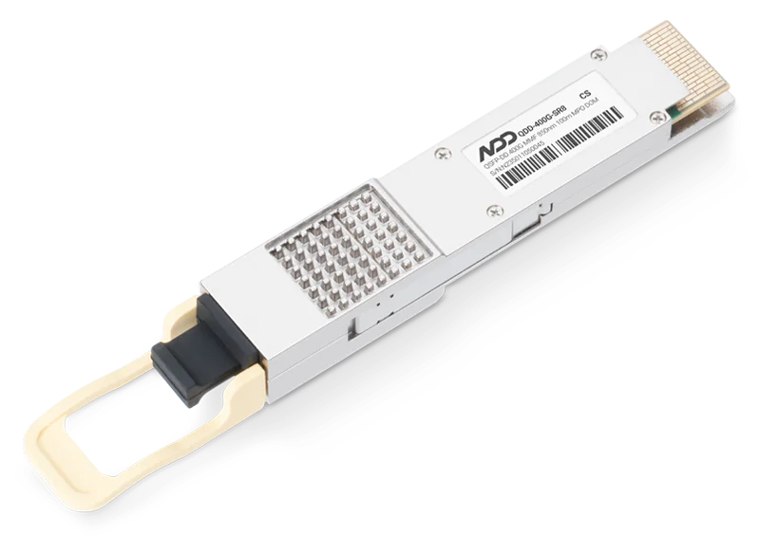
So QDD-400G-DR4-S resolves to QSFP-DD, 400 Gb/s, 400GBASE-DR4 — the same optics as a 400G QSFP-DD DR4 from anyone, on an MPO-12 APC over 500 m of OS2. Once you can do that translation you are no longer buying a vendor's part; you are buying a standard and asking for it to be labelled correctly.
Two habits make it safe. Put the standard name, not the vendor part number, on the cabling drawing — the drawing outlives the switch. And check the resolved standard in the standard lookup before the order goes out, so reach, connector and fibre type agree on paper and in the ground.
We build to that translation for a living. Tell us the switch platform and software version, the standard, and the fibre already in the ground, and we will build and code the module in Shenzhen to suit — including the MSA classes IEEE never wrote. Every module is traffic-tested in the target platform before it ships, which is the only way to know the coding is right rather than hope it is.
FAQ
Will an SR4 link to an SR4 from a different manufacturer? Yes — that is what the standard name is for. Coding decides whether the host accepts the module; the letters decide whether the optics interoperate. Separate questions.
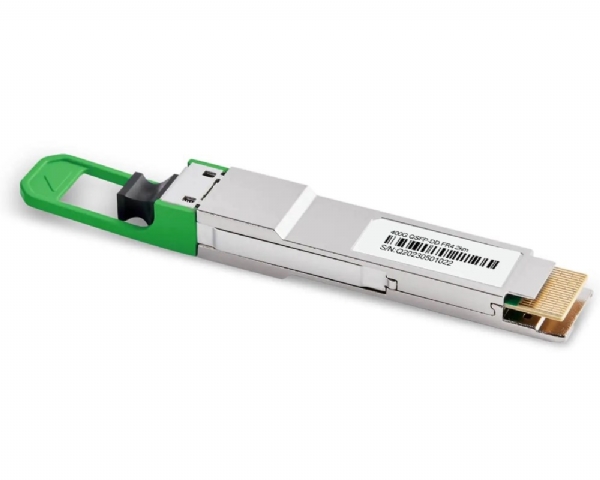
Is DR4 just a shorter FR4? No, and this is the most expensive misreading in the list. DR4 is four fibre pairs of parallel single-mode on an MPO; FR4 is four wavelengths on one duplex LC pair. Different cable plant, no mixing end to end.
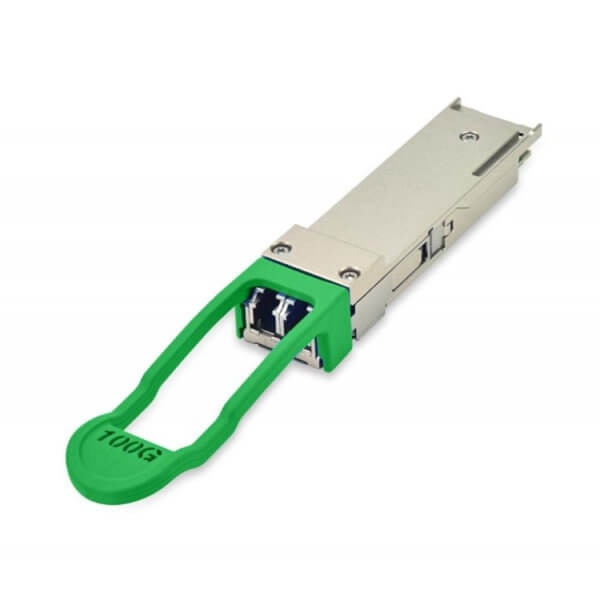
Why do 40GBASE-LR4 and 100GBASE-LR4 use different wavelengths? 40GBASE-LR4 uses the 20 nm CWDM grid; 100GBASE-LR4 uses the much tighter LAN-WDM grid at 1295.56–1309.14 nm, because four 25G lanes tolerate less chromatic dispersion spread over 10 km than four 10G lanes. Same letter, same digit, different optics.
What does the digit mean in 800GBASE-CR8? Electrical lanes — eight differential pairs in each direction through the twinax. Copper names have no fibre to count, so the digit always counts lanes.
When do the reach letters stop being reliable? At 200G per lane and above, read the amendment. The ladder describes 10G to 100G per lane well, and IEEE has already deviated once by using DR4-2 for the 2 km objective.