CWDM vs DWDM Mux/Demux: How to Actually Choose
"CWDM or DWDM?" is the question that arrives, and it is almost never really a question about channel count. Channel count is the easiest thing to change your mind about later. What you cannot change later, without replacing every optic on the link, is whether the wavelengths you chose can be amplified — and that decision is made the moment you pick a grid.
This article walks the five things that actually decide whether a CWDM or DWDM link closes: the grid, the insertion loss, the fibre already in the ground, chromatic dispersion, and amplification. It ends with the specification lines that stop the wrong module arriving.
Two Grids, and What the Spacing Really Buys
Both schemes are defined by ITU-T, and the two recommendations are worth reading as a pair because they answer the same question with opposite priorities.
ITU-T G.694.2 defines the CWDM grid: 18 channels from 1271 to 1611 nm, spaced 20 nm apart. Twenty nanometres is an enormous gap, and that is the entire point. An uncooled DFB laser drifts roughly 0.08 nm per °C; across an industrial temperature range that is several nanometres of wander. A 20 nm channel accommodates it, so the laser needs no thermo-electric cooler, no wavelength locker, and no closed-loop control. The optic gets cheaper, smaller and lower-power, and the filter gets cheaper too because a wide passband is easy to make.
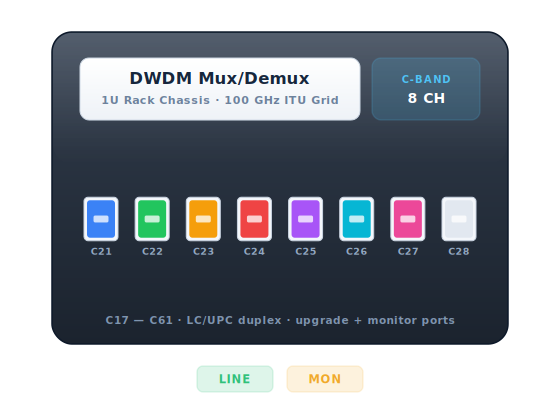
ITU-T G.694.1 defines the DWDM grid, anchored at 193.1 THz with channel spacings of 100, 50, 25 or 12.5 GHz. Channels sit at f = 193.1 + n × Δf. At 100 GHz that is about 0.8 nm of separation; at 50 GHz, about 0.4 nm. The 2012 revision added the flexible grid, where the central frequency moves in 6.25 GHz steps and the slot width comes in multiples of 12.5 GHz — which is how a 400G or 800G coherent carrier gets a 75 or 150 GHz slot of its own instead of being forced into a fixed 50 GHz box.
Note that DWDM is specified in frequency and CWDM in wavelength. That is not arbitrary: frequency spacing stays constant across the band while wavelength spacing does not, and coherent systems care about frequency. If you are converting between the two, the wavelength and frequency converter does it exactly rather than with the usual 0.8 nm approximation.

The row that decides most projects is laser cooling. A cooled, wavelength-locked DFB or EML is a fundamentally more expensive device than an uncooled one, and it draws more power. That single difference propagates into the price of every optic on the link, and it is why a CWDM optic is typically one third to one sixth the cost of its DWDM equivalent.
Where Each Scheme Lives in the Fibre
Standard single-mode fibre has five named bands. Which band you occupy determines your loss per kilometre, your dispersion, and whether an amplifier exists for you at all.

Three consequences fall straight out of that picture:
- CWDM crosses the water peak. Channels at 1371, 1391, 1411 and 1431 nm sit in the E-band, on the OH absorption peak. On modern G.652.D zero-water-peak fibre that is fine. On older fibre it is not, and the section below explains what that costs.
- DWDM sits inside the EDFA window. The C-band is 1530–1565 nm, which is exactly where an EDFA has gain. That is not a coincidence — the band was chosen because the amplifier exists.
- The 5G fronthaul schemes live in the O-band, around 1310 nm, where dispersion is near zero and reach is short. More on those below.
The Number That Constrains You: Insertion Loss
Here is the mistake that produces most of the WDM links that fail at commissioning. The mux's insertion loss is printed once on the datasheet, and it gets counted once in the budget. A point-to-point link contains two of them. One multiplexes at your end; one demultiplexes at the far end. Both are in the path of every channel.

Insertion loss rises with channel count because a thin-film-filter mux is a cascade: light passes through one filter per channel it does not belong to. A 4-channel CWDM unit is a short cascade and loses 1.3–1.6 dB. A 40-channel DWDM unit is a long one and loses 5–6 dB. Buy the 40-channel unit for an 8-channel need and you have paid for 4 dB of loss you did not have to carry — on both ends.
Two related numbers deserve a line on the datasheet request:
- Channel uniformity — the spread between the best and worst channel, typically 0.5–1.5 dB. Your budget must survive the worst channel, not the average.
- Isolation, adjacent and non-adjacent — how much of a neighbouring channel leaks into yours. Below about 30 dB adjacent isolation, crosstalk starts eating OSNR on long links.
A Worked Budget That Does Not Close
Take a realistic request: 40 channels of 100G, 80 km, on existing G.652.D fibre. Run the numbers before quoting.

Fibre at 1550 nm loses about 0.22 dB/km, so 80 km is 17.6 dB. Two 40-channel muxes add 11 dB. Splices, patch panels and connectors realistically add 3 dB, and any competent design carries about 3 dB of repair and ageing margin. That is 34.6 dB. A typical 100G DWDM pluggable has a 22–25 dB budget. The link is short by roughly 10 dB.
Three ways out, in increasing order of cost:
- Fewer channels. Sixteen channels instead of forty saves about 4 dB across the two muxes. If the real requirement is 12 services, this is free money.
- An amplifier. A booster or pre-amp recovers 15–20 dB. This is precisely why the link is in the C-band; see the pluggable EDFA guide for where in the chain it belongs.
- Coherent optics. A ZR or ZR+ module has a far larger budget and far greater dispersion tolerance, at a price. 400ZR vs ZR+ covers when that trade is worth making.
Run your own version before you commit. The link budget calculator takes fibre length, connector and splice counts and the mux loss and tells you the margin; the DWDM/CWDM grid calculator gives you exact channel wavelengths and frequencies to put in the specification.
The Water Peak Trap in CWDM
This one costs real money and is invisible until the link is built. Hydroxyl ions left in the glass during manufacture absorb strongly at about 1383 nm. Fibre made to the older G.652.A/B specification carries that peak; G.652.C/D is manufactured to suppress it, which is what "zero water peak" means.

Full 18-channel CWDM requires zero-water-peak fibre. On legacy non-ZWP fibre, four of the eighteen channels can carry more than 1 dB/km — five times the loss of the good channels — which on a 40 km span is 40 dB of extra attenuation and a dead channel.
This is why almost all commercial CWDM is sold as 8 or 9 channels. The common 8-channel plan runs 1471 to 1611 nm and stays entirely clear of the E-band. If someone offers you an 18-channel plan, the first question is what fibre it is going on, and the answer needs to come from a fibre certificate or an OTDR trace, not from an assumption. The test kit article covers what a proper acceptance trace looks like.
When Distance Stops Being About Loss
Below about 10 km, WDM design is a loss problem. Past 40 km at 10G and above, it becomes a chromatic dispersion problem, and adding power does not help.
Standard single-mode fibre has a dispersion of roughly 17 ps/nm/km at 1550 nm and close to zero at 1310 nm. Dispersion smears the pulse; past a certain accumulated ps/nm the receiver cannot recover the eye regardless of how much light arrives. The practical consequences:
- 10G direct-detect in the C-band runs out at roughly 80 km on standard fibre.
- 25G is worse, not better — the tolerance scales roughly with the square of the line rate.
- O-band channels are dispersion-immune at these distances, which is exactly why the 5G fronthaul schemes chose 1310 nm. They are loss-limited to 10–20 km and dispersion never enters the discussion.
- Coherent optics compensate dispersion in DSP, which is why a ZR+ module reaches hundreds of kilometres where a direct-detect module cannot.
The dispersion calculator will tell you the accumulated ps/nm for a given length and wavelength; compare it against the optic's stated tolerance before assuming a long CWDM or DWDM span will work.
Coloured Optics: What You Are Actually Buying
A mux is passive glass. The intelligence and most of the cost sit in the transceivers, and "coloured optics" — modules with a fixed non-850/1310 wavelength — are what make WDM work.
Practical points that catch people out:
- Every channel needs its own part number. An 8-channel CWDM link needs eight distinct CWDM SFP+ part numbers at each end, not eight of the same thing. Spares planning is per-wavelength.
- Tunable DWDM optics solve the spares problem. A tunable DWDM SFP+ covers the whole C-band from one SKU. It costs more per unit and less in inventory — the crossover is usually around a dozen channels.
- Check the budget class, not just the wavelength. A DWDM ER and a DWDM ZR on the same channel have very different budgets.
- Read the DDM. Digital diagnostics on both ends turn a WDM link from a guess into a measurement. Commission by recording Tx and Rx power per channel; the link-down diagnostic guide is built on those numbers.
- Four-wavelength optics are WDM in a cage. A 100G CWDM4 module multiplexes four lanes internally onto one fibre pair. It is not a substitute for a mux, but on a short link it can remove the need for one entirely.
OADM: the Cost of Passing Through
A point-to-point pair of muxes is the simple case. Ring and chain topologies need an OADM at each intermediate site, dropping one or two channels and passing the rest through.

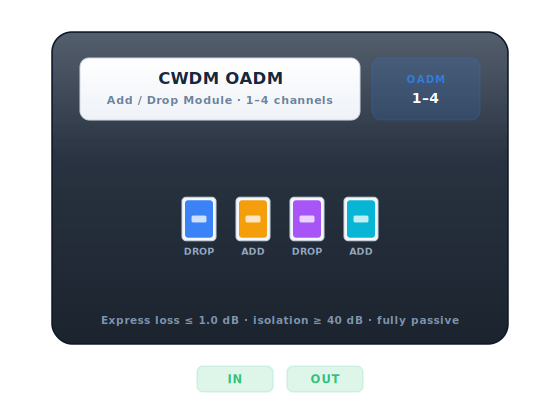
The trap is that OADM datasheets quote the drop loss, which is small, while the number that constrains the design is the express loss — typically 1.0–1.5 dB per node, paid by every channel that passes through. On a four-site chain, the channel that runs end to end has absorbed 4–6 dB before it has travelled a metre of extra fibre.
Design rule: budget the longest express path first, then verify the dropped channels. Doing it the other way round produces a ring that works at every local site and fails end to end. Both the CWDM OADM and DWDM OADM modules should be quoted with express loss stated explicitly.
MWDM and LAN-WDM: the 5G Middle Ground
Two schemes sit between CWDM and DWDM, both born from Chinese 5G fronthaul, where operators needed 12 wavelengths per base station at a cost closer to CWDM than DWDM.
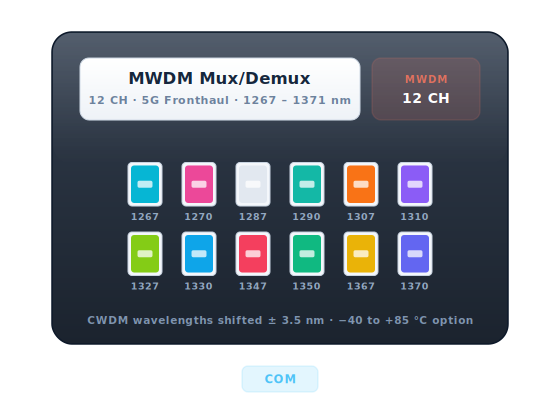
MWDM is China Mobile's answer, and it is an elegant piece of cost engineering. It takes the six lowest CWDM wavelengths and uses TEC tuning to shift each one ±3.5 nm, turning six channels into twelve with a pitch of 4.3–4.7 nm. The value is that it reuses existing CWDM laser chips — no new fab process — at the cost of adding a TEC, which draws roughly 0.5 W more per module. A 12-channel MWDM module is the passive half of that system.
LAN-WDM, also called LWDM, is China Telecom's answer: 12 channels in the O-band at 800 GHz spacing. Tighter than MWDM, still far looser than DWDM's 100 GHz, and also TEC-stabilised. Because it stays near 1310 nm it inherits the O-band's near-zero dispersion. The LAN-WDM module and the O-band DWDM module cover the two variants.
Both are worth knowing about outside fronthaul: if you need 12 channels over 10–20 km and CWDM's 8 usable channels are not enough, these reach the count without paying for C-band DWDM optics.
Why CWDM Cannot Be Amplified — Mostly
The standard rule is that CWDM cannot be amplified and DWDM can. The rule is useful and, stated absolutely, wrong.
An EDFA amplifies from about 1530 to 1565 nm. Of the 18 CWDM channels, two — 1531 nm and 1551 nm — fall inside that window and can be amplified normally. The other sixteen cannot, because no amplifier covers them. So the accurate statement is: a CWDM system as a whole cannot be amplified, because you cannot amplify sixteen of its eighteen channels. Two channels of a CWDM plan can be boosted, and occasionally that is exactly the workaround a long single-channel link needs.
The design consequence stands: if the link might ever need an amplifier, it must be DWDM in the C-band from day one. Retrofitting means replacing every optic and every filter — a forklift upgrade, not a change order. This is the decision in the whole article that is most expensive to get wrong, and it must be made against the five-year plan, not today's channel count.
Single Fibre, Dual Fibre, and Protection
Standard WDM uses a fibre pair: one for each direction. Single-fibre WDM puts both directions on one strand by assigning each channel two wavelengths — one out, one back.
When dark fibre is expensive or scarce, this halves the lease. The costs are real and worth stating plainly:
- Half the channel count for a given filter count, because each service consumes two wavelengths.
- Higher insertion loss, typically 0.5–1.0 dB more than the dual-fibre equivalent.
- Paired, non-interchangeable units. The A end and the B end are different products. Order them as a pair and label them, because they are indistinguishable on a shelf and will be swapped by someone eventually.
- Reflection sensitivity. With both directions on one strand, return loss matters much more. This is where APC connectors stop being optional.
For protected services, the honest note is that the passive mux does not provide protection. Path protection needs either an optical protection switch or diverse routing with the switching done in the equipment above. A mux with a monitor port makes the state observable; it does not make it redundant.
The Decision, in Order

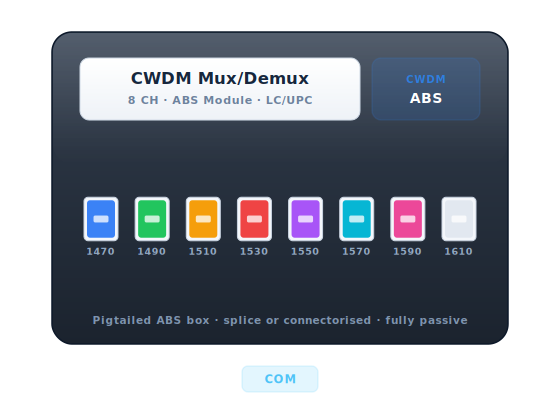
Working the sequence on a typical enquiry — "we need 8 × 10G between two buildings, 12 km apart, on our own fibre" — gives: eight channels points at CWDM; 12 km will never need an EDFA; the fibre is known G.652.D but eight channels stays out of the E-band anyway; 12 km at 10G is nowhere near the dispersion limit; and there are two fibres available. The answer is an 8-channel dual-fibre CWDM mux in an ABS box at each end, with eight pairs of CWDM SFP+, and the whole link closes with something like 20 dB of margin.
Change one input — "and we may need to reach the DR site 90 km away later" — and the answer changes completely, to a 100 GHz DWDM system with an amplifier position designed in from the start. That is the point of doing the questions in this order.
What to Put on the Purchase Order

Two lines deserve expansion because they cause the most rework:
The channel plan. "8-channel CWDM" is not a specification. There are several 8-channel plans in circulation, and a mux built for 1471–1611 nm will not pass a 1271 nm optic at all. Write the wavelengths, or for DWDM the ITU channel numbers, into the order. The grid calculator produces the list.
The upgrade and monitor ports. An upgrade port passes 1310 or 1550 nm around the filter, so an OTDR can test the fibre without unplugging live services. A monitor port taps 1–2 % of the signal for measurement. Neither costs much when specified up front; both are impossible to add later, and their absence is discovered on the night a link is down and nobody can measure anything.
One last commercial note. WDM filters are one of the areas where the gap between a good supplier and a cheap one shows up late — in channel uniformity, in isolation, and in whether the stated insertion loss is a typical or a maximum. Ask for per-channel measured data for the actual units shipped, not a generic datasheet. Any supplier who tests properly already has that file. The China sourcing checklist covers what else to ask for at the same time.
FAQ
Can I mix CWDM and DWDM on the same fibre?
Yes, and it is a common upgrade path. A DWDM band typically occupies the C-band while CWDM channels use the rest, joined by a FWDM filter. Budget the extra filter loss on both paths and check that no CWDM channel overlaps the DWDM band — the 1531 and 1551 nm CWDM channels do, and must be left unused.
Does a mux need power?
No. A passive mux is thin-film filters and glass. It has no power connector, no failure mode from a power cut, and no configuration. That is a real operational advantage over active WDM shelves, and one reason passive muxes dominate enterprise and metro edge deployments.
How many channels can I actually get on CWDM?
Eighteen on paper; eight or nine in practice on most fibre plants, because the E-band channels need zero-water-peak fibre. Specify 18 only with a fibre certificate in hand.
Is 50 GHz DWDM worth it over 100 GHz?
Only if you need more than about 40 channels. Halving the spacing roughly doubles the channel count but tightens laser and filter tolerances, raises insertion loss, and narrows the passband so the optic must be more accurately wavelength-locked. Most enterprise and metro links never exhaust a 100 GHz plan; carriers and DCI links do. A 200 GHz plan is worth considering in the other direction where channel count is modest and budget is tight.
What form factor should I order?
ABS box for a wall or a small cabinet, LGX cassette where an LGX chassis already exists, 1U rack unit for a data-centre rack with front-facing patching. The optical performance is the same; what differs is how it mounts and how the fibre is routed.
If you have a channel count, a distance and a fibre type, send them over — that is enough to size the system and say whether it closes. Quotations come from sales@topnetsystem.com, and an engineer reads every enquiry before it is priced.