SFP to OSFP-XD: Optical Module Form Factors, Decoded
Form factor arguments are usually conducted as if they were about size. They are not. A pluggable module has two hard constraints: how many electrical lanes the host connector carries, and how many watts you can pull out of the box before the laser inside goes out of specification. Everything else — latch, lid, length — follows from those two numbers.
Read the family tree that way and it stops being a list of acronyms and becomes arithmetic. Lane count times lane rate gives the port speed; the thermal envelope gives the reach classes and the DSP you may put in the box. A new form factor appears when one of those numbers has to change. This is the whole tree, from the one-lane SFP to the sixteen-lane OSFP-XD, plus what sits past the pluggable altogether.
What Actually Decides a Form Factor
Lane count is a property of the connector. The edge card in an SFP has twenty pads and one high-speed pair in each direction. A QSFP has thirty-eight pads and four lanes. A QSFP-DD has seventy-six — thirty-eight on each face of the paddle card, which is where "double density" comes from — and eight lanes. An OSFP-XD carries a 120-contact card with sixteen: thirty-two contacts for transmit, thirty-two for receive, the rest ground, power and control.

Lane rate is a property of the era. The same four-lane QSFP body has carried 4×10G, 4×25G, 4×50G and 4×100G as SerDes generations arrived, and QSFP+, QSFP28, QSFP56 and QSFP112 record nothing but which generation. The number in the name is the per-lane signalling rate, not the port speed — which is why QSFP28 is a 100G module and QSFP112 is a 400G one.
Power is what actually gates progress. A 400G module doing PAM4 with a full DSP draws several times what a 100G NRZ module did, and that heat leaves through the cage into the switch's airflow. OSFP exists because its designers assumed 400G would need a bigger thermal envelope than a QSFP-sized body could give. Model your faceplate first: the optics power and thermal calculator returns what the front panel has to dissipate.
The SFP Family: One Lane, Then Two
SFP is the oldest surviving pluggable shape and the most useful thing about it is that it has never changed mechanically. An SFP+ from 2008 and an SFP112 fit the same cage.
SFP, SFP+, SFP28, SFP56, SFP112 are one lane, at 1G, 10G, 25G, 50G PAM4 and 100G PAM4. One lane means one wavelength on one fibre pair, so a duplex LC and the simplest cable plant there is. Watts are the constraint: a single-lane body is budgeted around 1–2 W, which is why 25G SFP28 LR lives here happily and nothing with a heavy DSP does.
SFP-DD doubles the lane count by adding a second row of pads — forty in total, twenty on each face — giving 100G as 2×50G, or 200G as SFP-DD112. The MSA defines five power classes topping out at 5 W, which tells you what it is for: server-side and access ports, not spine optics.
The family's useful property is downward compatibility: an SFP-DD cage accepts SFP+ and SFP28 modules on the first lane, and so does an SFP112 cage. In an access layer upgraded a port at a time, that is worth more than density.
The QSFP Family: Four Lanes, Then Eight
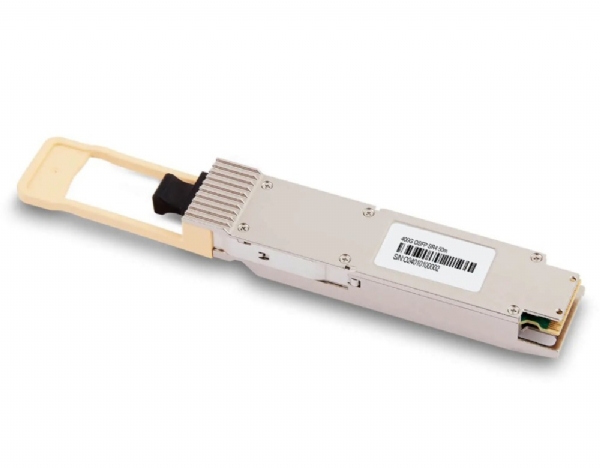
QSFP+ through QSFP112 is four lanes in a 38-pad body: 40G, 100G, 200G and 400G as the lane rate quadrupled. QSFP112 is the interesting member, delivering 400G with four lanes where QSFP-DD needs eight — fewer optical components, half the fibre for a parallel PMD, less power per bit. Its constraint is the host: a switch offers QSFP112 ports only if its ASIC has 100G SerDes wired four to a cage.
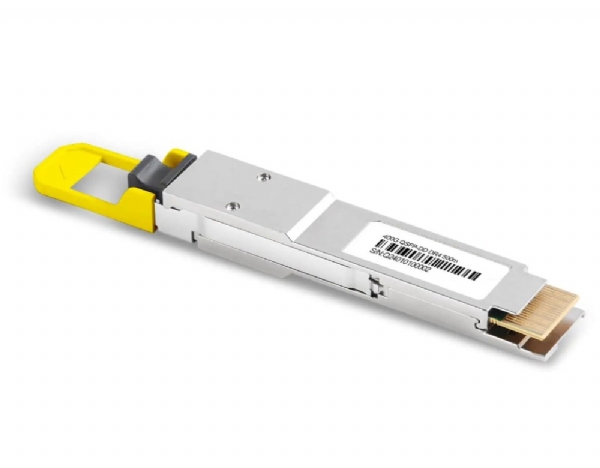
QSFP-DD is the eight-lane double-density body and the highest-volume 400G and 800G shape in the industry: seventy-six pads, 400G at 8×50G, 800G at 8×100G in QSFP-DD800, 1.6T at 8×200G in QSFP-DD1600. It is mechanically a QSFP with a deeper connector, which was the design goal — a QSFP-DD cage accepts a QSFP28 module on four of its eight channels.
Beside all of this, largely finished, sits the CFP family. CFP was the original 100G pluggable — ten lanes at 10G, a body around 82 mm wide, and a power allowance up to roughly 32 W in coherent versions, at a time when QSFP28 was budgeted 3.5 W. CFP2 halved the width and moved to 4×25G; CFP4 halved it again. They lost the volume market to QSFP28 and survive mainly in transport gear, where the power budget still buys something a QSFP-sized body cannot. If you have CFP2 in service, plan its replacement around QSFP-DD or OSFP.
OSFP, OSFP112 and OSFP-XD
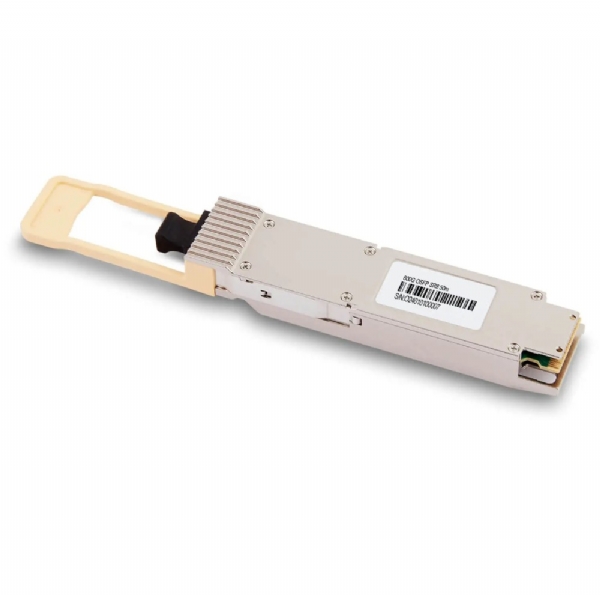
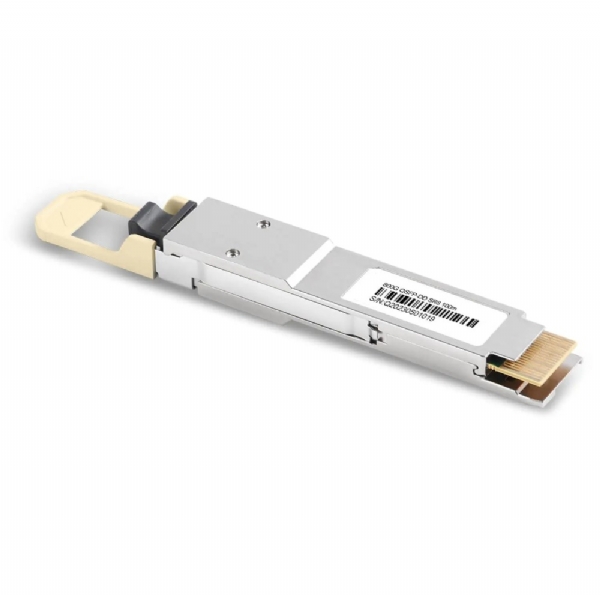
OSFP is eight lanes in a body about 107.8 mm deep, 22.58 mm wide and 13.0 mm high with its integrated heat sink — wider and taller than QSFP-DD, deliberately, for more than 30 W of thermal capability. The riding-heat-sink variant drops to about 9.5 mm because the cage carries the sink instead. OSFP112 and OSFP1600 are the same eight lanes at 100G and 200G apiece, reaching 800G and 1.6T; OSFP MSA Rev 5.22 raised the OSFP1600 maximum module power to 42.9 W. The OSFP versus QSFP-DD comparison covers the trade: OSFP buys thermal headroom and spends faceplate width, and neither choice has been wrong.
The twin-port convention confuses people at ordering time. An 800G OSFP 2×DR4 presents two MPO-12 APC receptacles on one faceplate, each a complete 400GBASE-DR4. That is how the module is built, not an accessory, and it means the link drops into an existing base-12 plant with two ordinary trunks and no conversion hardware. A DR8 on a single MPO-16 instead needs sixteen-fibre trunk or a conversion harness. Same 800 Gb/s, entirely different cabling order.
OSFP-XD takes the other route: instead of doubling the lane rate it doubles the lane count to sixteen electrical lanes on a 120-contact card, giving 1.6T at today's 100G lanes and 3.2T once 200G lanes arrive. The body is taller — about 16.6 mm with an integrated heat sink, 10.5 mm for the riding-heat-sink variant — and the specification allows up to 40 W. The cost is fibre: a parallel sixteen-lane module wants a thirty-two-fibre interface. Work it through in the MPO cabling planner first.
Past the pluggable, two things are happening. Co-packaged optics moves the optical engine onto the switch package, removing the cage and its thermal problem and field replaceability with it. XPO — eXtra-dense Pluggable Optics, an MSA launched in March 2026 — is the counter-proposal: 12.8 Tb/s per module across sixty-four lanes at 200G, on two 32-channel paddle cards belly to belly, cooled by an integrated liquid cold plate at 400 W and above, and still lever-latched and replaceable. The LPO, LRO, CPO and NPO comparison sets out where each fits.
Power Classes, Lids and Liquid Cooling
A module declares its power class in its EEPROM and the host reads it before the port comes up. Not advisory: a cage rated below the declared class holds the module in low-power state or refuses the port, and the symptom — seats, is recognised, never links — looks nothing like a thermal problem.

QSFP-DD defines eight power classes — 1.5, 3.5, 7, 8, 10, 12, 14 W, and above 14 W declared through the management interface. SFP-DD defines five, topping out at 5 W. Those two lists say more about what belongs where than any amount of marketing.
| Form factor | Electrical lanes | Top speed | Power ceiling | Host interface |
|---|---|---|---|---|
| SFP+ / SFP28 / SFP56 / SFP112 | 1 | 100G | 1–2 W | 20-pad card, duplex LC |
| SFP-DD / SFP-DD112 | 2 | 200G | 5 W (class 5) | 40 pads, 20 per face |
| QSFP+ / QSFP28 / QSFP56 | 4 | 200G | 3.5–5 W typical | 38-pad card, LC or MPO-12 |
| QSFP112 | 4 | 400G | About 20 W | 38-pad card, LC or MPO-12 |
| QSFP-DD / DD800 / DD1600 | 8 | 1.6T | Class 8, above 14 W | 76 pads, LC pair or MPO-16 |
| OSFP / OSFP112 / OSFP1600 | 8 | 1.6T | Over 30 W; 42.9 W at OSFP1600 | OSFP card, dual LC or MPO-16 |
| OSFP-XD | 16 | 3.2T | Up to 40 W | 120-contact card, MPO-32 class |
| CFP / CFP2 / CFP4 | 10 / 4 / 4 | 100G, 400G coherent | Up to about 32 W | CFP connector, duplex LC |
| XPO | 64 | 12.8T | 400 W and above, liquid | Two 32-channel paddle cards |
Finned and flat-top lids are not cosmetic. An OSFP module for a switch cage carries its own heat sink — the fins are part of the module and the switch blows air over them. An OSFP module for a NIC is flat-topped, because the host provides a riding heat sink that presses onto it: the OSFP-RHS variant. The two are mechanically incompatible both ways, and a flat-top OSFP-RHS module in a switch cage has nothing to conduct its heat into.
Liquid cooling is arriving from the top downward: OSFP-XD at 40 W is at the edge of what forced air removes from a full faceplate, and XPO skips the argument with a cold plate. Once a switch generation has a liquid loop, the optics decision stops being thermal and becomes a fibre-count one.
What Plugs Into What, and What Actually Links
The practical question is nearly always: my switch has QSFP-DD cages, what can I put in them? Four parts, and only the first is mechanical.
1. Mechanically. A QSFP-DD cage accepts QSFP+, QSFP28, QSFP56, QSFP112 and QSFP-DD modules; a QSFP-sized module lands on four of the eight channels and the rest go unused. What does not fit is anything from the OSFP family — different body, different card, no adapter worth using in production.
2. Electrically. The host must run the lane rate the module wants. A QSFP-DD800 cage is wired for 100G lanes; a 400G QSFP-DD module built on 8×50G works only if the switch can also configure those lanes at 50G. A port-group property, documented and frequently ignored.
3. Thermally. The declared power class must be within the cage's rating, which on a dense line card is sometimes lower for the middle cages than the edge ones. Vendors publish this; nobody reads it until a row of ports runs hot.
4. Administratively. The module must be coded for the platform and software version and advertise a CMIS application the host recognises. A module that is mechanically, electrically and thermally perfect still sits dark if the identity data is wrong — a procurement problem, not a fieldwork one.
Two more facts. QSFP112 modules seat and work in QSFP-DD800 cages, making a four-lane 400G optic a legitimate option on an eight-lane switch. And the OSFP and QSFP-DD ecosystems interoperate optically: an OSFP DR8 links happily to a QSFP-DD DR8, because the standard lives in the optics and the form factor is only how you hold it.
We build across the whole tree in Shenzhen: SFP28 through OSFP-XD, finned and flat-top lids, twin-port and single-connector constructions, coded to your platform and software version and traffic-tested in the target switch model rather than a reference board. If the switch end and the NIC end of a link need different mechanics, send the port inventory and we will build both ends as one bill of materials.
FAQ
Can I put an OSFP module in a QSFP-DD cage with an adapter? Adapters exist and are not worth using in production. The thermal path, the latch retention and the management interface all change. If the switch has QSFP-DD cages, buy QSFP-DD modules.
Is OSFP better than QSFP-DD? Neither. OSFP has more thermal headroom and takes more faceplate; QSFP-DD is backward compatible with the enormous installed QSFP base. Pick the one your switch has.
What is the difference between QSFP-DD and QSFP-DD800? Same mechanics, same eight lanes, specified for 100G per lane instead of 50G. A QSFP-DD800 cage is what makes an 800G QSFP-DD module possible.
Does a QSFP28 module lose anything in a QSFP-DD cage? No. It connects to four of the eight channels and behaves exactly as it would in a QSFP28 cage; the other four lanes are unused, which is a switch-capacity question rather than an optical one.
Do I need OSFP-XD, or should I wait for 200G lanes? If you need 1.6T ports on switches built with 100G SerDes, OSFP-XD is how you get them, at the price of double the fibre. If your next generation has 200G lanes, an eight-lane OSFP1600 gives the same 1.6T on half the glass. The 1.6T lane guide works it both ways.