Ribbon Fiber Cable: Construction, Fiber Counts and How to Specify It
A ribbon cable enquiry usually arrives as a list of fibre counts and a jacket rating, and that is genuinely most of what a buyer thinks they need to say. It is also not enough to build from. Two cables can both be "144F ribbon, plenum" and differ by a factor in price, because the fibre grade, the ribbon type, the armour and the reel length are all still open — and each of them moves the number.
This article is the construction walk-through that answers those questions. It covers what is physically inside the cable, how a fibre count is built out of ribbons, why an armoured plenum cable cannot be listed OFNP, and the nine lines that belong on the purchase order.
Why Ribbon Exists: One Splice Instead of Twelve
Ribbon cable exists for exactly one reason, and it is not the cable. It is the splice.
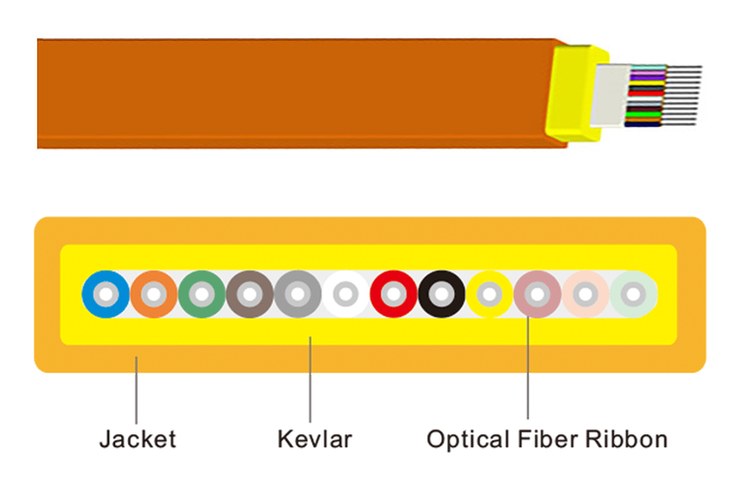
In a ribbon, twelve fibres are held in a precise flat row at a fixed pitch. A mass-fusion splicer drops the whole row into a V-groove holder, aligns all twelve at once, and fires a single arc. One operation joins twelve fibres. Everything else about ribbon construction — the flat stack, the matrix bonding, the ribbon numbering — exists to keep that geometry accurate enough for the splicer to trust it.

The saving is not marginal. Twelve splices instead of 144 is the difference between a closure that occupies most of a shift and one that is done inside a morning; the exact hours depend on the crew and the closure, but the ratio does not. At 576 fibres the comparison stops being a labour saving at all and becomes the difference between a job that is practical and one that is not.
The corollary matters just as much, and it is the part suppliers rarely volunteer: ribbon pays back on splice count, not on fibre count. A 48F ribbon cable pulled point-to-point with one splice at each end saves nothing over a stranded distribution cable and costs more. If the route has two splice points, buy on cable price. If it has fifteen, buy ribbon. The rest of the cable range exists precisely because ribbon is the right answer only some of the time.
Inside a Central-Tube Ribbon Cable
There are three mainstream ribbon constructions, and it is worth knowing which one you are being quoted. Central tube puts the whole ribbon stack in one oversized tube and is the dominant design in North America and Europe. Stranded loose tube distributes the ribbons across several tubes SZ-stranded around a central member. It is the usual construction in Asia, where the GYDTA and GYDTS families cover roughly 48F to 576F, and European stranded ribbon cable is built to 864F. Slotted core seats each ribbon in a machined groove and is the Japanese norm. The cross-section below is the central-tube version, because it is the one most enquiries end up with.

Working outwards from the middle:
- The ribbon stack. Twelve-fibre ribbons stacked flat and given a slow helical twist along the cable length, applied in manufacture by rotating the stack guide as the tube closes. An untwisted stack still bends — but only easily about one axis, and the outer fibres take all the strain. The twist is what makes the bend behaviour the same in every direction and keeps fibre strain even, which is what a sane bend-radius specification actually depends on.
- The central buffer tube, normally PBT. It is oversized on purpose: the ribbons must be free to move as the cable is pulled and as it contracts in cold weather. That freedom is what stops the fibres taking strain.
- Water blocking, inside the tube. This is the layer that replaces filling gel, and it sits in the tube around the ribbon stack — swellable yarn or tape rather than a thixotropic compound. Dry-core is the default on new central-tube designs, but gel-filled ribbon is still current tier-1 product, particularly in stranded loose-tube form, so check which one you are being offered. A dry core means no solvent and no degreasing step at every closure — a genuine time saving at every splice point, and one that compounds on a route with many of them.
- A core wrap or flooding tape outside the tube. A different job from the dry core inside it: this one keeps water out of the space between tube and jacket.
- Aramid yarn. Secondary strength and a cushion around the tube. It contributes to tensile performance; it is not the member the pulling hardware grips.
- Strength members, usually two FRP rods moulded into the jacket wall on opposite sides — so they sit outboard of the aramid, not inboard of it. These are the primary tensile members and they are what stops the cable buckling as it contracts in the cold; the pulling eye grips these, never the fibres. Two opposed rods rather than one central rod is about tensile strength and anti-buckling, not about bending: a cable that bends more easily in one direction than another is a defect manufacturers engineer against, not a feature. Where the route runs near power, specify dielectric FRP rather than steel, exactly as you would for an all-dielectric outdoor cable.
- The jacket. The listing, the UV resistance and the smoke behaviour all live here. A riser-rated indoor/outdoor jacket is what lets one cable run from a manhole to a floor closet without a transition splice, the same reasoning behind a riser cable on a tower route. Jacket compounds are worth understanding separately, because the same cable core sells under four different jacket ratings at four different prices.
- A ripcord, sitting just under the jacket. Ten cents of yarn that saves a technician twenty minutes and a scored buffer tube.
Fibre grade sits inside all of this and is invisible in the cross-section. Standard singlemode is OS2 / G.652.D. G.657.A1 bend-insensitive fibre costs more per fibre, and at 288F that difference is not small — which is why an enquiry that does not state the grade gets quoted as G.652.D, and why a spec written around tight in-cabinet bends needs to say so explicitly.
The Armoured Plenum Variant, and the Listing Trap
Add interlocking metal armour and an inner jacket to the same core and you get the cable used where rodents, crush risk or a nervous inspector are in play.

Here is the trap, and it turns up in real specifications several times a year:
Metal armour makes the cable conductive. A cable containing any non-current-carrying metallic member is a conductive optical fibre cable, and the listings in NEC 770.179 put it in the OFC series rather than the OFN series. So an armoured plenum cable is OFCP, and an armoured riser cable is OFCR. There is no such thing as an armoured-with-metal OFNP cable. A specification that asks for "plenum, armoured, OFNP" cannot be built as written, and somebody has to decide which half of the sentence wins.

Both resolutions are legitimate:
- Accept OFCP. Metal armour and a conductive cable. If that cable enters the building from outside, NEC 770.93 then applies to its metallic members: either bond them to ground close to the point of entrance (method in 770.100), or interrupt them with an insulating joint or equivalent device. Both are legitimate, and the second is often the simpler line on the labour estimate. An armoured cable that lives entirely inside the building, riser to riser, is not caught by 770.93 at all — worth knowing when an inspector assumes otherwise.
- Specify dielectric armour. A fibreglass rod or heavy aramid layer gives most of the crush and rodent resistance with no metal, so the cable stays OFNP and there is nothing to bond. It is the right answer near power infrastructure and in any building where the grounding scheme is somebody else's problem.
The same conductive/non-conductive logic governs the indoor armoured indoor cable family and shows up again on outdoor routes, where GYTS and GYTA53 carry steel and GYFTY does not. Choosing an outdoor construction works through that decision on the OSP side.
How the Fibre Counts Are Built
A fibre count is not an arbitrary number the factory dials in. It is a stack height, and it is a splice budget.

Twelve is the standard ribbon size and the one to default to. The MPO/MTP world lines up with it — twelve fibres per ribbon, twelve per ferrule, a clean mapping into MPO-LC cassettes or MPO-LC harnesses — although the causality runs the other way round: MPO is a twelve-fibre connector because twelve-fibre ribbon already existed. Four-, six- and eight-fibre ribbons are the right answer for low counts and for base-8 systems; 24-fibre ribbon exists at the top end; and 16-fibre ribbon now exists too, supported by current mass splicers. Where the switch side is 16-fibre, the MPO-12 versus MPO-16 question has to be settled before the ribbon size is fixed. Whichever you pick, a plant with mixed ribbon sizes is a maintenance problem for years.
Two details worth knowing when you read a datasheet:
A single tube goes further than most people expect. Corning's 576F SST-UltraRibbon is a single-tube cable, and central-tube plenum ribbon is built to 432F; a single un-subunitised stack is normal up to 576F, while subunit construction is universal at hyperscale counts and is offered well below them — Corning's RocketRibbon uses finger-peelable subunits from 432F. It is worth asking how a given count is constructed, because a stranded design arrives as several tubes of smaller stacks — which most splicing crews prefer in a tray — while a single-tube design arrives as one tall stack. Both are normal. They are not the same job in a closure.
Very high counts are a different product. At 1,728F and 3,456F you are in hyperscale OSP territory and the cable is built from peelable subunits rather than one stack. Both ribbon types are catalogued at these counts, which is exactly why the enquiry has to say which one: Corning's 3,456F Cable-250 is twelve 288F subunits of conventional 12F and 24F ribbon, while rollable-ribbon cables at the same count are what the duct-density comparisons below are drawn from. Fibre diameter splits the same way — 250 µm and 200 µm are both available at 3,456F, and 200 µm becomes unavoidable only around 6,912F. In this range the ribbon type and the coating diameter stop being details: between them they decide which holders, strippers and cleavers the splicing crew has to own.
TIA-598: Finding Fibre 31 of 144
The identification scheme is the same twelve colours everywhere in the industry. Within a ribbon, colour identifies the fibre. Between ribbons the colours repeat in the same order, but what actually identifies a ribbon in the stack is the legend printed along it — ribbon number, fibre type, colour and set — because colour alone on a matrix is not reliable enough to build a records system on.

So in a 144F cable, fibre 31 is in ribbon 3 (fibres 25–36), position 7 — the red fibre in ribbon 3, which the stack sequence also colours green. That arithmetic is the whole system, and it is why a 576F cable can be documented on one page.
Two field notes. First, trust the legend over the colour when those are the only two things you have: white, slate and aqua are genuinely hard to separate under a work light, and colour on a ribbon matrix is less saturated than colour on a 900 µm buffer. Second, if the cable terminates on MPO trunks or breakouts, the ribbon-to-port mapping is a separate decision from the colour code, and it is where polarity problems are born. The MPO cabling planner is the fastest way to check a mapping before it becomes a labelled reality.
Matrix Ribbon and Rollable Ribbon
This is the single most common gap in a ribbon enquiry. "Ribbon cable" describes two products that are priced differently, splice differently and pack differently.

Encapsulated matrix ribbon is the classic: twelve fibres fully embedded in UV-cured resin, forming a flat, rigid ribbon. The geometry is excellent and the splicing is completely conventional. The cost is stiffness — a flat stack does not pack into a round cable efficiently, and it resists bending across its width.
Rollable ribbon, also called intermittently bonded ribbon, bonds the fibres only at intervals. The result looks like a spider's web and behaves like a bundle: it folds into a round cross-section instead of staying flat, which is what lets a high-count cable pack efficiently into a round duct. Vendor comparisons put the gain at roughly two to one — one widely quoted figure has six 3,456-fibre rollable ribbon cables in a four-inch duct against about 9,500 fibres of 288F loose tube in the same space. Treat that as marketing arithmetic rather than a test result: the loose-tube side is a geometric packing number well above the fill ratio anyone would actually pull, and the comparison changes fibre coating diameter and cable generation at the same time as ribbon type. The direction is right; the multiplier is not a specification.
The trade-off is at the splice bench. Rollable ribbon has to be flattened into the holder before it will splice, which is a technique and a slightly different consumable set. Crews who have done it once do not find it difficult; crews meeting it for the first time on a live cutover do.
Practically: for enterprise, campus and FTTx feeder work up to a few hundred fibres, encapsulated matrix ribbon is the sensible default and the cheaper one. Above roughly 864 fibres, and wherever duct space rather than cable price is the binding constraint, rollable is what makes the job fit. Either way, name it on the enquiry — otherwise you are comparing quotes for two different cables and wondering why the prices diverge.
What Mass Fusion Actually Requires
Mass fusion is a technique with prerequisites, and buying ribbon cable without checking them is how a project discovers on site that its splicer cannot do the job.
- A mass-fusion splicer. A single-fibre splicer cannot splice a ribbon, and a mass-fusion unit is a different capital item. Confirm the site has one before the cable ships.
- Ribbon holders matched to the ribbon. 12F holders for 12F ribbon. A 24F ribbon or a rollable ribbon needs its own set.
- A ribbon thermal stripper and a ribbon cleaver. Both strip and cleave all twelve fibres in one action; single-fibre tooling cannot produce a coplanar set of ends.
- Ribbon splice protectors and trays sized for a stack, not for individual sleeves.
On the numbers, ITU-T L.400 gives two separate criteria for ribbon fibres aligned passively in V-grooves, and an acceptance test needs both: a per-splice maximum of 0.2 dB, and a batch validation of ≤0.1 dB average with ≤0.2 dB in 97 % of splices. Write both into the specification. In practice good mass-fusion work lands far better than either — a published measurement campaign averaged under 0.02 dB, with 97 % of splices at or below 0.04 dB.
Note what mass fusion trades away. Passive V-groove alignment means the splicer cannot actively optimise each fibre individually the way a core-alignment single-fibre splicer does. The average is superb; the worst fibre in a ribbon is where the variation lives. In that same campaign a handful of fibres came in as high as 0.28 dB — the batch still passed the average-and-percentile test comfortably, but those individual splices breach L.400's 0.2 dB per-splice ceiling. That is precisely why the per-splice maximum belongs in the acceptance criteria alongside the average: the average is what the batch achieves, the maximum is what one unlucky service sees. This is exactly why acceptance is written as an average plus a percentile, and why the OTDR traces matter: an average that passes can still hide one fibre whose insertion loss eats the margin. The field test kit article covers what to carry; the link budget calculator will tell you whether the splice allowance you have assumed actually survives the count.
One more thing that is not optional at these fibre counts: cleanliness. Every end-face that is not inspected is a coin flip, and at 576 fibres you are flipping a lot of coins. The discipline is the same as for MPO connectors — inspect before mating, every time.
Ribbon or Loose Tube?
The honest comparison, because ribbon is not automatically the better cable.

The decision comes down to three questions:
- How many fibres? Below about 48, stranded loose tube nearly always wins — a GYTA or GYTS outdoors, a distribution cable indoors. Above 144, ribbon nearly always wins. Between the two, question 2 decides.
- How many splice points? Ribbon's advantage is entirely in splice labour. Count the splices on the route — not the fibres — and the answer usually presents itself.
- Who maintains it, and with what? A route that will be accessed mid-span by a crew with single-fibre kit is a bad ribbon route regardless of the count. Mid-span access on ribbon means bringing out a whole ribbon, not one fibre.
There is a third option that gets forgotten in this comparison: for in-building high-density work, pre-terminated MPO bundle trunks remove the field splice entirely. If the run is short enough and the ends are known, the cheapest splice is the one that never happens — breakout cabling covers where that line falls.
Reel Length: the Splices Nobody Budgeted
This is the line item that most often turns a clean quote into an argument, and it has nothing to do with optics.
A high-count ribbon cable is heavy and bulky, and there is a practical limit to what fits on a shippable reel that falls as the fibre count rises. Do not guess where that limit is. A 576F central-tube ribbon ships in multi-kilometre lengths on a single drum without difficulty; the published maxima are around 3,500 m at 3,456F and around 3,000 m at 6,912F. Ask for the drum schedule rather than assuming, because every join between drums is a splice somebody has to make, house in a closure, and account for in the loss budget — and nobody prices those at tender.
So state two things on the order:
- The minimum continuous length you can accept, in metres or feet.
- The maximum number of reels, or equivalently the maximum number of joins, you are willing to have.
Ask the supplier to confirm both before the order is placed rather than discovering the drum schedule at delivery. Each unplanned join costs a closure, a crew visit, and a splice allowance — budget 0.1 dB of insertion loss, expect around half that in practice. On a long high-count route those add up to a real number — feed them into the link budget rather than assuming they will fit in the margin.
What to Put on the Purchase Order

Three of those lines deserve expanding, because they cause the most rework:
Fibre grade. An enquiry that does not say gets quoted as G.652.D. If the design has tight bends — cabinet routing, compact splice trays, anything where the installed bend radius is not generous — G.657.A1 is worth the money and has to be asked for by name. Comparing two quotes where one assumed each grade is a false comparison, and it is common.
Print legend. The jacket printing carries the cable type, the fibre count, the manufacturer and a sequential length mark. Sequential marking is what lets a crew cut a 3,000 m drum into planned lengths without measuring; its absence is discovered at the worst possible moment. If you want metres rather than feet, or your own part number in the legend, say so — it costs nothing at order time and cannot be changed afterwards.
Test data. Ask for an OTDR trace and an attenuation report per reel, from both ends. Both ends matters: a single-direction trace can hide a defect that only shows up from the other side. Any manufacturer testing properly already has that file, so a supplier who hesitates is telling you something. The China sourcing checklist covers what else to ask for in the same conversation, and tier 1 and tier 2 testing explains what the acceptance test on site should then look like.
FAQ
What is the smallest fibre count worth buying as ribbon?
Around 48 fibres, but treat that as shorthand rather than a rule — the honest answer is a splice count, not a fibre count, and the thresholds people quote run from 48 to 144 depending on labour rates. On any route with nothing but a splice at each end it does not pay at any count. Below the threshold a distribution or breakout cable is cheaper to buy and easier to work with. A 6F or 24F ribbon does exist — it is normally bought for compatibility with an existing ribbon plant, not for its own economics.
Can ribbon fibres be spliced individually?
Yes. The ribbon matrix peels, and the individual fibres underneath splice like any other fibre — check the coating diameter first, because 200 µm ribbon needs 200 µm-compatible holders and cleavers. It is the standard way to break a ribbon out to LC pigtails — pigtail splicing, in other words, and on an OSP or PON route those pigtails should be APC rather than UPC. You lose the speed advantage for that splice, which is fine — you bought it for the other four hundred.
Is ribbon cable available bend-insensitive?
Yes, G.657.A1 ribbon is standard product. G.657.A2 is available and worth specifying only where the bend radius is genuinely severe, since it costs more and A1 covers most real installations.
Does the armour need bonding and grounding?
Only where the cable enters the building from outside. NEC 770.93 then requires its metallic members either bonded to ground near the point of entrance or interrupted by an insulating joint; a wholly indoor armoured run is outside that rule. Either way, dielectric armour sidesteps the question — no bonding, no grounding conductor, no coordination with the electrical contractor.
What loss should a mass-fusion ribbon splice show?
Write the acceptance to ITU-T L.400: ≤0.1 dB average, ≤0.2 dB in 97 % of splices. Good work lands well inside that. If a set of traces sits close to the limit, the usual causes are a worn cleaver blade or a ribbon holder that does not match the ribbon.
Can ribbon be used outdoors?
Yes — dry-core central-tube ribbon is standard OSP product, and a dual-listed indoor/outdoor jacket lets one cable enter the building and run to the closet without a transition splice. That listing is the whole point: a listed OFNR or OFNP indoor/outdoor cable has no distance limit inside. Unlisted outside-plant cable does — NEC 770.48 caps it at 15 m (50 ft) from the point of entrance, which is exactly why the transition splice exists when the cheaper cable is used. Check the flame rating against the space it enters.
If you have a fibre count, a route length and the number of splice points, that is enough to specify the cable properly and to say whether ribbon is the right answer at all. Quotations come from sales@topnetsystem.com, and an engineer reads every enquiry before it is priced — including the ones where the honest answer is that loose tube would be cheaper.